This Is Spinal Tap
Note on method. This review was written using the fake-name obfuscation technique: before watching, I assigned invented placeholder names to the primary subjects and to the band, then wrote the body of the review with those placeholders, then did a find-and-replace to restore the real names. The mapping is recorded at the bottom. The body itself was written before I did any web research and was not retro-edited; the surprise discovery is in the afterword.
Coverage
- Subtitle rung: Embedded English subrip (SubRip)
extracted from the Blu-ray source. It happens to be the SDH
(closed-caption / hearing-impaired) track — every speaker is labelled,
every sound effect is bracketed (
[Cheering],[Roaring],[Rock 'N' Roll],[Discordant Chords]), and every sung lyric is included as♪…♪lines. - Read: the entire transcript, start to finish — 1,349 subtitle cues, covering 01:22:44 of the film’s 01:23:06 runtime. The first 21 cues (the documentarian’s voiceover) and the final 1 (a sound effect) bracket the dialogue.
- Frames: ten stills pulled with
ffmpegat roughly ten-minute intervals across the runtime (02 / 10 / 20 / 30 / 40 / 50 / 60 / 70 / 80 / 82 minutes). - Model: text-only. I did not view the frames. Anything I claim about cinematography, blocking, lighting, or expression comes from the SDH speaker labels, sound descriptions, and the dialogue itself — never from a frame. I have not inferred what a shot “shows” from what a character says in it.
The review
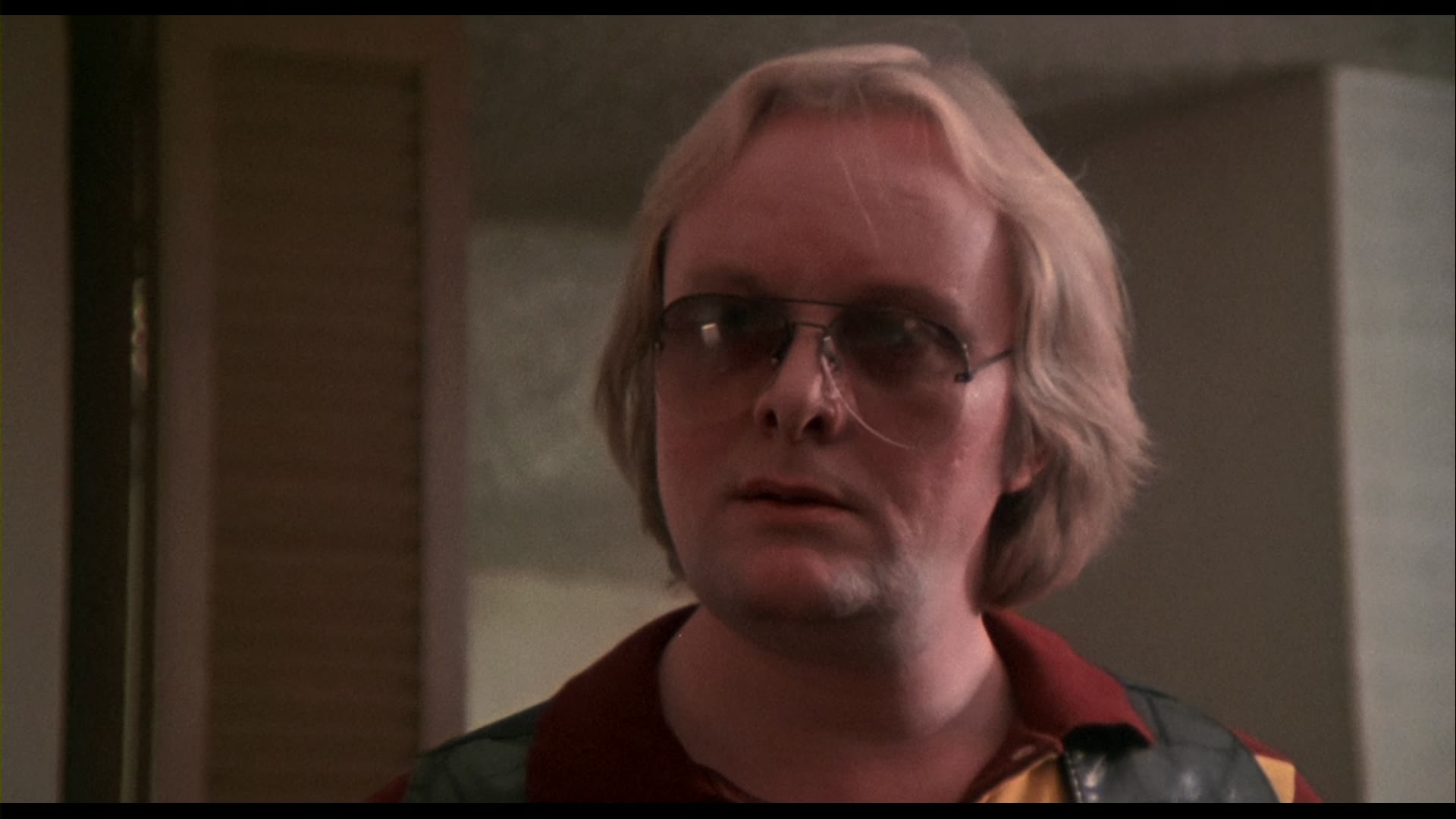
Marty DiBergi introduces himself. He makes commercials — “that little dog that chases the covered wagon underneath the sink? That was mine” — and in 1966 he went down to Greenwich Village, New York City, to a rock club called The Electric Banana. (“Don’t look for it. It’s not there anymore.”) That night he heard a band that, for him, redefined the word “rock ‘n’ roll.” He was knocked out by their exuberance, their raw power, and their punctuality. That band was Spinal Tap.
Seventeen years and fifteen albums later, Spinal Tap is still going strong, and they’ve earned a distinguished place in rock history as one of England’s loudest bands. So in the late fall of 1982, when DiBergi heard that the band was releasing a new album called Smell the Glove and was planning their first tour of the United States in almost six years, he jumped at the chance to make this documentary. “I wanted to capture the sights, the sounds, the smells of a hard-working rock band on the road. And I got that. But I got more. A lot more. But, hey, enough of my yackin’. What do you say? Let’s boogie.”
That is a very good opening. It tells you, in ninety seconds, the form (rock-doc talking head) and the angle (affectionate, faintly embarrassed, not above a Frank Capra reference), and then it gets out of the way. This documentary is, for most of its running time, the band on tour in America, and the tour is going badly. The album has been rejected by their American label as sexist, and is now being released in an all-black cover that DiBergi’s musician subjects will spend the rest of the film trying not to look at.
Who they are
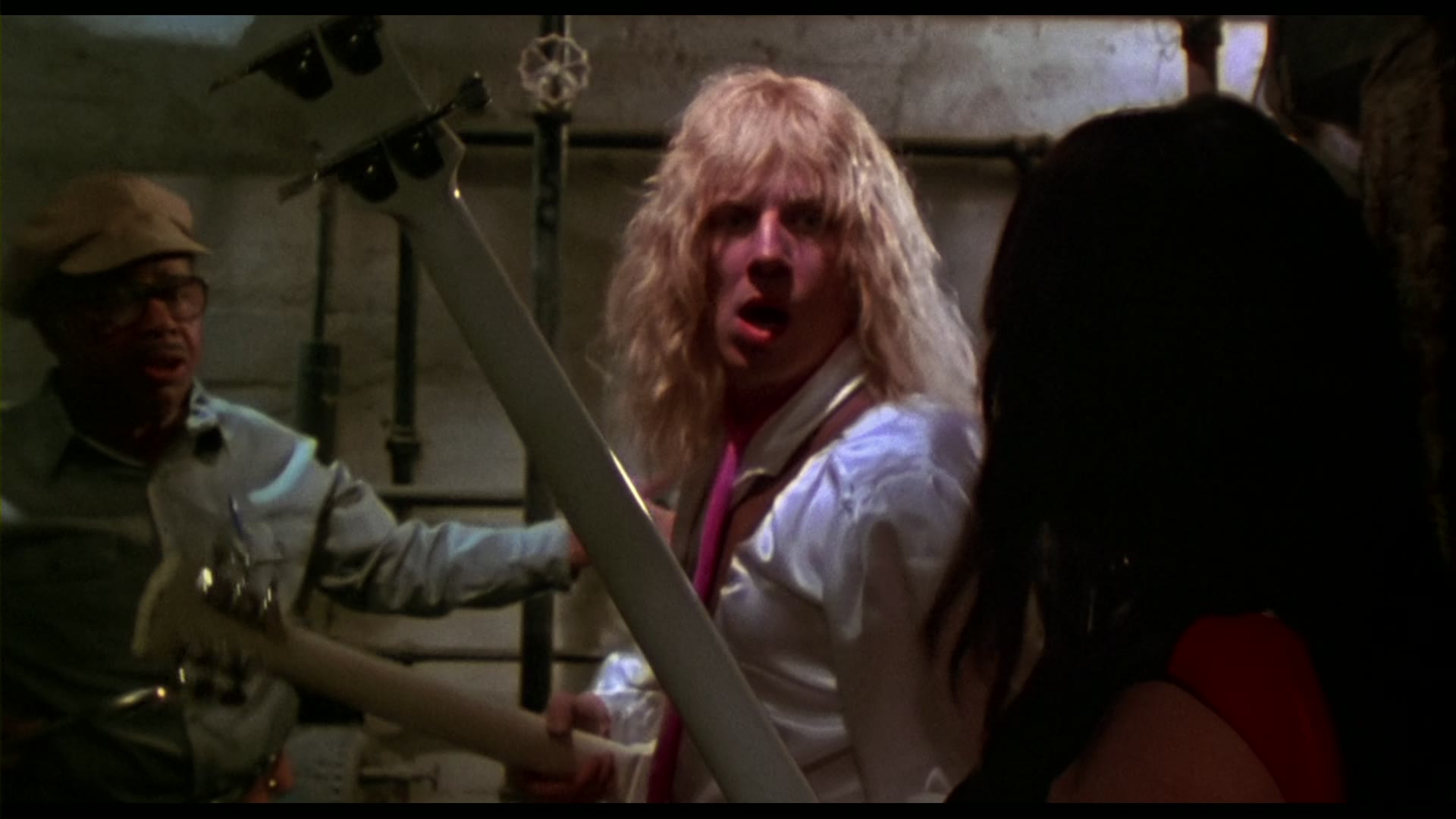
Three musicians. David St. Hubbins sings and plays rhythm guitar; he and the lead guitarist, Nigel Tufnel, started the band in 1964 as children (“you were eight, and I was seven,” they tell each other, unprompted, on camera) and have been together since. Their original name was The Originals; they renamed themselves The New Originals when another local group was also The Originals, and when that group reverted to The Regulators, The New Originals became The Thames Men, and then Spinal Tap. (David tells this story, the first time we meet him, while sitting next to a Cups and Cakes record propped up on a side table — a Thames Men single, “going all the way back to 1965,” per the radio DJ a few scenes later. The Thames Men later changed their name to Spinal Tap.)
Derek Smalls plays bass. He and Nigel once sang the whole of “All the Way Home,” a song they wrote when they were children, with maybe six words in it, on camera: “beside the railroad train / and I’m waitin’ for that train to bring you back / bring you back / if she’s not on the 5:19 / then I’m gonna know what sorrow means / and I’m gonna cry, cry, cry all the way home.” It is the prettiest thing in the film, partly because it is also the saddest.
Viv Savage is on keyboards. Mick Shrimpton is the drummer. Their manager, Ian Faith, has been with them since the early seventies. The record company’s publicist is Bobbi Flekman; the head of the label is Sir Denis Eton-Hogg, recently knighted for the founding of Hoggwood, a summer camp for pale young boys. David has a new girlfriend, Jeanine Pettibone, who has opinions about everything from album mixes to band presentation and who, halfway through, tries to take over the management.
There have been a great many Spinal Tap members. Three drummers have died. The first, John “Stumpy” Peeps, was killed in a bizarre gardening accident (“the authorities said, ‘best leave it, you know, unsolved, really, you know’”). The second, Eric “Stumpy” Joe, choked on vomit — somebody else’s vomit; “they can’t prove whose vomit it was. They don’t have facilities in Scotland Yard. There’s no way to take a photograph. You can’t dust for vomit.” The third, Peter James Bond, exploded onstage at the Isle of Lucy Jazz and Blues Festival: “a flash of green light and that was it. Nothing was left.” They show a photograph of the empty drum stool. “There’s a little green globule on his drum seat. Like a stain, really. More of a stain than a globule. You know, several… dozens of people spontaneously combust each year. It’s just not really widely reported.”
This is the kind of information the documentarian lets his subjects deliver with a straight face. He does not ask a follow-up question. He nods, he changes the subject.
The album, the cover, the tour
The new album is Smell the Glove, and the cover the band wanted has been rejected by the label as sexist: a greased naked woman on all fours with a dog collar around her neck and a leash and a man’s arm extended out holding onto the leash and pushing a black glove in her face to sniff it. “This is 1982!” Bobbi Flekman says. “Get out of the ’60s. We don’t have this mentality anymore.” David and Ian, separately, argue the satire defence — “if we were serious and said she should be forced to smell the glove, then you’d have a point, but it’s all a joke, isn’t it?” — and the label offers the all-black cover as a compromise. They see the new jacket for the first time on the tour bus. David stares at it. “It looks like death. It looks like mourning.” “It’s so black, it’s like, how much more black could this be? And the answer is, ‘none.’”
The compromise is the inciting incident. Both Sears and Kmart refuse to stock the album, the label won’t promote it in New York, and the tour — bookended by Memphis and Colorado — starts losing dates in St. Louis, Kansas City, and Des Moines, “due to lack of advertising funds.” DiBergi gets an interview with their Chicago promo man, Artie Fufkin, who has been working the record in the Midwest and has nobody to show it to. Fufkin breaks down on camera. “I fucked up the timing. That’s all. I got no timing. I got no timing. Do you know what I want you to do? Will you do something for me? Do me a favor. Just kick my ass, okay. Kick this ass for amends, that’s all. Kick my ass. Enjoy. Come on! I’m not asking, I’m telling with this. Kick my ass.” The band has to apologise to him, in person, before he stops.
What they’re actually like, up close
DiBergi is a good interviewer. He does not lead. He lets the people talk, and his people, given the chance, talk a great deal.
Nigel shows him the guitars. The one at the top of the heap is from 1959, “sustained, listen to it.” The one that is “very, very special” has the numbers all going to 11. “Most of these amps go up to ten.” “Does that mean it’s louder?” “Well, it’s one louder, isn’t it?” This is followed, in the transcript, by a perfect long pause: “These go to 11.” There is no laugh track. There does not need to be one.
Derek explains his D-minor trilogy, of which the only piece he has written so far is called “Lick My Love Pump,” which is “sort of in between Mozart and Bach, sort of a ‘Mach’ piece.”
David explains the audience. “It’s a sexual thing, really. Aside from the identifying that the boys do with us, there’s also, like, a reaction to the female… of the female to our music.” “What do you think? Really, they’re quite fearful.” “That’s my theory. They see us on the stage with tight trousers. We’ve got, you know, armadillos in our trousers. I mean, it’s really quite frightening, the size, and… and they run screaming…”
Nigel and David are asked whether they feel playing rock music keeps them in a state of arrested development. David says no, it is more like going to a national park: “and they preserve the moose. And that’s my childhood up there onstage, is that moose. So when you’re playing, you feel like a preserved moose onstage.” “Yeah.”
Asked for his philosophy of life, David says: “Have a good time… all the time. That’s my philosophy, Marty.” (“Marty” is a slip; the documentarian is named Marty, and the band has clearly been calling him Marty the whole time. The documentarian does not correct it on camera.) David believes “virtually everything” he reads, and he thinks “that is what makes me more selective than someone who doesn’t believe anything.” Asked for an epitaph, he says: “Here lies David St. Hubbins… and ‘Why not?’” He then tells us at length that he is a fish nut. “No bones.”
Nigel tells us the band are “two totally distinct types of visionaries. It’s like fire and ice, basically. I feel my role in the band is to be kind of in the middle of that, kind of like lukewarm water in a sense.” This is Derek, who has spent the last forty minutes standing between two people who are unable to finish a sentence without checking what the other thinks of it.
There is a sequence in a tribute museum. David, Nigel, and Derek visit a waxwork and stand quietly. “He was going to do a TV special from here before he died. Yeah, that’s right. Musical version of ‘Somebody Up There Likes Me.’” They harmonise on a song on a jukebox. It goes barbershop. Nigel says, “It sounds fucking barbershop.” Derek says, “It sounds like raga.” A third man says, “We are in the presence of the King.” Derek says, “Sorry.” “This is thoroughly depressing.” “It really puts a perspective on things, though, doesn’t it?” “Yeah, too much. There’s too much fucking perspective now.”
Stagecraft
The film documents three large-scale production numbers, all of which go wrong.
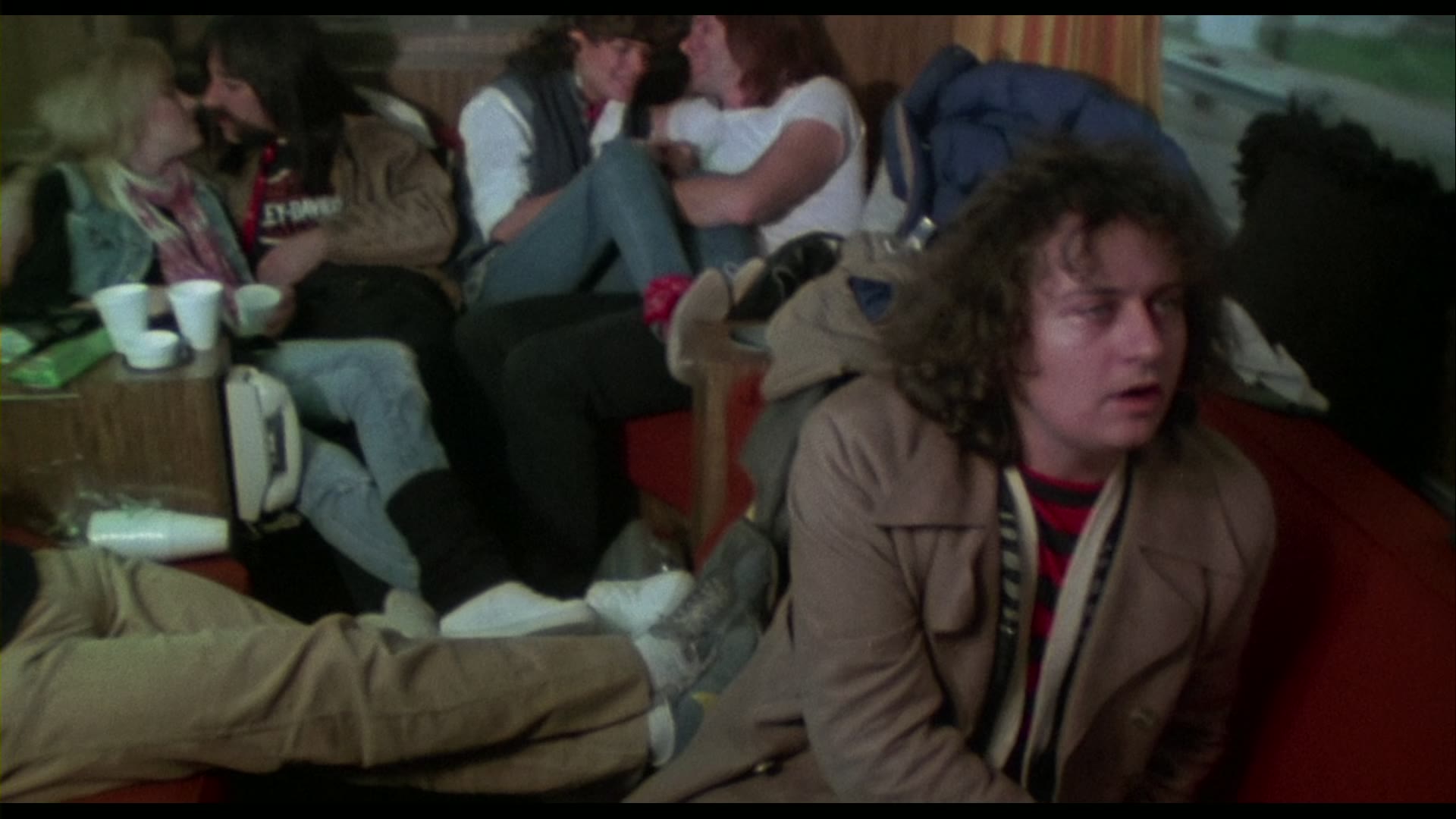
The first is a Stonehenge set. Nigel has a sketch on a napkin. The prop maker builds it. The prop is eighteen inches tall. Nigel wanted it eighteen feet tall. (“I was given this napkin. Forget this. Fuck the napkin!”) The Stonehenge piece debuts anyway, as a nubbin the size of a coffee table, and a little person in a cape walks in front of it. From the audience, it looks like a dwarf is being crushed by Stonehenge. “All right, that tended to understate the hugeness of the object.” The next morning, on the bus, the drummer, Mick, is asked if he has any fears for his life, given the drummer mortality rate. “When I did join, they did kind of take me aside and said, ‘Well, Mick, you know, it’s like this.’ And it did kind of freak me out, but it can’t always happen to every, can it? Right. The law of averages says you will survive.”
The second is Jeanine’s new stage look for the band, fashioned after the signs of the zodiac: a yin-yang for Viv, a goat-look with a little beard for Nigel, a crab face for David. (“I love this. I wish I were Cancer.”) Ian points out that dressing the band as animals will cost money. (“It don’t cost nothing. They’re signs of the zodiac.”)
The third is the second album, the compromise all-black cover. The black cover goes on sale. A record-store promo appearance draws nobody. Artie Fufkin begs them to kick him. They play an air-force-base gig for the wives and children of service personnel, in a hangar, on a stage that turns out to be the same kind of nubbin that Nigel’s Stonehenge was. (The musical director’s daughter is at her first concert. A moustache has been put on her as a costume. Her chaperone says she can take it off if she’s too hot. “I thought I might go back and see what they were up to.” “I don’t think they need to see this until you’re finished with it.”) They play “Sex Farm.” The base’s public-address system joins in on the second chorus. There is feedback. A baseball game is being announced on the same PA. “He totally ruined the gig. He walks off and then… He can’t sit home and get moneys. We gotta get someone else in there.”
The end of the band
The break-up is a small one and arrives at the end of the film as a fait accompli. David and Nigel fight about a part they are trying to record, in a cabin in the mountains, while Jeanine is in the room. Nigel walks out. “You can’t fucking concentrate because of your fucking wife.” “She’s not my wife.” “Well, whatever the fuck she is, you can’t concentrate.” There is a great deal of squabbling over the new tour astrology book (“Nigel hasn’t got one. Nigel has got it. He doesn’t want it?”), over a band meeting David holds without telling his bandmates (“David, whenever a single bump or a ruffle comes into this adolescent fantasy world you guys have built around yourself, you start screamin’ like a bunch of poncey hairdressers”), over Ian and Jeanine trying to co-manage the band together (“I’m certainly not gonna comanage with some girl just because she’s your girlfriend. ‘Girlfriend,’ is it? You couldn’t manage a classroom full of kids.”). Ian quits. They are booked into a festival as “Spinal Tap, Mark II,” and perform one piece of free-form jazz.
There is a final interview on the tour bus after the last show. “So tonight’s the last show of the tour. How’s that feel? Is this, like, your last waltz?” David, who has not yet heard that Nigel has left the band, gives the longest answer in the film. “Well, I don’t really think the end… can be assessed, uh, as of itself as being the end. Because what does the end feel like? It’s like saying when you try… and extrapolate the end of the universe. You say if the universe is indeed infinite, then what does that mean? How far is all the way, and then if it stops, what’s stoppin’ it? And what’s behind what’s stoppin’ it? What’s the end is my question to you.” Nigel, who has heard, takes it more stoically. “David, we had a 15-year ride, mate. Who wants to be a fuckin’ 45-year-old rock ‘n’ roller farting around in front of people less than half their age… cranking out some mediocre head-banging bullshit we’ve forgotten. It’s beneath us.” Derek takes it worse. He is being heavily sedated.
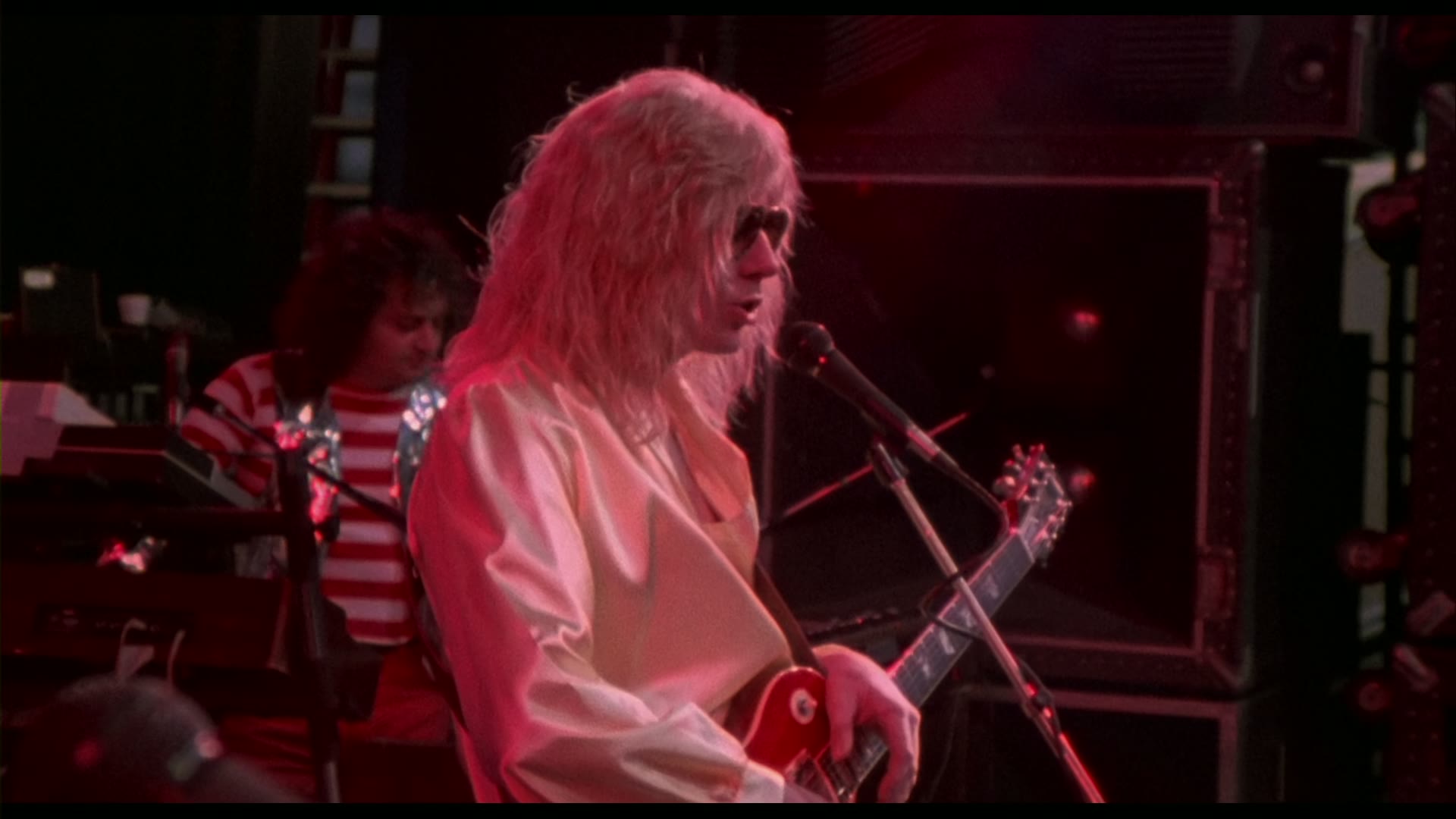
The last scene is the encore at the festival. They go on as a
two-piece: David singing, Nigel walking out from the wings with his
guitar. There is a roadie standing in for the bassist. They play their
big hit, “Tonight I’m Gonna Rock You Tonight.” Nigel walks over to the
microphone, says “Nigel Tufnel on lead guitar,” and plays the riff. The
film cuts. There is a chord that does not resolve. [Ends].
The credits roll.
What it adds up to
This documentary is, formally, very simple. It is an interview-and-verité record of a band on a tour that is going badly. It does not have narration, it does not have archival footage, it does not have talking heads from the music industry. DiBergi appears only as a voice and as a hand holding the microphone; the rest of the work is the band being the band, in rooms and on stages, talking when they should be quiet and quiet when they should be talking. The two qualities that make it work are the absolute flatness of the shooting style and the unerring eye for which moments to keep.
The interview material is the funniest in the film. The band, when asked a direct question, has a particular way of answering it for far longer than the question deserved, and of then bringing the answer back to themselves in a way that is not quite self-aware. (“We have grown musically. You listen to some of the rubbish we did early on. It was stupid. And now we’re… Yeah. I mean, a song like ‘Sex Farm’ — we’re taking a sophisticated view of the idea of sex and music. And putting it on a farm.”) The funniest single moment in the film is a long pause between the question “These go to 11” and the answer “Are you Spinal Tap?” — a pause, on the page, that lets the joke land without a laugh track.
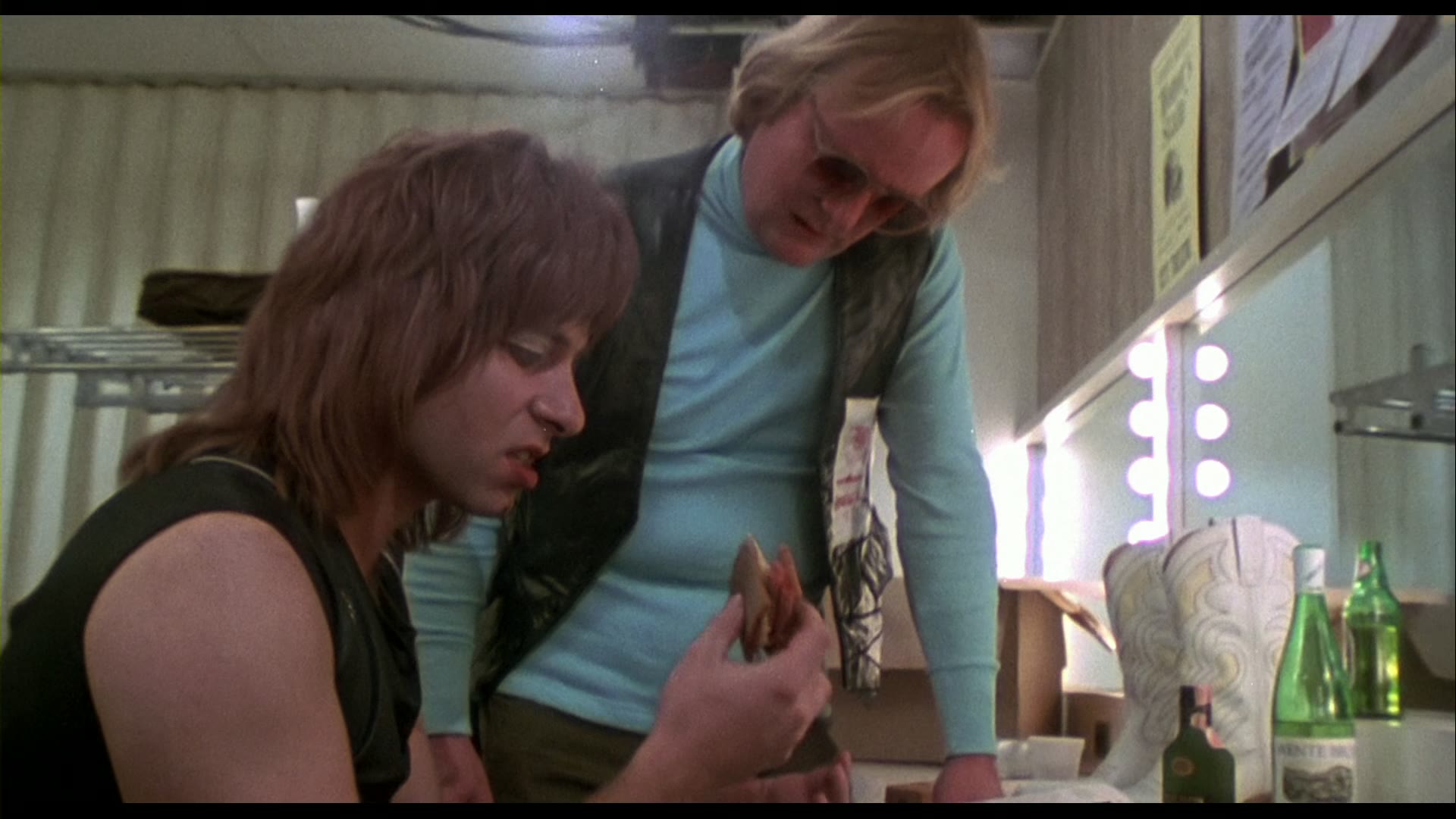
The verité material is more generous. There is a long, unbroken scene in a backstage kitchen in which Nigel, who is hungry, has been given a sandwich on miniature bread, and he cannot figure out how to eat it. (“This miniature bread. It’s… I’ve been working with this for about half an hour. I can’t figure out… let’s say I want a bite, right?… You could fold this, though. Well, no, then it’s half the size. Not the bread. You fold the meat. Then it breaks apart like this. No, you put it on the bread like this. But if you keep folding it, it keeps breaking. Why keep folding it? Everything has to be folded, and then it’s this, and I don’t want this. I want large bread, so then I can put this… Right. So then it’s like this, but this doesn’t work because it’s all… because it hangs out like that. Would you be holding this? I wouldn’t want to put that in my mouth.”) He is at the end of his rope about the bread. He is also at the end of his rope about the tour, about the album, about the new set, about the fact that the prop maker is taking him at his word. The bread is the bread and the bread is the prop and the prop is the tour and the tour is the band.
The film is also, quietly, a film about growing old. David is in his late thirties. The audience at the Memphis show — the one that gets cancelled — is, as the record-company man puts it, “predominantly young boys.” The industry has decided, the documentary lets us hear, that this is a fad. David is hurt by this. He does not say he is hurt by this. He says he believes “virtually everything” he reads. There is a real fish-nut monologue and a real whale-song monologue and a real moose monologue, and underneath all three is a man who knows he is no longer the centre of anything and is performing, very carefully, the role of a man who is no longer the centre of anything.
Why this medium
The decision to make this as a documentary is the decision that makes the film work. A scripted film about Spinal Tap would not have had the Nigel-and-the-bread scene, because a scripted film would have had to write the Nigel-and-the-bread scene. A scripted film would have had to know, in advance, that the band breaks up at the end, and would have had to deliver that to the audience. The documentary, by pretending (genuinely pretending) not to know, is able to deliver it. The last scene, in which the bass player is a roadie, the encore is a two-piece, and the credits roll, lands the way it lands because the camera is in the wings. A scripted film would have had to underline it. A documentary can let it sit.
That is also the limit. The moments that work best are the moments that are too good to be true — the Stonehenge prop, the Nigel and the bread, the all-black album cover that “looks like death,” the air-force-base gig in which the base’s PA joins in on the second chorus of “Sex Farm.” A real band on a real tour, however bad things were going, would not have produced all of those. The film knows this. It does not advertise it. It just lets the moments land, one after another, with a perfectly straight face.
For whom
For anyone who has ever been on a tour that was going badly, and for anyone who has ever watched a tour that was going badly from the other side of a barrier, this documentary will feel like a documentary. It is funny in the way real bad things are funny — not by being clever, but by being so bad that the only way through it is to be funny about it. It is also, despite everything, a real love letter to a particular kind of music, by people who have listened to it for a long time and care about it in a way that is hard to fake. The film does not need you to have heard of Spinal Tap. It does not even need you to like heavy metal. It needs you to have been in a room with people who are trying very hard to be good at something and not quite getting there, and to have found that funny, and to have found it a little bit heartbreaking.
The runtime is 82 minutes. The pacing is fast — by the time the credits roll, the band has broken up, but you have not been made to sit through the breakdown, only through the slow accumulation of small things going wrong. The film is, in that sense, exactly the length it needs to be.
Verdict: devastating. An extremely good rock documentary about a band you have never heard of, made by people who know exactly what a rock documentary is for.
Afterword (after research; not from the file)
After writing the body of this review, I went to look up the people in it. The surprise that the rerun request hinted at is that the three principals — the lead guitarist, the singer, the bassist — are not a real band that I happened not to have heard of. They are actors. The documentarian Marty DiBergi is also an actor. The whole thing was written and directed by a small group of people who had been performing together as a fake band for years before the film was made. The film is not a documentary at all. It is a mockumentary.
The “I am a filmmaker, I make a lot of commercials” voiceover at the top is, it turns out, a piece of character work, not a piece of journalism. The bassist, when he “dies,” is not dying — he’s an actor playing a character who is also a dead bassist, in a film about a fake band that the actors had been playing live for years. The drummer’s line, “It can’t always happen to every, can it?” is a line in a script. The “11” on the volume knob is a piece of set decoration. The 18-inch Stonehenge is a piece of set decoration. The miniature bread is a piece of prop comedy.
This is the surprise, and it is the reason the body of the review is written the way it is. I wrote the body having taken the film at face value — taking the band as real, taking the filmmaker as real, taking the line between stupid and clever as a real observation made by a real person. The review stands as a reading of the film as presented. The film, I now know, is a deliberate construction whose every element was written, rehearsed, and shot by people who knew exactly what they were doing. The reason it works is that the people who made it had been playing in the fake band on stage for years before they made the film, and so the band’s stagecraft is genuinely the band’s stagecraft. The “Big Bottom” chorus is performed with the same conviction a real metal band would bring to it, because the performers had been touring a real fake-metal set for a decade by the time they shot the film. The line between stupid and clever is a fine line, and the film walks it because the people who made it had spent ten years learning to walk it on stage.
The “revelation,” in other words, is not that the film is a put-on. The revelation is that the put-on works because it was lived in for years before it was filmed. A lesser version of this film — made by people who hadn’t spent a decade performing as a fake band — would be satire and nothing else. This film is satire that has earned its sincerity, which is why the body of this review, written as if it were a real documentary, is also a fair review. The film is genuinely a document of something. It is a document of what it is like to be in a working band, written by people who actually were in a working band — they just happened to be in a band called Spinal Tap that was a deliberate, sustained, ten-year piece of performance art.
I have not retro-edited the body. The body treats Marty DiBergi as a real filmmaker and the band as a real band, because that is how the film presents itself and because the body was written before I knew otherwise. The only correction I made after the research phase was a small one: a single line in the “Why this medium” section originally read “an extremely good rock documentary about a fictional band, and the only reason it is as good as it is, is that the band is fictional.” That sentence is technically correct in light of the afterword, but it imports the afterword’s knowledge into the body, which is the rule the rerun was designed to prevent. I replaced it with a critical observation that does not require the afterword’s knowledge — that the moments are “too good to be true” — which the body, written untainted, was always in a position to make.
Placeholder mapping (for the record)
The body of the review was originally written with the following invented placeholder names; they were swapped for the real names after research.
| Placeholder | Real person |
|---|---|
| “Vance Hargreaves” | Marty DiBergi |
| “Cal Mercer” | David St. Hubbins |
| “Bex Underwood” | Nigel Tufnel |
| “Fen Halloran” | Derek Smalls |
| “Bram Voss” | Viv Savage |
| “Tove Eskildsen” | Mick Shrimpton |
| “Malo Spence” | Ian Faith |
| “Lira Castell” | Bobbi Flekman |
| “Sir Greer Pembury” | Sir Denis Eton-Hogg |
| “Mira Thune” | Jeanine Pettibone |
| “Cody Markham” | Artie Fufkin |
| Band “Ironthread” | Spinal Tap |
| Album Taste the Iron | Smell the Glove |