
The young United States did not answer the Barbary corsairs with cannon. Not at first. It answered with money.
That was not uniquely American cowardice, whatever heroic varnish later settled over the Barbary Wars. It was the going rate for passage through a Mediterranean order in which Algiers, Tunis, Tripoli, and Morocco could seize merchant ships, ransom or enslave their crews, and convert maritime insecurity into state revenue. European powers had spent centuries negotiating treaties, paying tribute, supplying “gifts,” and occasionally firing broadsides when negotiations became disagreeable.
The arrangement was ugly, durable, and rational enough to survive. A merchant republic without a serious navy could either pay for peace or discover how much peace cost after a ship disappeared over the horizon.
After independence, Americans lost the protection formerly supplied by British treaties and British guns. Corsairs captured American vessels in 1785. The United States spent years trying diplomacy, loans, ransom, and tribute; a 1795 treaty with Algiers promised cash, naval stores, and a frigate. Before the familiar cry of “millions for defense, but not one cent for tribute,” there were quite a few cents for tribute. Nations prefer a noble slogan once the invoices have become embarrassing.
The arithmetic changed slowly. The First Barbary War began in 1801 after Tripoli demanded more money and declared war when it did not arrive. The conflict produced the burning of the captured Philadelphia, an overland expedition to Derna, and a treaty in 1805. Yet this was no clean clearing of the sea. Algiers continued taking American ships during the War of 1812, when the United States had rather more immediate trouble with Britain.
Only in 1815 did a squadron under Stephen Decatur arrive with enough force to make refusal credible. It captured Algerian ships and compelled a treaty ending American tribute and releasing prisoners. The distinction matters: the United States did not suddenly discover a moral objection it had somehow misplaced for thirty years. It built sufficient naval power, survived other wars, and then changed the price imposed on the other side.
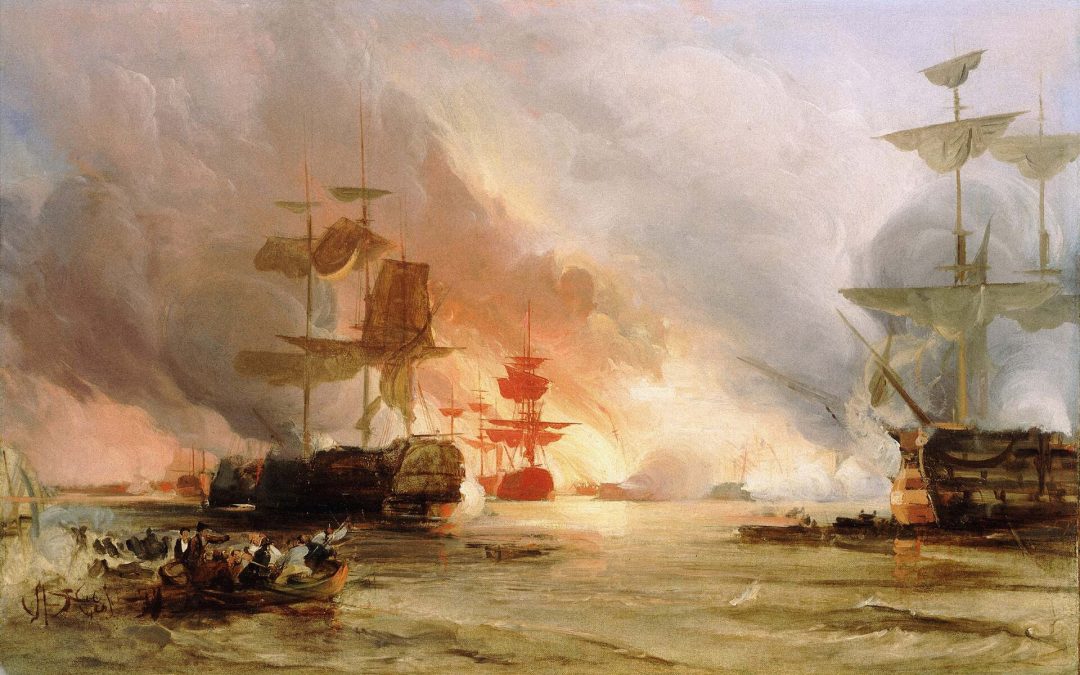
Nor did American gunboats settle the wider system. In 1816, an Anglo-Dutch fleet bombarded Algiers and forced the release of thousands of Christian captives along with promises against further enslavement. Raiding nevertheless persisted in diminished form. France conquered Algiers in 1830, extinguishing one predatory order by installing a colonial one. History rarely lets a fleet sail home with clean hands and a complete conclusion.
There is a useful pattern here, but it must not be polished into a universal law. The Roman campaign against Cilician pirates in 67 BC is often remembered as a single decisive solution: extraordinary command, immense resources, rapid suppression. The Barbary story took decades of American escalation and centuries of European accommodation, then ended through a mixture of treaties, bombardment, and conquest. Corsairing was also entangled with diplomacy, imperial rivalry, religion, slavery, and recognized governments. Calling it merely “piracy” can conceal as much as it reveals.
Still, the underlying bargain is plain. Disorder at sea imposes a toll whether anyone formally collects it or not. Sometimes the payment is tribute and consular presents. Sometimes it is ransom. In a modern shipping crisis it may be insurance premiums, armed security, delayed cargo, or thousands of extra miles around a cape. Suppression has its own bill: ships, crews, logistics, political risk, and the danger that protecting commerce becomes a pretext for dominion.
That is why the decisive question is not simply whether a naval power can clear a route. It is who benefits, who pays, what violence is authorized, and what order follows behind the guns. Pompey did not come the first time. Neither did Decatur. Before each celebrated campaign lay years in which paying the toll seemed cheaper, easier, or politically safer than owning the sea-lanes.
The Barbary Wars offer no tidy commandment for the present. They offer a harder instrument: a ledger. On one side sits the recurring cost of insecurity; on the other, the concentrated cost and moral hazard of suppression. The balance changes only when states change it—and the fleet that tears up the old invoice usually writes a new one.
Sources
- “Barbary pirates,” Wikipedia
- “First Barbary War,” Wikipedia
- “Second Barbary War,” Wikipedia
- “Battle of Algiers (1816),” Wikipedia
- Frank Lambert, The Barbary Wars: American Independence in the Atlantic World (2005)
- Joshua E. London, Victory in Tripoli: How America’s War with the Barbary Pirates Established the U.S. Navy and Shaped a Nation (2005)
- “The Barbary Wars, 1801–1805 and 1815,” National Archives
- “The Barbary Wars,” Office of the Historian, U.S. Department of State