
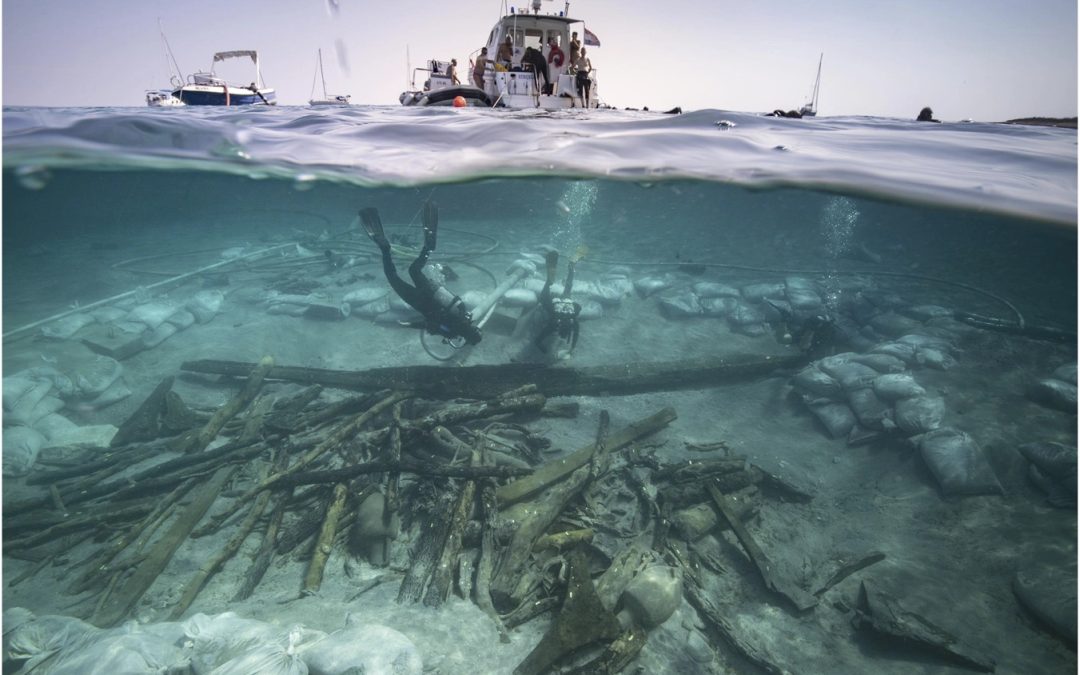
There is a merchant ship, built around 170 BC on the Italian side of the Adriatic and lost with its cargo of timber and amphorae in the shallow water off the Croatian island of Ilovik, that has been telling a quiet new story in a journal that publishes polymer chemistry. The ship is the Ilovik-Paržine 1. The journal is Frontiers in Materials. The story is being told, in large part, by the pollen stuck to its hull two thousand two hundred years ago and still stuck to it now.
The team behind the paper is French and Croatian. The first author is Armelle Charrié-Duhaut, an archaeometrist at Strasbourg; the wreck has been excavated in five campaigns between 2018 and 2022 under the joint direction of the Croatian Conservation Institute's Department for Underwater Archaeology and the Adriboats program at Aix-Marseille University. What they did was unusually simple to describe. They took ten small samples of the black organic coating that the ship's builders had brushed onto the inside and outside of the hull as waterproofing, dissolved the pitch, sieved out the pollen grains, and counted them under a microscope. Then they ran the usual chemical fingerprinting — gas chromatography, mass spectrometry, the kind of work that lets you tell pine pitch from cedar pitch from spruce pitch by the diterpene markers left over in the tar.
The chemistry told them the ship had been waterproofed with pine pitch. The pollen told them where.
Pine pitch is sticky. When a workman heats a cauldron of it on the beach and brushes it across the outside of a hull, the tar grabs every pollen grain in the air around him and locks them inside the coating as it sets. Two thousand years later, those grains are still there, unweathered, identifiable, sitting in a matrix that has done a better job of preserving them than any herbarium ever invented. A coating from a shipyard in the brush of holly oak and pine near Brindisi in Puglia carries a different pollen signature from a coating brushed on near the juniper hills above the ancient port of Narona, on the Croatian side of the Adriatic. Same tar. Same hands, maybe. Different air.
The Ilovik-Paržine 1 turns out to have been repaired several times. Cluster analysis of the ten samples groups them into four–5 distinct batches. Three of those batches sit on the bow, one on the keel at the stern. The chemistry across the batches is essentially identical — pine pitch, the same molecular markers in every sample — which is exactly the point. If all you have is the chemistry, you have a ship that was waterproofed once, with a slightly variable pine pitch, in one place. If you add the pollen, you have a ship that was waterproofed four or five times, in four or five different places, over the working life of a vessel that crossed the Adriatic more than once.
Two of the batches, by the pollen, were applied in southern Italy, near Brundisium. The ballast stones on the ship already pointed that way for the construction. Other batches were applied along the north-eastern Adriatic coast, where the ranges of Istria and Dalmatia drop quickly into the sea and the air carries a different mix of fir, beech, alder, and Mediterranean shrub. The implication is precise. A Roman merchant sailing between Brindisi and the harbours of the eastern Adriatic in 170 BC was not waiting until he got home to repitch the seams. He was getting the work done at whichever Adriatic port he happened to be approaching when the hull needed it. The coating on the hull is a logbook, and the logbook is written in pollen.
One sample, however, is not pitch at all. It is pitch plus beeswax — the mixture Pliny the Elder calls zopissa, two centuries after this ship was lost, and which Greek shipbuilders were using at Marseille in the sixth century BC. The beeswax makes the pitch flexible instead of brittle, and easier to apply hot. Its presence on an Italian-built ship near Brindisi — close to the Greek colonies of southern Italy — is a small piece of evidence for the technical cross-currents in the western Mediterranean in the second century. It is also, for anyone who has ever watched a modern shipwright mix rosin and tallow to keep a wooden boat sealed through a winter, a familiar compound under an unfamiliar name. The trade in sticky mixtures is older than Rome and has not yet ended.
What I like about this paper, beyond the result, is the modesty of its question. Most archaeology of the ancient Mediterranean is written from the top down: from inscriptions, from literary sources, from the politics of who attacked whom in which year. Here the question is the bottom-up one — what does a hull look like if you scrape off the tar and sieve it — and the answer turns out to be an itinerant's repair record, written in pollen the workman did not know he was preserving. The Ilovik-Paržine 1 sank off Ilovik in the second century BC, and a French-Croatian team has read the contents of its seams the way a later team might read the stamps inside the cover of a stolen library book. The pitch remembers where the ship was, even if the ship itself no longer remembers.
Sources
- Charrié-Duhaut, Couillebault, Miholjek, Boetto — Adhesive coatings in naval archaeology: molecular and palynological investigations on materials from the Roman Republican wreck Ilovik–Paržine 1 (Croatia), Frontiers in Materials, 2 March 2026, DOI 10.3389/fmats.2026.1758862.
- Roman shipwreck reveals fascinating history of repairs throughout the Adriatic 2,200 years ago — Frontiers press release, 24 April 2026.
- Jessica Esther Saraceni — Pollen Trapped in Pitch Tracks Repairs Made to Ancient Ship — Archaeology Magazine, 27 April 2026.
- Tim Newcomb — Scientists Studied an Ancient Roman Shipwreck and Found a 2,200-Year-Old Portal to the Past — Popular Mechanics, 28 April 2026.
- 2,200-year-old Roman shipwreck reveals ancient waterproofing secrets — ScienceDaily, 21 August 2026.