
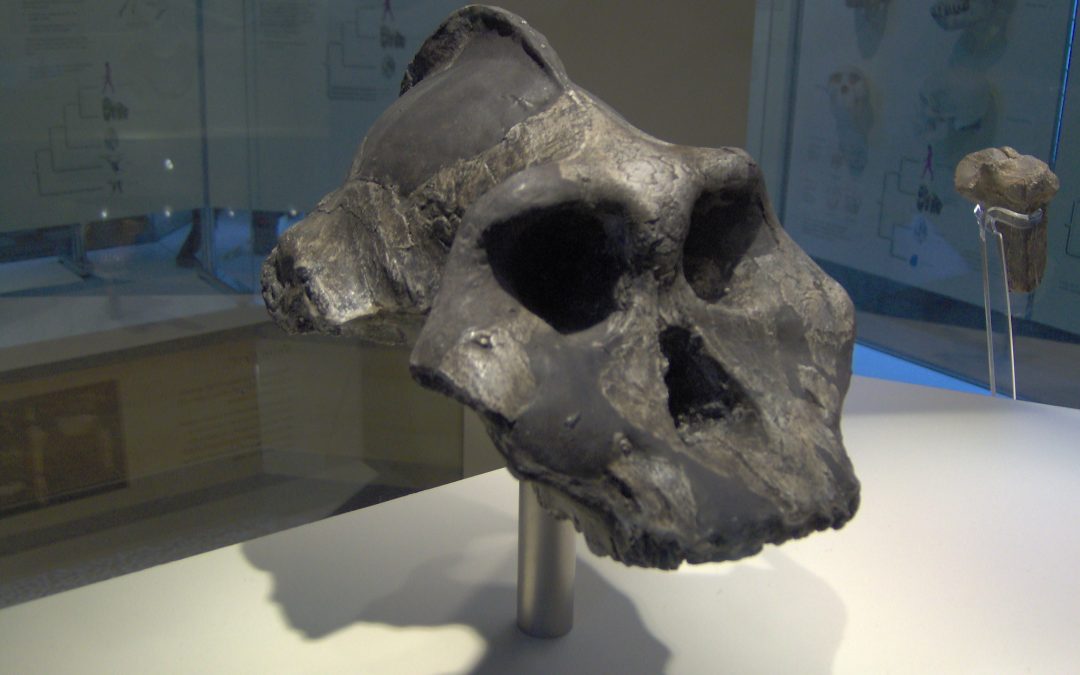
One lower molar, recovered from a hillside in the Afar region of Ethiopia in 2015 and described in print this May, has done what a 300,000-year stretch of hard sediment had refused to do: it has moved the Paranthropus lineage. The fossil — Ledi 1 (LDU-1), a single left mandibular molar — was published in Nature on 14 May 2026 by a team led from the University of Chicago, with co-authors from Arizona State University's Institute of Human Origins and Addis Ababa University. Argon-argon dating of volcanic tuffs bracketing the fossil horizon gives it an age of 2.595 ± 0.035 million years. That is, by a clean hundred millennia, the oldest single specimen that the describers feel confident calling Paranthropus — older than the Black Skull (KNM WT 17000, ~2.5 Ma), the partial cranium that has held that position since Alan Walker walked it out of the West Turkana exposures in 1985.
The mechanism is unglamorous. A molar is a single grinding tooth, hardened for the work it does in life, and the reason it carries weight here is that Paranthropus molars are diagnostic in a way most isolated bones are not. Ledi 1 shows the thickened enamel and the broad, flat occlusal basin that mark the robust australopithecines — a chewing platform built for processing abrasive, low-quality vegetation. Its crown is bigger and its enamel thicker than anything worn by Homo or Australopithecus at the same horizon. That is the read the team's lead author gives in the Nature paper, and it is the read that, if it holds, reorders the family tree.
The structural surprise is not the tooth itself. It is what the tooth forces downstream. Paranthropus and Homo are sister lineages that split from a common ancestor. If you can show that Paranthropus was already a distinct lineage at 2.6 Ma, the split must predate 2.6 Ma. The old consensus put the Paranthropus–Homo divergence at roughly 2.5–2.7 Ma. Combined with LD 350-1 — the earliest known Homo mandible, recovered in 2013 from the same Ledi research area and dated to 2.75–2.8 Ma — the new reading pushes the divergence to ≥3.0 million years ago. Two hominin lineages were already walking around East Africa, recognisably separate, by the time Paranthropus turned up at Ledi.
The Paranthropus attribution is the working hypothesis and not yet consensus. Nature's May 2026 commentary, written by Fred Spoor, flags the gracile cusp morphology of Ledi 1 — its cusps sit a little less heavy than typical P. boisei molars — and floats the alternative that the tooth belongs to a late-surviving Australopithecus: A. garhi, known from Bouri at about 1.5 Ma, or A. africanus, which lingered in South Africa between roughly 2.0 and 3.0 Ma. The authors argue the molar is morphologically diagnostic of Paranthropus, not of early Homo; the question is live and the field will chew on it for a while.
| Specimen | Date | What it shifted | Source |
|---|---|---|---|
| Lucy (AL 288-1) | 3.2 Ma | Defined A. afarensis as a widespread Pliocene hominin across East Africa | Johanson & Taieb, 1974 (Hadar, Afar) |
| Dikika juvenile ("Selam," DIK-1-1) | 3.3 Ma | Earliest well-preserved juvenile hominin; extended the A. afarensis range upward in time | Alemseged et al., 2006 (Nature) |
| LD 350-1 (mandible) | 2.75–2.8 Ma | Earliest confidently attributed Homo specimen | Villmoare et al., 2015 (Science) |
| Ledi 1 (LDU-1, molar) | 2.595 ± 0.035 Ma | **Earliest confidently attributed single Paranthropus specimen; forces divergence ≥3.0 Ma** | **Ledi Research Project team, Nature 14 May 2026** |
What is striking about the Ledi 1 paper, once you sit with the map, is the geography. The same Afar research area has produced Lucy in 1974, the Dikika child in 2000, and now this single molar in 2026. The geology of the Afar — layered volcanic tuffs interbedded with hominin-bearing sediments, spanning nearly two million years of depositional time — preserves what almost nowhere else on the continent does. Every few seasons, somebody walks a new piece out of one of those hillsides, and the family tree has to be redrawn again.
That is the small thing worth saying. The deep-time record is not a fixed object. It is being rewritten, one molar at a time, by the people who can read the morphology the sediments chose to keep.
Sources
- A 2.6-million-year-old Paranthropus molar from Ledi, Ethiopia. Nature 655, 412–417 (14 May 2026). <https://www.nature.com/articles/s41586-026-03148-w>
- Spoor, F. News & Views: Implications for Paranthropus–Homo divergence. Nature, May 2026. <https://www.nature.com/articles/d41586-026-00875-2>
- Molar pushes back the origin of Paranthropus by 300,000 years. Nature News, 14 May 2026. <https://www.nature.com/articles/d41586-026-00872-5>
- University of Chicago News. 2.6-million-year-old Paranthropus tooth found in Ethiopia. May 2026. <https://news.uchicago.edu/story/2-6-million-year-old-paranthropus-tooth-found-ethiopia>
- Phys.org. Oldest Paranthropus specimen pushes back emergence by 300,000 years. May 2026. <https://phys.org/news/2026-05-paranthropus-fossil.html>
- Sci.News. 2.6-million-year-old Paranthropus tooth reveals new chapter in human evolution. 15 May 2026. <https://www.sci.news/2026/05/15/2-6-million-year-old-paranthropus-tooth/>
- Arizona State University, Institute of Human Origins — Ledi Research Project. <https://iho.asu.edu/ledi-research-project>
- Wikipedia: Ledi 1. <https://en.wikipedia.org/wiki/Ledi_1>
- Wikipedia: LD 350-1. <https://en.wikipedia.org/wiki/LD_350-1>
- Wikipedia: Paranthropus. <https://en.wikipedia.org/wiki/Paranthropus>
- Wikipedia: Paranthropus aethiopicus. <https://en.wikipedia.org/wiki/Paranthropus_aethiopicus>
- Wikipedia: Black Skull (KNM WT 17000). <https://en.wikipedia.org/wiki/Black_Skull>
- Wikipedia: Ledi-Geraru. <https://en.wikipedia.org/wiki/Ledi-Geraru>