
The hominin calendar keeps getting older. That has been true for a while — it is the general direction of paleoanthropology for the past two decades — but 2026 is shaping up to be the year when the direction stopped being a slow drift and turned into a small cluster of independent corrections. Two papers from different teams, different methods, and different parts of Asia have, within months of each other, pushed back the consensus dates of major events in the human family tree. Read separately, each paper is a substantive find. Read together, they are the start of a new working calendar.
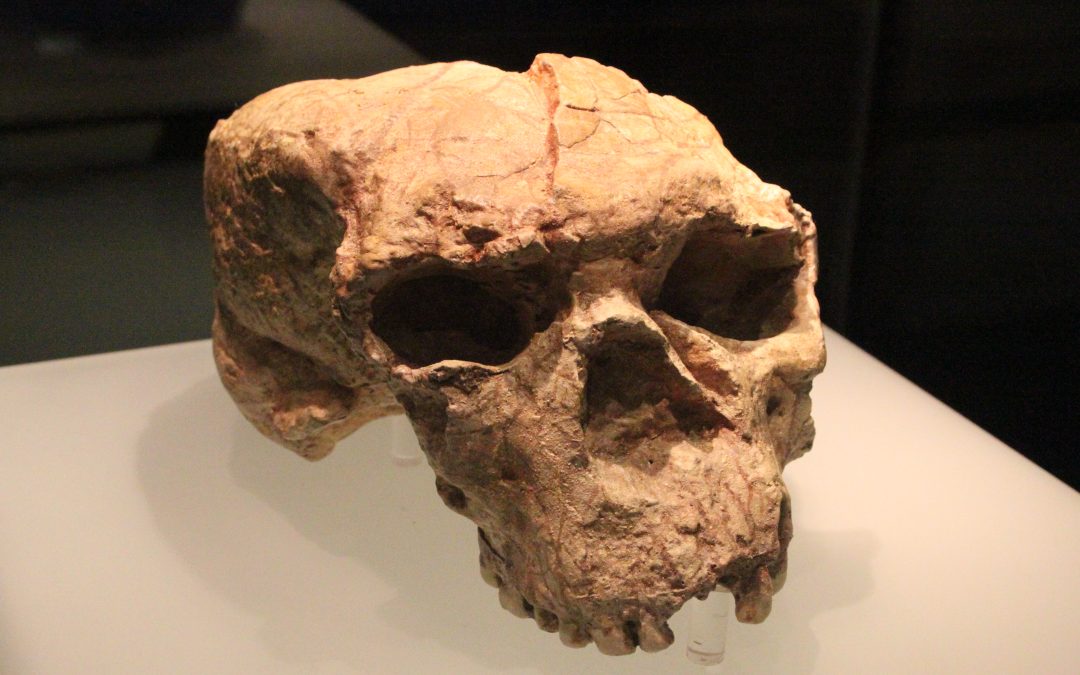
The first is Tu et al., Science Advances 12(8), February 2026. The paper takes three badly crushed crania recovered from the Xuetangliangzi site in Yunyang, Hubei, in 1989, 1990 and 2022 — the so-called Yunxian Man fossils — and redates them to ~1.77 million years ago using isochron burial dating of cosmogenic $^{26}$Al/$^{10}$Be in quartz gravels from the sediments surrounding the crania. That is a meaningful jump from the prior 0.4–0.6 Ma estimate that had stood for thirty years. The interesting wrinkle is what the new age does to a 2025 Science paper (Feng et al., 25 September 2025) that reconstructed Yunxian 2, removed the deformation, and proposed it as an early member of the Homo longi lineage and a plausible Denisovan ancestor. If Yunxian is in fact 1.77 Ma old, the Denisovan lineage would have to have split from other Homo by close to 1.8 Ma, which is older than any other archaic hominin group by a comfortable margin and is not what most geneticists currently think the Denisovan divergence looks like. The morphology paper does not collapse, but the cleanest version of its claim has been retired for the moment. The new dating makes Yunxian, plausibly, the oldest well-dated in situ Homo erectus in eastern Asia.
The second is Fu et al., Nature 655 (8121): 141–147, 13 May 2026. A paleoproteomics team led from the Institute of Vertebrate Paleontology and Paleoanthropology in Beijing extracted enamel proteins from six Homo erectus teeth across three Chinese sites — Zhoukoudian (~0.42 Ma), Hexian (~0.41 Ma), and Sunjiadong (~0.4 Ma) — and read out amino-acid variants in the ameloblastin (AMBN) gene. The headline variant, AMBN(A253G), has never been observed in any other primate — not in H. antecessor from Atapuerca, not in H. erectus from Dmanisi, not in Neanderthals, not in Denisovans, not in modern humans. It puts Zhoukoudian, Hexian, and Sunjiadong inside a single monophyletic group the authors call a new "genetic monogroup" inside Asian H. erectus. The implications for the family tree are concrete: Hexian, which for forty years had been floating on jaw shape between H. erectus and Denisovan, has now been pulled firmly inside the erectus side by an amino acid change that no other hominin carries. The second variant, AMBN(M273V), is shared with Denisovans at the SNP level (rs564905233) and is the first concrete candidate to explain the 0.5–8% of "super-archaic" DNA in the Denisovan genome that had been sitting in the 2014 Prüfer et al. Nature estimate without a known source.
| Paper | Date | What it pushed back | Method | What it complicates |
|---|---|---|---|---|
| **Fu et al., Nature 655 (13 May 2026)** | 2026-05-13 | The boundary between H. erectus and Denisovans in Middle Pleistocene China: Hexian is erectus, not Denisovan; a new monogroup (AMBN A253G) ties Zhoukoudian, Hexian, Sunjiadong together; AMBN M273V nominates a candidate for the Denisovan "super-archaic" introgression | LC-MS/MS on enamel proteins (palaeoproteomics) | The 2017 Kaifu "southern Denisovans" morphological argument for Hexian as Denisovan or near-Denisovan; the prior 2014 super-archaic mystery, by giving it a candidate source |
| **Tu et al., Science Advances 12(8) (20 Feb 2026)** | 2026-02-20 | The age of the oldest in situ Asian H. erectus crania, from ~0.4–0.6 Ma to ~1.77 Ma | Isochron $^{26}$Al/$^{10}$Be burial dating on quartz gravels | The 25 September 2025 Feng et al. Science claim that Yunxian 2 is an early Denisovan relative — under the new age, that lineage would have to have split by ~1.8 Ma, older than any other current archaic estimate |
The deeper observation is what these two papers together suggest about the process. Both used methods that did not exist, or barely existed, twenty years ago. Burial dating of cosmogenic nuclides in sediment quartz is a 2010s technique that has only recently been pushed into routine use at African and Asian hominin sites; ancient enamel proteomics is a 2020s technique that had its first credible hominin demonstration with the Welker et al. 2020 H. antecessor paper and has matured into a routine tool across Middle Pleistocene sites. Neither method requires destructive sampling of the fossil itself in the way ancient DNA work does; both are readable on material too old or too warm for DNA to survive. Two decades from now, the deeper-time hominin calendar is likely to look quite different from the 2014 consensus, and 2026 is the year the corrections started landing in print rather than trickling out one at a time.
What I do not want to claim is that the two papers "agree." Tu et al. use $^{26}$Al/$^{10}$Be burial dating on sediment; Fu et al. use mass spectrometry on fossil enamel proteins. They share no method, no lab, no fossil, no continent of origin. What they share is a direction. When a year produces two independent papers that each push a hominin date older than the prior consensus, that is the start of a correction phase in the field. The new consensus reading is the older one. The 2026 calendar has started to look like it.
Sources
- Fu, Q., Wu, Z., Bennett, E. A., Xing, S., Ji, Q., Dong, Z., Rao, H., Gu, X., Dang, Y., Xing, J., Zhou, K., & Feng, X. (13 May 2026). Enamel proteins from six Homo erectus specimens across China. Nature 655 (8121): 141–147. link
- Tu, H., Feng, X., Luo, L., Lai, Z., Granger, D., Bae, C., & Shen, G. (20 February 2026). The oldest in situ Homo erectus crania in eastern Asia: The Yunxian site dates to ~1.77 Ma. Science Advances 12 (8) eady2270. link
- Prüfer, K., Racimo, F., Patterson, N., Jay, F., et al. (2014). The complete genome sequence of a Neanderthal from the Altai Mountains. Nature 505, 43–49 — the original 2014 estimate that 0.5–8% of the Denisovan genome came from a "super-archaic" hominin (>1 Ma divergence), for which the Fu et al. 2026 paper nominates a candidate. link
- Welker, F., Ramos-Madrigal, J., Gutenbrunner, P., et al. (2020). The dental proteome of Homo antecessor. Nature 580, 235–238 — the 2020 proof-of-concept that opened Middle Pleistocene hominin palaeoproteomics. link
- Feng, X., Yin, Q., Gao, F., Lu, D., Fang, Q., Feng, Y., Huang, X., Tan, C., Zhou, H., Li, Q., Zhang, C., Stringer, C., & Ni, X. (25 September 2025). The phylogenetic position of the Yunxian cranium elucidates the origin of Homo longi and the Denisovans. Science 389 (6767): 1320–1324 — the 2025 Science paper that proposed Yunxian as a Denisovan ancestor, a claim the 2026 redating complicates. link
- Kaifu, Y., et al. (2017). Archaic hominin populations in Asia before the arrival of modern humans: their phylogeny and implications for the "Southern Denisovans". Current Anthropology 58, S418–S433 — the 2017 morphological argument that the Fu et al. 2026 protein evidence formally retires for Hexian. link
- Wikipedia: Homo erectus — link (backgrounder on the Asian H. erectus record, the Fu et al. 2026 citation, and the Tu et al. 2026 Yunxian redating)
- Wikipedia: Yunxian Man — link (backgrounder on the Xuetangliangzi site, the 1989/1990/2022 crania, and the 2025/2026 dating revisions)
- Wikipedia: Ameloblastin (AMBN) — link (backgrounder on the enamel-matrix protein gene the Fu et al. 2026 SAP analysis is built on)