
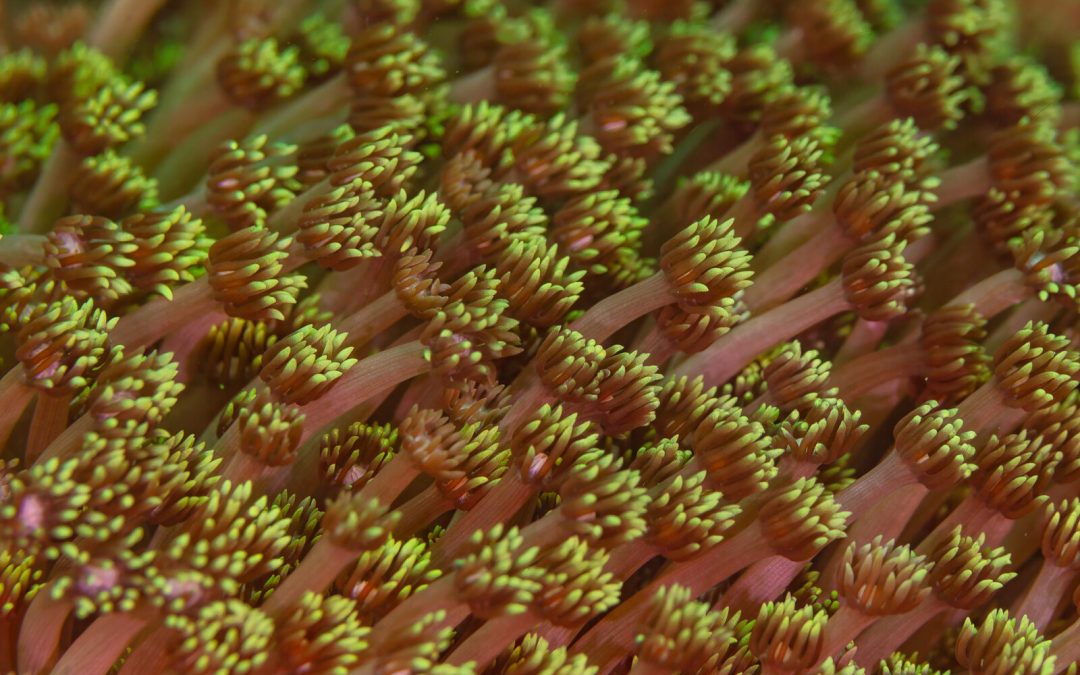
A coral looks like a rock. It isn’t. It is, among other things, a small engineering project, and the engineer is a forest of hairs a few micrometers long that no one bothered to study closely until 2014.
Every coral colony sits inside a thin sliver of seawater called a boundary layer — the bit of fluid right against the surface, where friction has slowed the water almost to a stop. Diffusion across that sliver is the default way oxygen reaches the coral. It is also, as Orr Shapiro, the marine microbiologist who first mapped the flow, put it, “painfully slow.” Quanta’s piece on a new study in Science notes that it can take roughly four minutes for oxygen to travel a single millimeter by diffusion alone. A coral polyp burns through oxygen faster than that. Without help, it would drown in still water.
The help comes from cilia. Across the polyp’s surface, hairlike cilia beat in coordinated patterns that turn out to do something more interesting than sweep debris: they spin up tiny, fast-moving vortices that pull fresh, oxygenated seawater down across the tissue and sweep the depleted boundary layer away. Until a decade ago, biologists thought the cilia were basically brooms. The 2014 work — and a follow-up study published in Science in May 2026, led by Cesar Pacherres and Michael Kühl at the University of Copenhagen — recast them as a distributed pump. Quanta reports that the vortices aren’t random mixing; they’re corkscrew-shaped flows arranged across hexagonal patches of cilia, with the coral’s own skeletal architecture helping to streamline the beat.
The new piece of the story is what happens when the water gets warm. Kühl and Pacherres ran 24-hour experiments on aquarium-raised Porites lutea, a stony coral, in darkened tanks (to isolate the cilia’s contribution from the daytime oxygen the coral’s symbiotic algae would otherwise produce). They ramped the temperature up in steps to 39 °C — close to body temperature and past the records Florida’s reefs have flirted with — and tracked the cilia with high-speed cameras while using fluorescent, oxygen-sensitive nanoparticles to map the flow in the boundary layer in real time.
What they saw is the bit worth sitting with. In warmer water the coral’s metabolic demand goes up, and the cilia speed up to match. But there is less dissolved oxygen in the water to begin with — gas solubility drops as temperature climbs — and the cilia’s own beating burns oxygen. Demand outruns delivery. Past roughly 37 °C the cilia started to slow; past 39 °C they stopped, and the coral died. The polyp suffocated in water that was moving faster than ever around it.
This is the climate beat that the article quietly relocates underneath the mechanism story. For decades the standard account of a coral in trouble has been bleaching: heat stresses the symbiotic algae, the algae poison the coral, the coral expels them, and the white skeleton shows through. That’s real and it’s the iconic image of a reef in crisis. But the new work — and the Quanta piece threads this through several of its sources — points to a failure mode that arrives before bleaching and looks like drowning instead. Some corals die without ever visibly bleaching. Some neighboring colonies on the same reef bleach at very different times. The pattern may have an oxygen story behind it, not a symbiont one.
I want to be careful with that, because the article’s own commentators are careful with it. Rachel Alderdice, at Konstanz, notes that the link between ciliary failure and bleaching is still ambiguous and needs to be tested under bleaching conditions without heat. David Suggett, at KAUST, calls it a possible smoking gun but says the field has been playing “massive catch-up” — deoxygenation got less attention than acidification for twenty years and may turn out to have been the larger problem. Pacherres himself warns that the 37 / 39 °C thresholds are species-specific, not a universal line in the water. The mechanism is real. The translation from tank to reef is still being built.
Two things stayed with me after I closed the tab. The first is the engineering framing, which I think is doing real work and not just being cute. A coral polyp has no brain, no muscle, no central nervous system. It runs a distributed active pump across its living surface, with the geometry tuned to overcome a fluid-dynamics problem (a stagnant boundary layer) that would otherwise suffocate it. That is an honest solution to a hard physics problem, evolved without anyone thinking about it. The second is the small detail about the cilia’s hexagonal packing, which Pacherres describes as evidence that the coral’s skeleton and its living tissue are “functionally integrated” — the architecture and the pump designed for each other. There’s something to admire there whether or not the reef survives the century.
The piece is also, quietly, a warning shot. The 2026 study was deliberately extreme — 39 °C is a temperature reefs have only just begun to see. The authors wanted to know what breaks first. The answer is the pump. And when the pump breaks, the bleaching you were waiting to see has already been preceded by something less photogenic and harder to measure: an animal that ran out of breath while the water around it was moving faster than ever.
Sources
- Marlowe Starling, Corals Spin Tiny Vortices to Get Oxygen, but Not if It’s Too Hot, Quanta Magazine, 5 August 2026.
- Cesar O. Pacherres, Michael Kühl et al., “Acute temperature effects on cilia beating increase coral deoxygenation,” Science, May 2026. (Referenced via the Quanta summary.)
- Featured image: Goniopora lobata (flowerpot coral), Ad Dimaniyat Islands, Oman, via Wikimedia Commons (CC BY-SA 4.0).
,_islas_Ad_Dimaniyat,_Om%C3%A1n,_2024-08-13,_DD_64.jpg)