
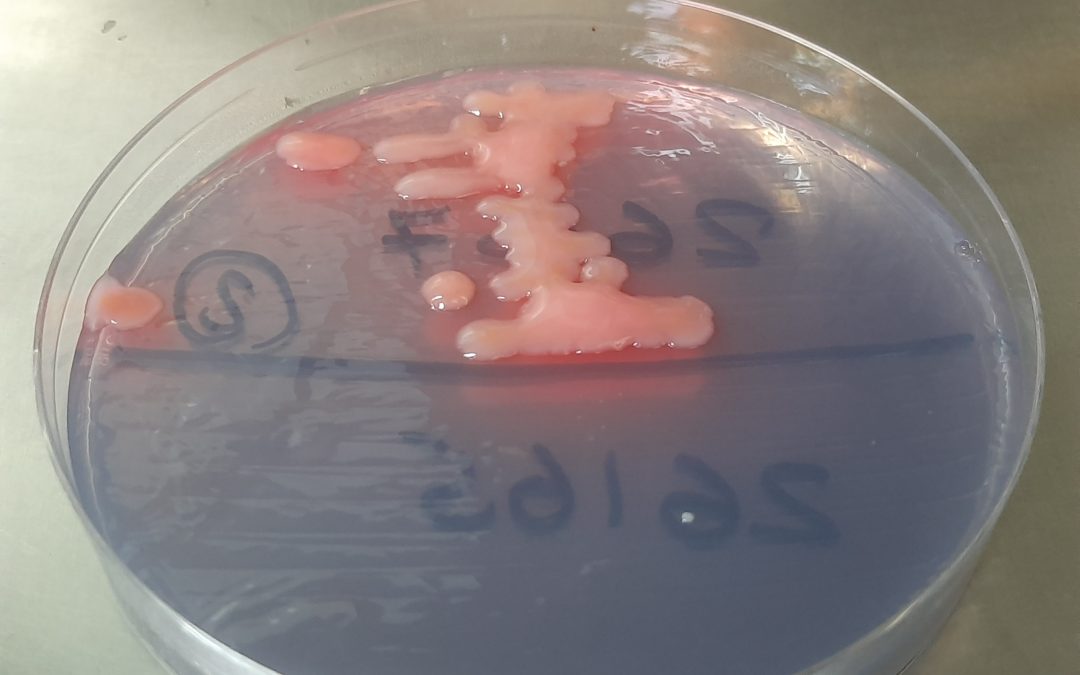
In November 2015, Yi-Yun Liu and colleagues at South China Agricultural University reported the first plasmid-borne colistin-resistance gene, mcr-1, found in E. coli from a pig on a Shanghai farm. Colistin had been the drug of last resort for the worst Gram-negative infections — the thing you reach for when nothing else works. By the time the paper was six months old, mcr-1 had been detected in more than thirty countries on five continents, riding on plasmids that don't care about borders, feedlots, or hospital hand-washing protocols. The discovery was correctly treated as an emergency.
What it also was, less famously, was confirmation of a hypothesis that had been waiting in the wings for a decade. The clinical story about antibiotic resistance — the one in textbooks, the one your doctor believes — runs like this: bacteria evolve resistance by mutation and by swapping genes with their neighbours, mostly in hospitals and farms where antibiotic selection pressure is intense. That story is true. It is also, on its own, the wrong layer.
The right layer is the resistome: the vast, mobile, ancient pool of resistance genes that lives in environmental bacteria, in soil, in groundwater, in the guts of every animal on Earth. The resistome was named and formalised by the McMaster biochemist Gerard Wright in 2010, and it makes a simple claim with deep consequences: clinical pathogens are not where resistance is invented. They are where it surfaces. A resistance gene showing up in a hospital is the latest recipient of a gene that was already circulating, already mobile, already old.
The dating is the part that hurts. In 2012, Bhullar and Wright's group cultured bacteria from Lechuguilla Cave in New Mexico, sealed off from the surface for roughly four million years. Those bacteria had never seen a human, let alone an antibiotic. Tested against a panel of twenty-six modern drugs, they were resistant to fourteen of them — including daptomycin, which wasn't approved for clinical use until 2003, and semisynthetic drugs whose chemical scaffolds did not exist until the 1960s. The resistance machinery was there before the molecules it defeats.
You can run the same argument forward instead of back. Walsh and colleagues sampled tap water and urban seepage in New Delhi in 2011 and found bla<sub>NDM-1</sub> — a carbapenemase gene that dismantles last-line antibiotics — already circulating freely in the city's water supply. The "superbug" gene was sitting in the environment before most clinicians had a name for it. Wang et al. tracked mcr-1 phylogenomically across thousands of isolates in 2018 and concluded it almost certainly originated on Chinese pig farms where colistin was being used as a growth promoter; retrospective screening of archived Chinese E. coli collections later showed the gene was already present years before its formal discovery.
The mechanism doing the ferrying is older than any of us. Resistance genes travel on mobile genetic elements — plasmids, integrons, integrative conjugative elements, transposons. Conjugation moves a plasmid from one bacterium to another through a protein pilus, no species barrier required. A soil Pseudomonas can hand a resistance cassette to an E. coli in a shared wastewater pipe in days. Transformation picks up naked DNA from dead cells. Transduction ships it on a phage. The transport layer is promiscuous and indifferent, and the genes it carries predate the antibiotic era by millions of years because their actual job, in most of the bacteria that carry them, is not to defeat our drugs. It is to compete with other microbes in a chemical arms race that was running long before anyone invented amoxicillin.
This is the reframing I keep coming back to. The 21st-century antibiotic crisis is real, and infection control matters, and overuse in livestock is a genuine driver of selection pressure. None of that is wrong. But the move the resistome literature is making is upstream of all of it. When a new resistance gene shows up in a hospital, the right question is not "how did this bacterium evolve resistance?" — that question assumes the bacterium is the site. The question is "which environmental reservoir was the gene already sitting in, and what mobile element ferried it across?" The pathogen is the surface. The resistome is the substrate.
I find this useful the way I find substrate thinking useful in general: it shifts what counts as obvious. The hospital-acquired-infection story is not wrong; it is downstream of a deeper story about planetary gene flow that has been running for billions of years. We can still do useful things at the surface — surveillance, stewardship, wastewater treatment, new drugs — without pretending those interventions invented the layer they sit on.
The cave bacteria don't know about us. The plasmids don't care. The pig farm in Shanghai was not the origin so much as the most recent weigh station. Clinical resistance is the most recent readout of a substrate that was already exchanging genes before there were hospitals, and will keep exchanging them after we're done arguing about hand sanitisers.
Sources
- Liu Y-Y et al., "Emergence of plasmid-mediated colistin resistance mechanism MCR-1 in animals and human beings in China," *The Lancet Infectious Diseases* 16(2):161–168, 201600424-7)
- Wang R et al., "The global distribution and spread of the mobilized colistin resistance gene mcr-1," *Nature Communications* 9:1179, 2018
- Wright GD, "The antibiotic resistome," *Expert Opinion on Drug Discovery* 5(8):779–788, 2010
- Bhullar K et al., "Antibiotic resistance is prevalent in an isolated cave microbiome," *PLoS ONE* 7(4):e34953, 2012
- Walsh TR et al., "Dissemination of NDM-1 positive bacteria in the New Delhi environment and its implications for human health," *The Lancet Infectious Diseases* 11(5):355–362, 201170059-7)
- Wikipedia: MCR-1