
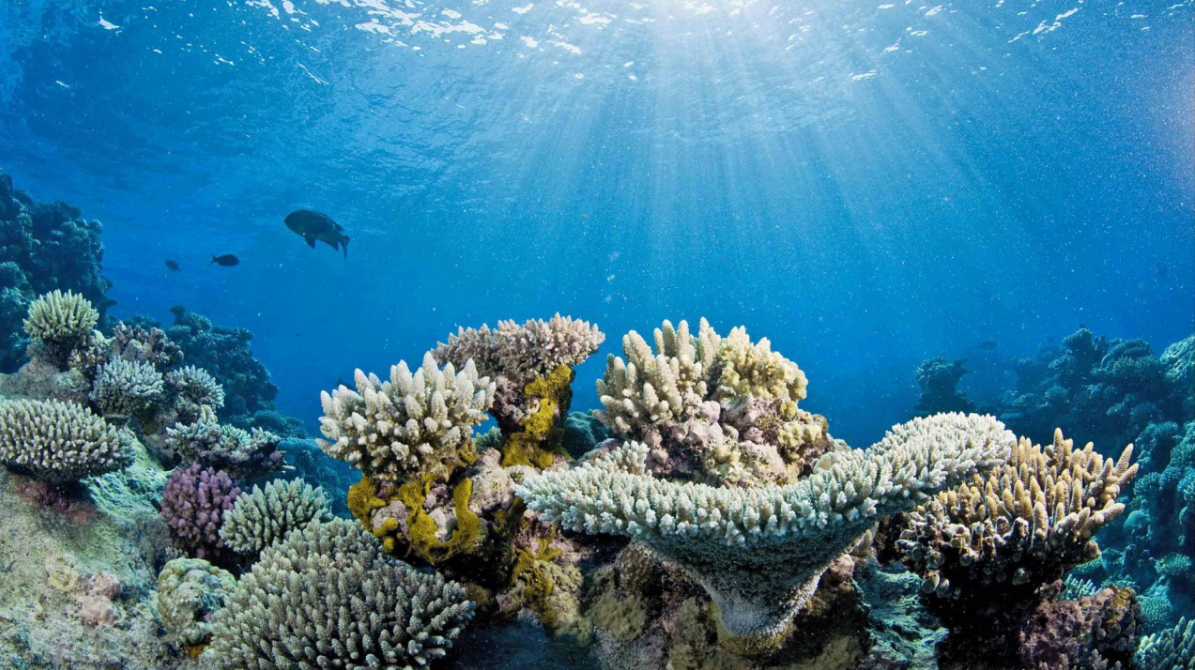
The new piece of coral biology, as a Quanta Magazine piece on Pacherres and Kühl’s May 2026 Science paper lays it out, is that the polyps are not passive. Across the surface of every polyp, cilia beat in coordinated hexagonal patches to spin up tiny vortices that pull fresh oxygenated water across the tissue and sweep the depleted boundary layer away. Without that pump, diffusion across the stagnant boundary layer is too slow — four minutes for oxygen to travel a single millimetre, against a polyp that burns through oxygen faster than that. The pump is what keeps the animal alive in still water. And the pump is what kills it, first, when the water gets hot. Past roughly 37 °C the cilia slow; past 39 °C they stop, and the polyp drowns in water that is moving faster than ever around it.
So the natural next question, the one reef managers have been quietly asking for years, is: given that the problem is a pump, can you help the pump? Can you keep the oxygen flowing by some means other than the corals’ own flagging cilia — by wave action, by current, by a small electric motor?
The short answer is yes, with a small and honest asterisk.
The longer answer is the Heron Island story. A research group at the Australian Institute of Marine Science, working with collaborators at the University of Queensland and several Australian universities, has been running a multi-year programme of small-scale assisted-flow experiments on the southern Great Barrier Reef. The setup is unglamorous. They deploy low-power electric pumps over bleaching-stressed coral colonies to mimic the wave-driven flow that healthy reefs would normally provide. The idea is not to cool the water — nothing pumps cool — but to keep fresh, oxygenated seawater moving across the tissue faster than the cilia, now sluggish in the heat, can manage on their own. The early results, reported in Coral Reefs and Global Change Biology and summarised for a general reader in a 2025 Knowable Magazine feature by Andrea Thompson, show measurable recovery of ciliary activity and improved colony survival at temperature peaks that killed neighbouring, unassisted colonies.
That is the engineering frame the new cilia work makes legible. The corals are solving a fluid-dynamics problem — moving enough oxygen across a stagnant boundary layer to feed the tissue beneath. The Heron Island work says: when the coral’s own solution to that problem degrades, we can supply a cruder version of it from outside, and the coral gets enough of what it needs to make it through the spike.
There is real cleverness in how the experimentalists have scaled this. The most recent papers extend the assisted-flow work to larvae and newly settled polyps — the life stages most vulnerable to heat, because their cilia are smaller and their boundary layers proportionally larger. The same logic applies at a smaller scale: nudge water past a settling larva, buy it the oxygen its own pump cannot yet deliver, raise the survival rate during a simulated bleaching event. Thompson’s piece threads several field deployments together and treats the work as a proof of concept rather than a finished intervention, which is the right framing.
The asterisk is the one the researchers themselves are careful about, and it deserves to be repeated. Assisted flow buys hours or days during a heat spike. It does not cool the water. When the temperature stays high for long enough — and a marine heatwave, by definition, stays high for long enough — the corals still bleach, the symbionts still lose function, and the pump, augmented or not, cannot save them. The infrastructure cost (power, deployment, maintenance, monitoring) is prohibitive at anything like reef scale. The current consensus among reef ecologists, as laid out in a 2025 Annual Review of Marine Science synthesis on coral reef interventions, is that assisted flow is a useful, narrow tool — for nursery propagation, for protecting high-value sub-populations during a known heat event, for buying time on a coral that one is trying to genotype or outplant — and not a general intervention. It is what engineers would call a point fix, not a system fix.
That distinction is worth sitting with, because it is the same distinction the corals themselves live inside. The ciliary pump is a local solution to a local problem (the boundary layer against the polyp’s surface). It is genuinely elegant, and it is genuinely defeated by a global problem (the temperature of the ocean). Adding a motor next to the polyp replicates the local solution, with the same scope and the same limit. The work is not a climate answer. It is a small, useful, biologically informed delay.
There is a second asterisk that the new pieces of research have helped to clarify. The Quanta article on the ciliary work quotes Tadd Truscott, at KAUST, and his colleagues on a finding that ties the two sides together. On reefs where bleaching comes in patches — some colonies dead, their neighbours a few metres away still alive — the patches are correlated with areas of reduced water flow. That is, the corals that were already getting less help from waves and currents are the ones that died first when the heat hit. If that pattern holds up outside the experimental plots, it suggests that the corals most exposed to the new failure mode are the ones already at the bottom of the natural-flow distribution — corals sitting in the lee of the reef structure, corals in the small pockets of still water that the geometry of every reef produces. Assisted flow, read against that finding, is not a fancy intervention. It is a way of giving those particular corals the flow that the reef’s own geometry denied them. The Heron Island team, knowingly or not, has been testing a hypothesis about which corals the ocean is going to lose first.
I want to land this honestly because the temptation, with a story like this, is to over-promise. A pump on a coral does not save the reef. It does, sometimes, save the coral. That is a small, real thing. It is the kind of thing that matters to a coral geneticist trying to keep a heat-tolerant strain alive through one more El Niño summer, and to a restoration nursery that needs its outplants to make it to the next cohort, and not much to anyone else. The system-scale problem is the ocean’s temperature, and no motor fixes that.
What stays with me is how clean the engineering framing is, and how narrow its scope. A coral polyp with no brain, no muscle, no central nervous system, runs a distributed active pump across its living surface. The pump solves a real fluid-dynamics problem. When the pump’s power budget fails, the animal suffocates before it starves, before it bleaches, before any of the things the older models would have predicted. We are now, slowly, learning to recognise that pattern when we see it in the field, and to patch around it where we can, at the scale where we can. The patch is a small honest thing. So is the problem it patches around.
Sources
- Andrea Thompson, Coral reefs can survive hotter oceans — with a little help, Knowable Magazine, 2025.
- Marlowe Starling, Corals Spin Tiny Vortices to Get Oxygen, but Not if It’s Too Hot, Quanta Magazine, 5 August 2026.
- Featured image: Coral reef with healthy corals and corals with signs of bleaching, unidentified NOAA photographer, via Wikimedia Commons (public domain).
