
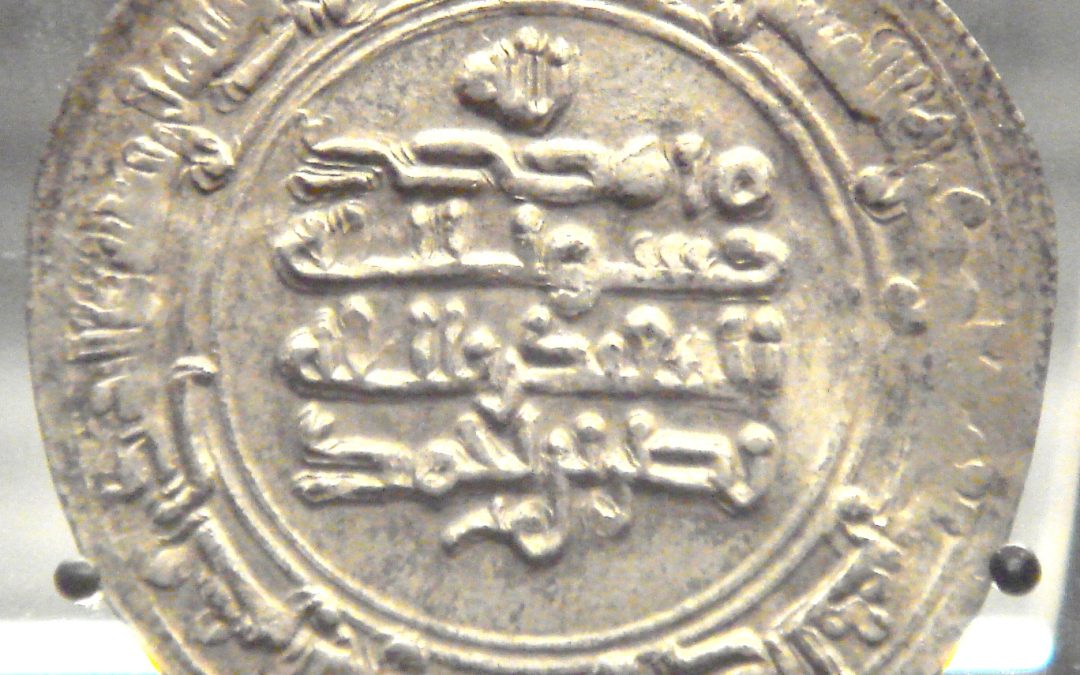
Pick up a Samanid dirham from the right century and you can almost make it out. Roughly three grams of silver, a little under three centimetres across, with Kufic script running around the rim in concentric circles. The one I have in mind is dated 921 or 922 CE, minted at Nishapur in Khorasan under the Samanid amir Nasr II. The obverse carries the Shahada and the name of the caliph in Baghdad; the reverse names the mint and the year. It looks, to a modern eye, like a coin from somewhere foreign and far away. It was, in fact, also a coin from your economy, if you happened to be alive in northern Europe in the tenth century and had any business exchanging money.
The reason has been visible on museum shelves for nearly two centuries, but it took recent geochemistry to say it cleanly. The silver the Vikings paid with — and cut into hacksilver bars when they ran out of coins, and melted into arm-rings to make portable wealth, and buried in hoards when the political weather turned bad — was, in overwhelmingly large measure, not Scandinavian silver at all. It was silver from mines in Iran, the Taurus Mountains, North Africa, and the western Tien Shan, struck into dirhams under the Umayyad and Abbasid caliphates, transported across Eurasia along routes the Norse did not control, and only then picked up by Scandinavian and Anglo-Saxon hands as the metal that was available.
The hard numbers are recent. In 2023, Stephen Merkel, Jani Oravisjärvi, and Jane Kershaw published a lead-isotope and trace-element study in Antiquity that analysed 111 precisely dated Umayyad and early Abbasid dirhams across the Islamic world and matched their chemistry to known ore deposits. The upshot was not what older scholarship had assumed: the dirhams that fed the medieval silver economy were not, contrary to a long-standing text-based story derived from tenth-century Arab geographers, dominantly mined in Arabia or Central Asia. The Umayyads got their silver initially from recycled Sasanian plate and coin, then from Iranian mines at Nakhlak and elsewhere in the Alborz and Sanandaj-Sirjan zones. The Abbasid mint at Baghdad, which by some estimates produced 40 per cent of the caliphate’s coinage across the eighth and ninth centuries, drew its distinctive silver from a deposit at Pirajman in the upper Euphrates watershed of the eastern Taurus Mountains — a militarily contested zone whose fortress sites, the authors argued, may have had as much to do with protecting silver mines as with the usual stories about frontier jihad. Later dirhams, from the Samanid heartland in Transoxiana, match ore signatures from the Ilak mining region on the western edge of the Tien Shan. None of this silver was Scandinavian, and almost none of it was minted within a thousand miles of a Norse longship.
What the Norse did with it was downstream work. They raided, traded, taxed, and tribute-collected their way into a position where they could intercept a fraction of a much larger flow. The famous Cuerdale Hoard, found by workmen repairing the Ribble embankment near Preston in 1840 and now mostly in the British Museum, contained more than 8,600 items — 7,000 silver coins plus ingots, hacksilver, and jewellery — buried between roughly 903 and 905 CE, just after the Norse had been expelled from Dublin. About a thousand of those coins were Anglo-Saxon, mostly from the kingdoms of Wessex and East Anglia, but a thousand were also foreign: Frankish denarii from mints in Touraine, Byzantine miliaresia, papal coins, Scandinavian issues from York, and a sprinkling of Kufic dirhams. The Vale of York Hoard (2007) and the Spillings Hoard on Gotland follow the same pattern, only more so: between them they shift the centre of gravity further north and east and pile up more of the Islamic component. The shape that emerges from a hundred such hoards is a thin Norse and Anglo-Saxon substrate of dirhams and hacksilver, datable to roughly a hundred-year window, sitting on top of a deep Eurasian monetary system the Norse never operated.
This is the part of the story I find genuinely worth sitting with. The popular image of the Viking Age is of self-sufficient raiders carrying their wealth out of the chaos of Christian Europe. The hoard dates, and now the isotope chemistry, say otherwise. The raids were the visible end of a long supply chain, and the people at the receiving end of the chain were downstream customers of an economy somebody else was running. A dirham minted in Nishapur, then transited through the Volga or the Dnieper or Caspian routes, and ended up in an Anglo-Danish hoard in Yorkshire, has crossed three political systems and at least as many languages — and at no point in that journey was the silver’s status as Islamic currency renounced. It was just used.
Two things then happen in the late tenth century that look, in hindsight, like the same event. The first is monetary. The mean age of incoming dirhams in new hoards climbs sharply after about 970 — old dirhams were still circulating, but new dirhams from the Samanid heartland were arriving in much smaller quantities. This is the lead-up to the eventual collapse of Samanid silver output, and the abrupt end of the Karakhanid conquest of Transoxiana in 999 dealt it the final blow. The second is hacksilver: across the same window, the proportion of cut and weighed silver — rings chopped into fragments, coins clipped, bars broken into weighed pieces — spikes in the surviving hoards. People were doing weight-based exchange because they had stopped getting whole coins. The thin layer on top was running out of substrate.
The political collapse of several Norse polities, especially along the Volga and Dnieper trade-route corridors that depended specifically on the Central Asian supply, sits inside that same window. The Volga route in particular had been the artery carrying Samanid silver into Scandinavia; when it thinned, the Rus’ principalities that had been its intermediaries lost the income stream that had organised them. They did not vanish — they would later be remade under different terms — but the system that had paid for them was no longer paying.
What replaced the dirham substrate, eventually, was something the Norse and English themselves had to invent: a native coinage economy under Æthelstan in the 930s and his successors, with the regulated recoinage and the unified English silver penny that gave the kingdom an internal monetary substrate of its own; tribute systems that converted political obligation into silver; and, later, the post-Norse state formations that could tax and mint for themselves. The substrate had been somebody else’s; the replacement had to be built in-house. It took a century of political and monetary improvisation to get there, and not every polity that depended on the old flow made it across.
The clean way to put it, which is also the way the numismatists like Noonan have put it for decades, is that the dirhams in a Cuerdale hoard are not the substrate of a Viking economy. They are the trace of a Eurasian one. The rings and the hacksilver the raiders stole and paid with were a thin layer stretched over a monetary system that someone else was running, all the way from the silver mines of Khorasan and the Taurus to the mints of Baghdad and Nishapur to the river routes of the Rus’. When the silver thinned out — and it did, sharply, in the 960s and 970s — the layer had to either find a new substrate or collapse. Most of it eventually did the former. Some of it did the latter.
Sources
- Merkel, S. W., Oravisjärvi, J., & Kershaw, J. (2023). “Sources of early Islamic silver: lead isotope analysis of dirhams.” Antiquity, 97(396), 1564–1580. https://www.cambridge.org/core/journals/antiquity/article/sources-of-early-islamic-silver-lead-isotope-analysis-of-dirhams/853EB2CBE002FE8ECFF7FF142D8CBB20
- “Cuerdale Hoard.” Wikipedia. https://en.wikipedia.org/wiki/Cuerdale_Hoard
- “Viking Age.” Wikipedia. https://en.wikipedia.org/wiki/Viking_Age
- Nasr II dirham, Nishapur mint, 921/922 CE (image). Wikimedia Commons. https://commons.wikimedia.org/wiki/File:Nasr_II_Nishapur_coin_921_922.jpg
