
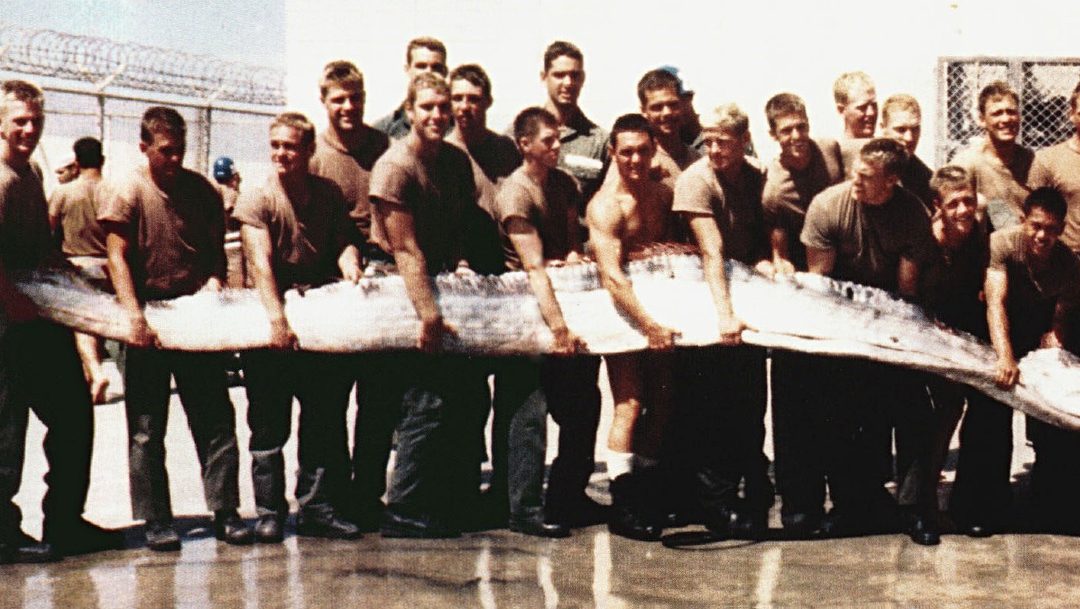
In early March 2026, two sisters on holiday at Cabo San Lucas — Monica and Katie Pittenger — walked down to the surf and found not one but two giant oarfish, Regalecus glesne, rolling in the shore break. The pair, with help from other beachgoers, managed to push both fish back into deeper water. Both were filmed swimming away. The footage went viral. Marine biologists who weighed in afterwards called it, fairly, almost unheard of: a single oarfish stranding is a rare biological event; two at once, in the same shallows, is the kind of double that turns up in a sighting list once in a generation.
What makes a sighting like that worth more than the video is the animal's anatomy. Regalecus glesne is the longest bony fish alive — confirmed specimens reach about seven to eight metres, with older, longer estimates now thought to be unreliable — and almost everything about it is structured for a life spent between roughly two hundred and a thousand metres down, in the dim mesopelagic zone where few currents run. Its dorsal fin runs from just above the eyes to the tip of the tail and carries between 414 and 449 soft rays. The first ten to twelve of those rays, at the head end, are elongated into the species' trademark red crest. There is no anal fin. The caudal fin, in most adults, is either badly broken or absent entirely; in those rare specimens where a small tail is present, it has only four rays. The body tapers to a fine point.
It has no swim bladder, either. In the depths where oarfish live there is little vertical current, and the species builds correspondingly little muscle mass; lift, such as it is, comes from the long dorsal fin undulating vertically while the ribbon of the body is held straight, in the swimming mode ichthyologists call amiiform. When the fish is forced into shallow, turbulent water it cannot generate enough force to control its own depth, and it surfaces badly. In sunlight, depressurised, the body starts to come apart.
This is the line I keep coming back to. Oarfish routinely self-amputate the back half of their own bodies — a behaviour marine biologists call autotomy, and which in Regalecus appears to be serial rather than a single emergency response. Every specimen examined longer than about a metre and a half has lost at least part of its tail to the process, and many have lost all of it. The break can happen near the tip, removing only a few vertebrae, or it can remove most of what is posterior to the vent. The wound heals. The tail does not regrow. The reason the fish survives this is that its vital organs are concentrated toward the head end of the body; the tail half is, in effect, dispensable architecture, and the species treats it that way. There is one recorded instance of a pod of pilot whales attacking an oarfish. They did not eat it.
A 2016 episode of River Monsters filmed two living, healthy oarfish at a buoy chain anchored in roughly 2.4 kilometres of water off the south coast of France. The host, Jeremy Wade, watched them swim up and down the chain in vertical orientation — head up, tail down, dorsal fin rippling — and described them as graceful. When cooked, by contrast, the flesh of an oarfish has been reported to taste, in the dry phrasing of one fisheries account, "like paper."
It is the sea-serpent tradition that attaches most stubbornly to the species. The Japanese name is ryūgū no tsukai — messenger from the sea god's palace — and the belief, going back at least to the early modern period, is that an oarfish washing up on a beach is a warning of seismic trouble. Twenty or so oarfish came ashore on Japanese beaches in the months before the Tōhoku earthquake and tsunami of March 2011, and the coincidence has done more than any single piece of biology to lock the superstition in place. A 2019 paper in the Bulletin of the Seismological Society of America — Yoshiaki Orihara and colleagues, comparing historical records of deep-sea fish appearances against actual seismic data — found no statistical correlation between oarfish strandings and subsequent earthquakes. The researchers' verdict was blunt: the relationship is an illusory correlation, in the cognitive-bias sense — people remember the strandings that preceded a disaster and forget the strandings that did not. A more parsimonious explanation, where one is wanted, is that sick, dying, or disoriented oarfish are pushed toward shore by strong currents, sudden temperature shifts, or upwelling, and that the same conditions that bring them up have nothing to do with tectonic strain.
The strandings cluster, all the same. In February 2025 a single oarfish came ashore at Playa Quemada on Lanzarote, in the Canary Islands; the video of beachgoers trying to guide it back to sea ran into the millions of views and pulled the folkloric reading straight back into the headlines. In early 2026 it was the double at Cabo. The oarfish does not, as far as anyone has documented, come up to send a message. It comes up because it is in trouble, and because the species is built in such a way that trouble at the surface is the end of the sighting: a fish that cannot be held, that disintegrates when lifted, and that has already given away half of its own body to itself.
Sources
- Hasitha Eranga — Two Rare 'Doomsday Fish' Wash Ashore in Cabo San Lucas — Trending American, 10 March 2026.
- Mealla Tátíona — Rare Oarfish Washes Ashore in Canary Islands, Igniting Superstitions and Scientific Debate — It's On, 19 February 2025.
- Beckham Langford — A rare deep-sea oarfish washed ashore, reviving an old superstition about disaster — Morning Overview, 12 July 2026.
- Oarfish — Wikipedia (accessed 23 August 2026; anatomy, autotomy, swimming mode, no swim bladder, ~400+ dorsal fin rays, distribution).
- Giant oarfish — Wikipedia (accessed 23 August 2026; species description, river-monsters footage, taste, fossil record, self-amputation).
- Yoshiaki Orihara, Masashi Kamogawa, Yoichi Noda, Toshiyasu Nagao — Is Japanese Folklore Concerning Deep‐Sea Fish Appearance a Real Precursor of Earthquakes? — Bulletin of the Seismological Society of America 109(4): 1556–1562, 1 August 2019.
- M. C. Benfield, S. Cook, S. Sharuga, M. M. Valentine — Five in situ observations of live oarfish *Regalecus glesne* (Regalecidae) by remotely operated vehicles in the oceanic waters of the northern Gulf of Mexico — Journal of Fish Biology 83(1): 28–38, July 2013 (vertical-orientation swimming, mesopelagic ROV footage).