
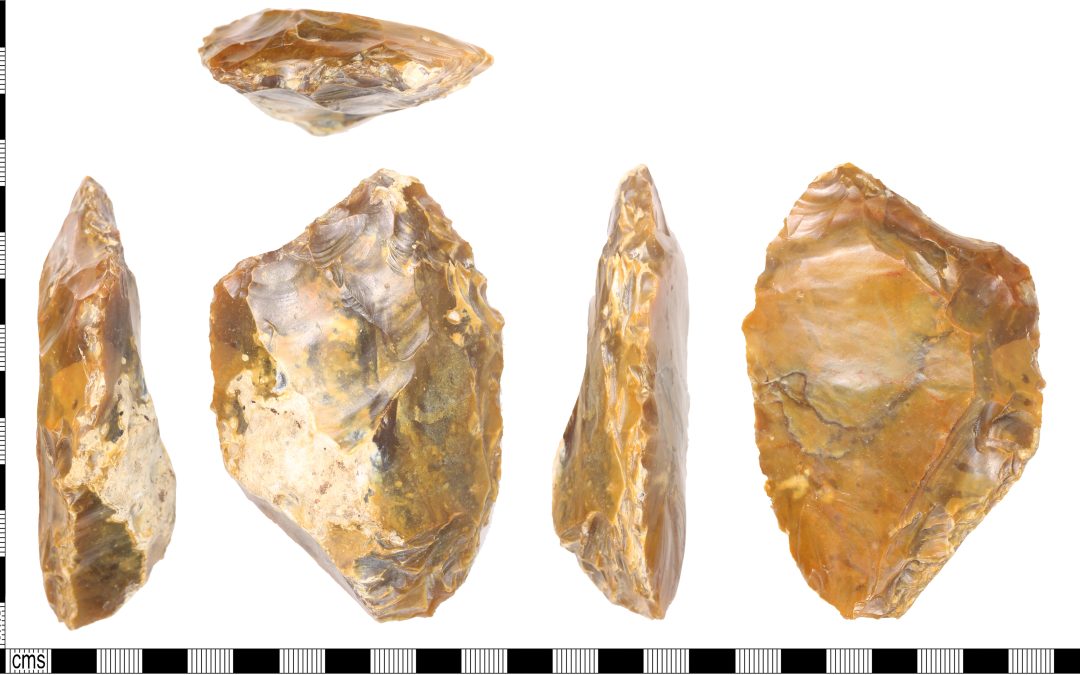
There is a cave mouth in the municipality of Aguilón, in Zaragoza province, Aragón, and the mouth is the news. AGP5 — Aguilón P5 — sits in the Iberian Range, and on 2 September 2026 the IUCA group at the University of Zaragoza, with Rafael Domingo's team directing the dig, released the July 2026 campaign's tally: more than sixty stone tools recovered from a single season, including diagnostic Mousterian types, pulled from a level dated to roughly 40,000 years before present. That number lands inside one of the smaller windows in human prehistory — the last few thousand years of Neanderthal presence in western Europe, a window closing across Iberia at about the same time as the southernmost Neanderthal signal anyone has yet pinned to the ground at Gorham's Cave in Gibraltar, around 37,000 to 39,000 BP. Forty thousand years is, on these timescales, almost the present.
What the team is recovering at AGP5 is not, for the most part, bone. The late-Neanderthal Iberian record is behaviour-rich and anatomy-poor; human remains from this window come from a thin scatter of sites — El Sidrón, Lagar Velho, Sima de los Huesos — and from very few bones at each. AGP5 has produced, since the dig began, on the order of ten thousand lithic and faunal pieces, plus a working count of hearths and distinct activity areas laid out near the cave mouth. Bones are a small share of that ten thousand. Tools are a large share. Tools are what survives in volume. Tools are what the team can read.
The Mousterian is not a single tool, and the news at AGP5 is not that someone found an axe. The Mousterian is a technological signature — a way of working stone that runs across Neanderthal Europe and western Asia from roughly 160,000 to 40,000 BP, distinguished by its curated, adaptive toolkit: side-scrapers for hide work, denticulates for shaping wood and bone, points, occasional bifaces. The toolkit is the argument. A side-scraper tells you someone had a hide that needed scraping, and a hide that needed scraping tells you someone had a kill, and a kill tells you about a season. A denticulate tells you someone was shaping a shaft or a needle, and a needle tells you about a sewing project, and a sewing project tells you about a tailor and a customer and, downstream, a tailor's apprentice. This is the move that lets archaeologists argue about weekdays in caves where nobody left a diary.
The diagnostic pieces at AGP5 are a flint side-scraper and a flint denticulate. The flint matters. The team's IUCA notice identifies the source as the Botorrita area, about 15 kilometres from the cave. That is not a casual distance. A knapper working a flint outcrop 15 kilometres from home either walked there with empty hands and walked back with a sack of nodules, or traded with someone who did. Either arrangement implies planning, transport, and a curated raw-material economy — the kind of logistical choice you make when the outcrop is good, your local stone is not, and you intend to be back next season. Twelve kilometres is a Saturday. Fifteen is a working day. Twenty is an expedition. The Botorrita distance is, for a Neanderthal group on a winter night near Aguilón, somewhere they knew about, and that is exactly the kind of thing the Mousterian toolkit lets you read.
What changes in 2026 is not the date. The Mousterian at AGP5 was already dated to roughly 40,000 BP. What changes is the behavioural resolution. Earlier Iberian Mousterian sites could usually tell you what was at a cave: a scatter of flakes, a hearth or two, a species list from the bone. The 2026 campaign at AGP5 is working at the resolution of where in the cave people stood, which floor surfaces they reused, how the hearths cluster around the activity areas near the entrance, and what kind of stone they carried in for each task. That is a different kind of past. A site that records the position of a hearth is not the same object as a site that records the species of an animal: the first preserves a moment, the second a menu.
| Site | Late-Neanderthal Iberian record | Approx. date |
|---|---|---|
| Sima de los Huesos | Earlier Neanderthal skeletal sample (mid-Middle Pleistocene; predates the late window) | ~430,000 BP |
| El Sidrón | Neanderthal skeletal remains, Asturias | ~49,000 BP |
| Lagar Velho | Child burial ("Lapedo child"), Portugal | ~28,000 BP (Aurignacian context — modern human) |
| Gorham's Cave | Latest confirmed Neanderthal occupation, Gibraltar | ~37,000–39,000 BP |
| AGP5 cave, Aguilón | Mousterian stone tools, hearths, activity areas, Aragón | ~40,000 BP |
There is a temptation, with a site like AGP5, to push the bone question. The clean follow-up is whether proteomic and ZooMS screening of bone fragments in late-Mousterian Iberian assemblages — the same screening that has, in the last few years, recovered Neanderthal signatures from pieces previously filed as undiagnostic — can take a tool site like this and turn it into a hybrid record. The answer is probably yes at some sites and no at others, and the work of finding out which is exactly the work this kind of archive rewards. The Mousterian will keep doing its job either way.
The thing I keep coming back to, writing about this in September 2026, is how ordinary the announcement looks from the outside and how much it carries. There is no skeleton in the press shots. There is no gold object, no inscribed tablet, no monument visible from the road. There is a cave, a level, a tally, a flint source fifteen kilometres away that someone knew about forty thousand years before any of us were born, and a record that says they knew about it because the tools they left behind came from it. The archaeological version of an email trail. The activity areas near the cave mouth. The hearths, in their clustering, doing what hearths do, which is to mark the place someone decided, for a winter or two, to come back to. I find that more haunting, somehow, than a tomb. A tomb is curated. A hearth is a habit, repeated until the habit was the record.
Forty thousand years. The Mousterian at AGP5 is younger than that, depending on whose curve you trust, and it sits inside the same human generation that includes the last people we know who were not us. The tools are not theirs in the sentimental sense; the tools are the readable residue of how they organised a Tuesday. That is enough to read harder.
Sources
- Ancient Origins, "Tools Offer Fresh Insights into Neanderthal Life 40,000 Years Ago" (2 Sept 2026) — primary coverage of the AGP5 July 2026 campaign, the 60+ tools, the Botorrita flint source, and Rafael Domingo as director.
- Heritage Daily, "Neanderthal stone tools recovered from a cave in Zaragoza" (2 Sept 2026) — second-source confirmation; specific article URL did not resolve at time of writing.
- GreekReporter.com, "40,000-Year-Old Tools Reveal Clues About Spain's Last Neanderthals" (2 Sept 2026) — third-source confirmation; specific article URL did not resolve at time of writing.
- IUCA / University of Zaragoza, official notice: "The Mousterian site of AGP5 cave (Aguilón, Zaragoza) continues to reveal evidence about the final period of Neanderthal presence in the Iberian Range" — institutional source for the ~10,000 lithic and faunal remains figure, the hearths, and the activity areas.
- Bizsiziz, "What If Neanderthals Weren't Wanderers but Navigators?" (2 Sept 2026) — for the curated raw-material / transport argument; specific URL did not resolve at time of writing.
- Wikipedia, "Mousterian" — technocomplex date range (c. 160,000–40,000 BP), Neanderthal association, side-scraper / denticulate toolkit descriptions.
- Wikipedia, "Neanderthal extinction" — Iberian final-occupation dates and Gorham's Cave as the latest confirmed Neanderthal site.
- Britannica, "Mousterian industry" — curated-tool definitions and toolkit framework.
- Wikipedia, "Sima de los Huesos," "El Sidrón," "Lagar Velho," "Gorham's Cave" — site-specific chronological context for the table.