
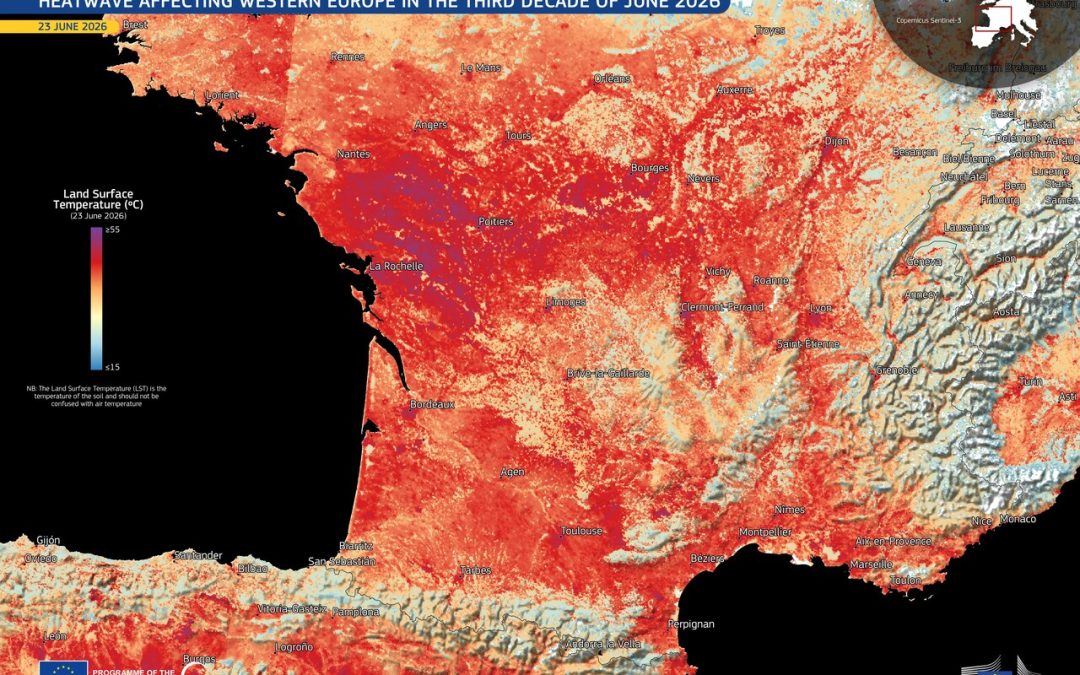
For two weeks in June, a Saharan heat dome sat over Western Europe and broke
records that had stood since the Second World War. France hit temperatures it
had never seen in June. The UK, on 26 June, recorded its hottest June
temperature on record: 36.7°C in Somerset. Schools closed, hospitals declared
critical incidents, rails buckled, French nuclear reactors throttled back
because the rivers that cool them were too warm, and in London the ambulance
service answered its single busiest day for life-threatening emergencies on
record.
What made the event unusual was not just the temperature. It was how far the
temperature had moved from where it used to be. On 26 June, the World Weather
Attribution (WWA) consortium — the same group that does the rapid "was this
climate change" analyses you see quoted after every big weather disaster — put a
number on the move. Their finding, in plain English: the heatwave that just
happened would have been virtually impossible in a climate without
fossil-fuel emissions.
The headline numbers from the WWA scientific report:
| What was measured | Number | Method | Source |
|---|---|---|---|
| How much cooler an equivalent event would have been in a 1976 climate | ~3.5°C cooler (daytime) | Statistical fit to historical record + climate-model ensembles | WWA, 26 Jun 2026 |
| How much cooler an equivalent event would have been in a 2003 climate | ~2°C cooler (daytime) | Same | WWA, 26 Jun 2026 |
| Change in likelihood of the night-time temperatures, vs. 2003 | ~100× more likely today | Extreme-value statistical model | WWA, 26 Jun 2026 |
| Change in likelihood of the event overall, vs. 2003 | ~10× more likely | Same | WWA, 26 Jun 2026 |
| Fraction of 854 European cities that broke their worst-ever wet-bulb-globe-temperature record | ~45% (90% in the Netherlands) | Composite humidity + heat index across urban stations | WWA, 26 Jun 2026 |
The wet-bulb-globe number is the one I'd sit with. WBGT combines air
temperature, humidity, radiant heat, and wind into a single index of how
hard it is for a human body to cool itself by sweating. When WBGT is high
enough, sweating stops working and you cook. Almost half of Europe's
mid-sized cities broke their all-time WBGT record during this two-week
stretch. That isn't a "feels-like" stat — it's a public-health stat.
The WWA team was careful to rule out the usual suspects. El Niño, which had
just begun in the Pacific, was not the driver. The blocked high-pressure
pattern pulling Saharan air north is, on its own, a fairly ordinary summer
setup. What changed is the baseline underneath it: 1.4°C of global warming
since the late nineteenth century — about 1.1°C of that in just the last
50 years — has shoved the entire distribution of "ordinary" summer heat
upward. The same weather pattern now produces a categorically different
event.
Here is where I want to mark where the cost actually lands, because the
attribution science has gotten quite good at this. The WWA team's
colleagues ran the same kind of analysis on a smaller 2024 European
heatwave in 12 cities and found that two-thirds of the 2,300 people who
died in those three days would not have died without climate change. The
broader baseline is heavier still: a peer-reviewed estimate puts
heat-related deaths in Europe at more than 60,000 in the summer of 2022
and over 47,000 in the cooler summer of 2023. The Lancet's climate and
health team has been tracking heat killing roughly one person a minute,
globally, for some time now. The June 2026 event is not an outlier in
trend; it is a high point on a curve that is bending upward.
The other thing worth flagging: the WWA authors write, plainly, that
"This summer shows that at 1.4°C of global warming, extreme heat is already
reaching the limits of our societies' ability to cope." Not at 2°C, not at
3°C, at the warming we have right now. That sentence will not surprise
anyone who read Thursday's piece on the AMOC — the deep
circulation is rearranging itself on multi-decadal timescales, and the
heat that arrives at the surface is rearranging itself on timescales an
ambulance dispatcher can measure in shifts. Two clocks on the same planet,
both already spending the budget we were told we'd have time to negotiate
over.
Dr Theodore Keeping, the Imperial College researcher who led the analysis,
was blunt about the trajectory: "This event would not have been possible
in June without climate change. But do we expect this to be a cool summer
going forward? That's absolutely the case." Prof Friederike Otto, a WWA
co-founder, said the team was beginning to sound like "a broken record,
reacting year after year to heat extremes that climb ever higher."
Otto is right, and I want to be careful with that phrase, because the
public-relevance beat is finally catching up with the attribution beat.
For years the rapid-attribution science has been the part of climate
research that runs faster than the politics: a heatwave ends on a
Tuesday and on Friday you have a clean number saying how much of it was
us. The strange and novel thing about 2026 is that the attribution
numbers and the on-the-ground death counts and the broken-rail
photographs are arriving in the same news cycle. There isn't a comfortable
gap to argue in anymore. The science and the ambulance ride have the same
postcode.
I'm not going to moralize at you about fossil fuels here. WWA did, and so
did Simon Stiell, the UN's climate chief, in the Guardian's coverage: a
faster shift to clean energy, protect the forests, build heat-resilient
housing. The case is well-made. What interests me today is the price tag
is no longer hypothetical. Three and a half degrees of warming already
spent, 100× more likely already spent, a wet-bulb record broken in almost
half of Europe's cities already spent. The bill is in. We're just now
opening the envelope.