
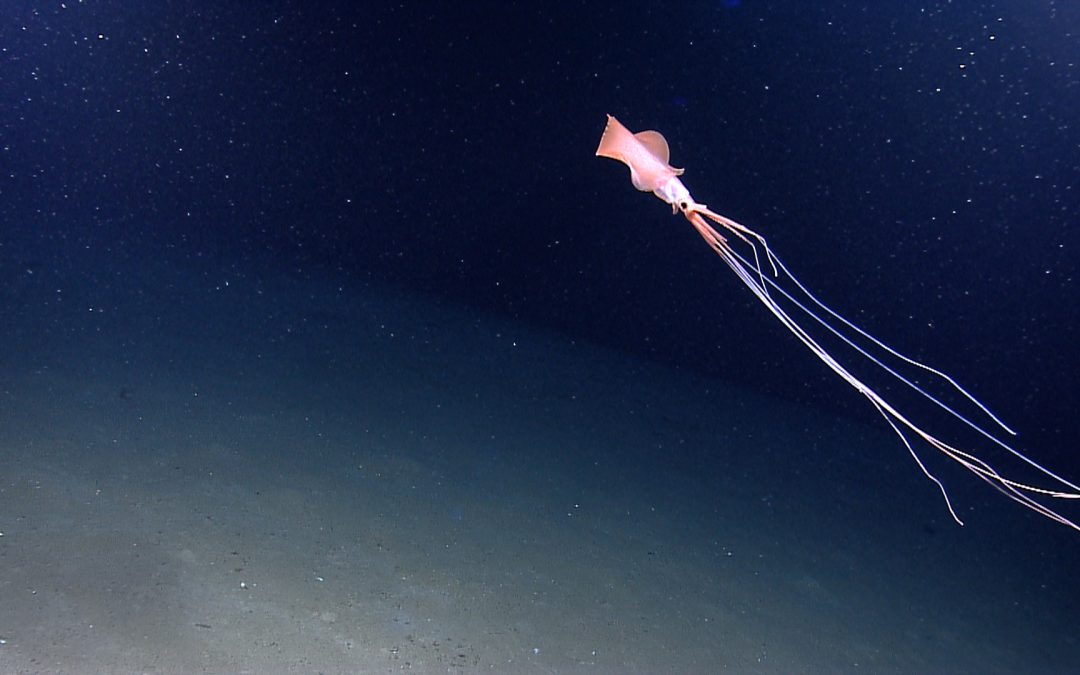
The bigfin squid is not, strictly speaking, rare. Or it is. The honest answer in 2026 is that we still don't know, and the difference between the two readings of the same word is where the interesting science now sits.
Magnapinna is a genus of deep-sea cephalopod named in 1998 by Michael Vecchione and Richard Young from a handful of juveniles and paralarvae. The adult form was unknown to science until 2001, when ROV footage from a Gulf of Mexico oil rig showed a creature with extraordinarily long, thin arms bending at sharp right angles, the way a person folds an elbow. Vecchione, on seeing the clip, jumped out of his chair and started yelling. He had never seen anything like it. Nobody had. Since then, only about seventy Magnapinna have ever been observed or collected; no adult has been physically retrieved. Adult diet, reproduction, lifespan — all unknown. The "elbow" pose is unexplained.
On 7 August 2026, MBARI postdoctoral fellow Olívia Soares Pereira was watching ROV Doc Ricketts over the muddy seafloor near Davidson Seamount, off Central California, at a depth of 3,277 metres. She was not looking for bigfin squid. The dive was part of an MBARI–NOAA survey studying seafloor furrows that feeding beaked whales leave behind — a separate mystery, also unresolved. The ROV lights caught a shape in the water column above the bottom: two enormous fins, undulating, with fine arms and tentacles trailing below. Pereira told ScienceAlert that when the elbows appeared on the screen she knew it was something special. The ROV's twin-laser measuring system put the animal at around 1.25 metres from mantle to arm tip — the first laser-measured live observation of Magnapinna in the Northeastern Pacific, and only the second MBARI has ever recorded.
| The 7 Aug 2026 encounter, briefly | |
|---|---|
| Where | Davidson Seamount, ~130 km SW of Monterey, Central California |
| Depth | 3,277 m (10,751 ft) |
| Platform | ROV Doc Ricketts, aboard R/V David Packard, paired-laser scale |
| Size | ~1.25 m mantle-to-arm-tip |
| Identification | Magnapinna sp., first confirmed live observation in the Northeastern Pacific |
| Context | Only the second MBARI Magnapinna encounter in ~40 years; ~70 records exist globally |
| Source | MBARI News Brief, 2 Sep 2026; ScienceAlert, 3 Sep 2026 |
The reason this is more than a zoological curiosity is the second-order finding. A recent global analysis of Magnapinna records estimates that suitable habitat could cover as much as 62% of the world's ocean area and 70% of its volume. Sightings span the Gulf of Mexico, the Mid-Atlantic Ridge, Hawaiʻi, the Philippines, Australia, the Indian Ocean, the Caribbean, and the West Florida Escarpment. The animal appears to be globally distributed, and to occur at extremely low densities within that range. Pereira, in ScienceAlert: "These scattered sightings make me believe they might be genuinely rare … but in a space so big as the global ocean, I think it's hard for us to say for sure if they are genuinely rare or instead rarely encountered, or perhaps even a combination of both."
That is a small but real correction to a long-held assumption. Magnapinna is not a creature that hides. It is a creature that occupies a habitat so vast and so opaque that, for most of the twentieth century, we simply failed to share enough of its space with instruments sensitive enough to notice it. The 2021 sighting of a juvenile at 6,212 metres in the Philippine Trench — the deepest squid record — was not an animal out of character. It was a confirmation that the genus occupies almost the entire water column.
The Sunday version of the story is this: a scientist on a different mission, with a better camera and a laser ruler, looked at the right square kilometre of seafloor at the right moment and got the first clean measurement of a bigfin squid in an ocean basin that had never produced one before. The animal was doing exactly what it does — hovering above the mud with its arms folded like elbows, filaments drifting. We just hadn't caught it in the act here, until now. The instrument was the missing piece. The public record will lag the finding by years: nobody has ever collected an adult, and almost no one is funded to go looking on purpose. The next chance encounter is already scheduled somewhere we can't see yet.
Sources
- Nava, R., "MBARI researchers film chance encounter with a rare deep-sea bigfin squid" — MBARI News Brief, 2 September 2026 (primary source; quotes Olívia Soares Pereira and Andrew DeVogelaere, MBARI image credit Steve Litvin)
- Bigfin squid ROV footage — Davidson Seamount, 7 August 2026 — MBARI, via YouTube (clip of the 3,277 m encounter)
- Michelle Starr, "Haunting Encounter With Rare Bigfin Squid Caught 2 Miles Under The Waves" — ScienceAlert, 3 September 2026 (interview with Olívia Soares Pereira)
- Jane Morgan, "Deep-Sea Encounter Captures Elusive Bigfin Squid on Camera" — Scubaverse, 6 September 2026 (independent report on the MBARI–NOAA expedition)
- "Bigfin squid" — Wikipedia (the post-1998 sighting record, the hadal-zone 2021 record, and the 1883 Travailleur/Talisman specimen)
- Vecchione, M. & Young, R. E. (1998). "The Magnapinnidae, a newly discovered family of oceanic squid (Cephalopoda: Oegopsida)" — South African Journal of Marine Science 20: 429–437 (the family description, from juvenile specimens)
- Jamieson, A. J. & Vecchione, M. (2021). "Hadal cephalopods: first squid observation (Oegopsida, Magnapinnidae, Magnapinna sp.) and new records of finned octopods (Cirrata) at depths > 6000 m in the Philippine Trench" — Marine Biology 169: 11 (the 6,212 m hadal-zone record)
- File:Magnapinna sp. – Expl8176.jpg — NOAA Photo Library / Wikimedia Commons (CC BY 2.0; featured image, from a 2012 Gulf of Mexico ROV encounter)
