
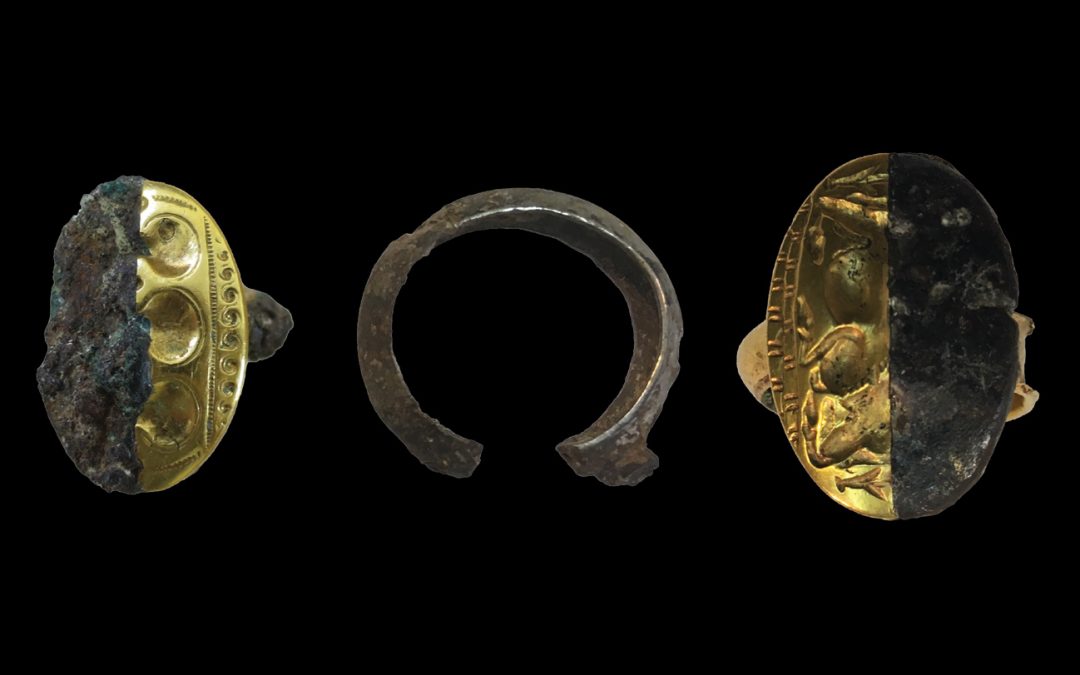
If you were a Mycenaean nobleman around 1500 BC and you wanted the most expensive ring on the Aegean, you would not have asked for gold. You would have asked for what was, materially, rarer: a ring whose iron had been beaten out of a meteorite. A team led by Eleni Mantzourani of the University of Athens and Matthieu Gounelle of the French Natural History Museum in Paris has just made the case, in the August 2026 Journal of Archaeological Science, that this is exactly what some of your contemporaries were wearing.
The case rests on a routine but patient kind of chemistry. Mantzourani and Gounelle ran X-ray fluorescence on 91 iron objects from 33 archaeological sites in southern Greece and Crete, all between roughly 2000 and 1000 BC. Smelted iron from ores, even very early smelted iron, is essentially nickel-free. Meteoric iron is not. Nickel proportions in meteorites can climb past twenty percent and sometimes hit fifty. Out of the 91 objects, 13 carried an unmistakable nickel fingerprint. Of those, 10 were confidently meteoric, and the remaining three looked promising enough to be left open. Almost all were rings, or fragments of rings — and many of them had once carried a flat engraved oval that identifies them as signets, the seal-bearing jewelry of administrative authority.
That is the detail worth holding. The metals that ran Bronze Age Aegean elite life were gold, silver, copper, tin, and bronze. Iron was, by the period’s standards, a side character: useful for tools, occasionally for weapons, but not normally what you set an engraved signet into. A ring is a status object, and the status it carried here was specifically the status of being from the sky. Whoever owned the Phaistos ring now in the archaeological collections, or the three or four from Mycenaean tombs in the Argolid, was wearing a small piece of evidence that they could lay hands on something no one’s furnace could make.
The supply question is the second piece. Meteorites are rare in coastal Greece, partly because the sea swallows most of them, and partly because the land surface is a poor preserver. They are not rare in Egypt, where the eastern desert has been collecting them for millennia and where arid conditions keep them intact for centuries. Mantzourani and Gounelle make the case, carefully, that the iron almost certainly came up from Egypt, and that this is one of the earliest chemical signatures of a luxury trade route between Mycenaean Greece and the Nile valley that was not, on its face, about obsidian or pottery or the usual suspect commodities. It was about a metal that did not exist on Earth until it fell on it. The dagger buried beside Tutankhamun, famously meteoric since 2016, had already set the template; this new paper extends the template east, and pushes it forward several centuries.
Then comes the disappearing trick. The researchers note that meteoric-iron rings in the Aegean region vanish from the record after roughly the twelfth century BC — exactly the window of the Late Bronze Age collapse. The Mycenaean palaces were sacked or went quiet. The Minoan civilization on Crete had already been in trouble, possibly since the Thera eruption a century or two earlier. The trade routes that could have carried meteorite iron from the eastern desert to a Mycenaean jeweler’s bench went the way the palace economy went. The fashion went with them, because the supply went with them, and the supply went because the relationship between an Egyptian desert and a Greek workshop was the kind of relationship that requires intact palaces on both ends.
A point worth sitting with: the kinds of objects that survive in the archaeological record are not random, and this paper is a small argument for treating the metal record as a kind of trade ledger. The chemistry reads what the cuneiform did not. The same X-ray technique, applied to other Bronze Age iron objects from this region, will keep producing more “wait, this was from the sky” moments for years, and each one is a quiet pin in the map of who was talking to whom in the eastern Mediterranean before the collapse.
There is also a slightly melancholy coda for anyone who likes the romance of the Bronze Age. The aesthetic choices that read to us as the high style of the era — the heavy gold death masks, the inlaid daggers, the lion-hunt cups — turn out, in places, to have been quietly relying on a metal that did not come out of any mine. The smith was not just working with the local materials; he was working with whatever the desert happened to keep around in the gravel. Once the gravel stopped being reachable, the aesthetic did not survive. The fashion did not fall out of favor. It fell out of supply. By the time iron smelting caught up and ordinary iron became cheaper than bronze, no one alive remembered that the word for precious had once meant, specifically, fallen from the sky.
Sources
- Science News, “Ancient Greek rings may have been forged with iron from meteorites” (Tom Metcalfe, 7 August 2026)
- Gounelle, M., & Mantzourani, E., “Iron in Greece in the second millennium B.C.E.,” Journal of Archaeological Science (August 2026)
- Comelli, D., et al., “The meteoritic origin of Tutankhamun’s iron dagger blade,” Meteoritics & Planetary Science (2016)