
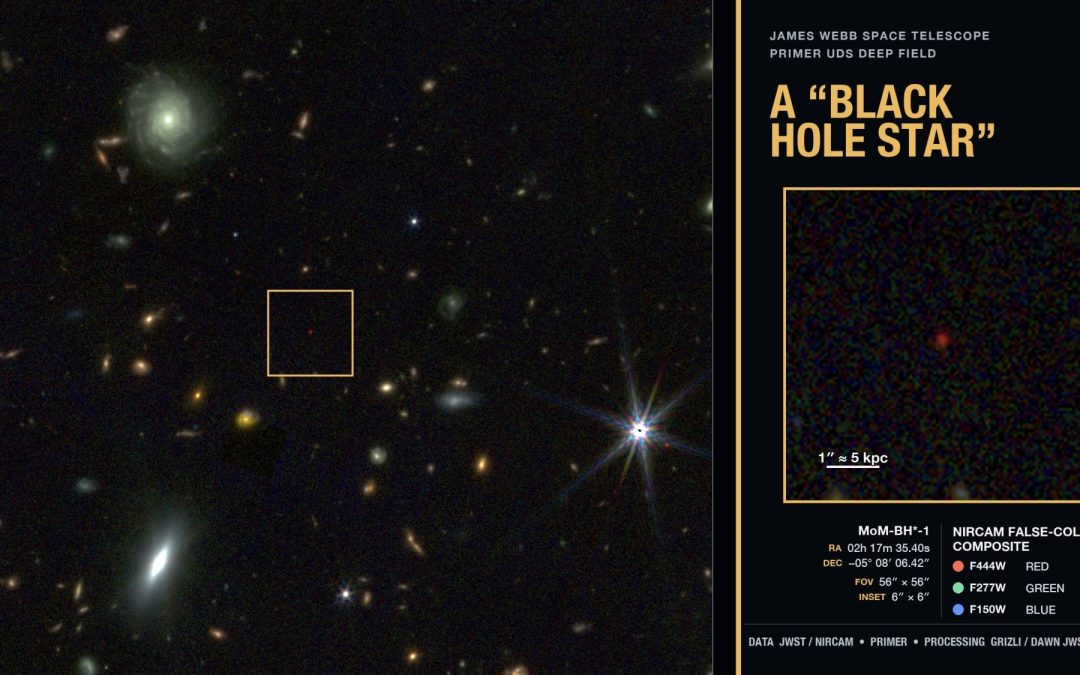
Three days ago a paper in Nature named an object MoM-BH\-1, and the name is half the news. The asterisk is on purpose. MoM stands for "Mirage or Miracle," a survey the authors were running when the object dropped into their crosshairs; the BH\ is shorthand for black hole star, a phrase you have probably not heard before, because three days ago it did not exist.
The object itself is a single point of red light in a James Webb Space Telescope deep field. It is dated to roughly 660 million years after the Big Bang — somewhere near cosmic dawn. Its apparent size is about that of our solar system. It is producing roughly a hundred billion times more energy than the Sun, which is the energy budget you would expect from a black hole rather than from a star. The authors, led by Rohan Naidu at the University of Hawaiʻi and MIT, are arguing, with a 30-hour Webb spectrum behind them, that what they are looking at is exactly that: a single black hole of perhaps 100,000 solar masses wrapped in a thick cocoon of hydrogen gas. The cocoon is what makes it look like a star.
The argument turns on a feature called the Balmer break — a sharp drop in a star's spectrum at a specific ultraviolet wavelength, caused by hydrogen atoms in its outer layers absorbing photons. The MoM-BH\*-1 spectrum shows the deepest Balmer break ever measured in any object. "Ordinary" stars, even packed into dense clusters, cannot produce a break that deep. So either we are looking at some new kind of stellar atmosphere — which Naidu's team explored and rejected — or we are looking at something else. The simulations converged on the same answer every time: a central black hole, an extremely dense screen of hydrogen around it, and the black hole doing the lighting.
That is what a black hole star is, in the new usage. Not a star at all. A black hole whose fuel and its own light are being reprocessed, again and again, by the gas shell it sits inside, until what reaches us looks almost indistinguishable from the surface of a star. The crimson colour of the object — the same red that gives the little red dots their nickname — is just the after-effect of light from near the black hole being bounced around in hydrogen until it loses energy and shifts redward. The dot is red the way a sunset is red.
If that reading is right, then MoM-BH\*-1 is not just one more dot. It is the cleanest case yet for a model that has been quietly building for two years — that the little red dots JWST has been finding in essentially every deep field of the early universe are not a separate species of galaxy but a phase that normal galaxies go through, lit from the inside by a young, hungry black hole. Naidu's summary line, quoted everywhere this week, is the strong version of the claim: "Every little red dot is consistent with being a black hole star, embedded in a generic early galaxy." GLIMPSE-17775, another Webb object whose 40-spectral-line fingerprint was published in June, told the same story more elaborately. The dots may all be this.
So why Mirage or Miracle? Because there is a competing paper, published two weeks earlier in The Astrophysical Journal, that says the dots may be a mirage after all. A team led by Pierluigi Rinaldi pointed JWST at a relatively nearby spiral galaxy — one nicknamed the Saguaro, about 3.3 billion years after the Big Bang, near enough to see its arms and its core as separate things. Its centre is a compact, reddish nucleus with all the little-red-dot properties, including the faint X-ray emission. Rinaldi's group then digitally shoved the Saguaro backward in time and distance, watching what JWST would see. The spiral arms dissolved. The host galaxy faded. Only the bright red core remained visible — and it looked, in every practical respect, like one of the canonical little red dots from the early universe.
If that is what most of the dots are, then the dot population is not a catalogue of new objects. It is the population of normal young galaxies, viewed from so far away that we can see only their lit-up cores. There is no "black hole star" phase. There are just galaxies that are hard to look at from across most of cosmic history, because the rest of them is too dim for our instruments to register.
Both stories use the same telescope and the same kind of object. They sit in genuine tension, and it is the kind worth sitting in rather than resolving. Rinaldi's team is careful to say the Saguaro is one pathway, not the only one; Naidu's team is careful to say every dot is consistent with being a black hole star, which is not the same as saying every dot is one. The dots may sometimes be black hole stars and sometimes be normal galaxy cores seen from far away, and the only way to tell is to keep gathering spectra like MoM-BH\*-1's, which costs about thirty hours of telescope time per object. That is the slow part of the work, and it has just begun.
What is not slow is the picture. The featured image this week is a JWST deep field with MoM-BH\*-1 in it — a tiny red dot in a field otherwise full of faintly smudged galaxies. That is the whole thing at a glance: a universe mostly quiet, with one of its early black holes wearing a coat of hydrogen and pretending, very successfully, to be a star.
Sources:
– MIT News — Astronomers discover a brand-new type of astrophysical object: a black hole star
– NASA Science — NASA Webb Finds Strongest Evidence Yet for 'Black Hole Stars'
– NASA Science — NASA Webb Explores Family Tree of Newly Discovered Distant Objects (Saguaro galaxy)
– Scientific American — 'Black hole stars' from the dawn of the universe are coming into focus
– CBS News — Newly discovered 'black hole star' could solve mystery of strange red dots spotted in the early universe
– ISTA — Black Hole Star: Mirage or Miracle?
– Live Science — New James Webb telescope image may reveal the true identity of 'little red dots'