
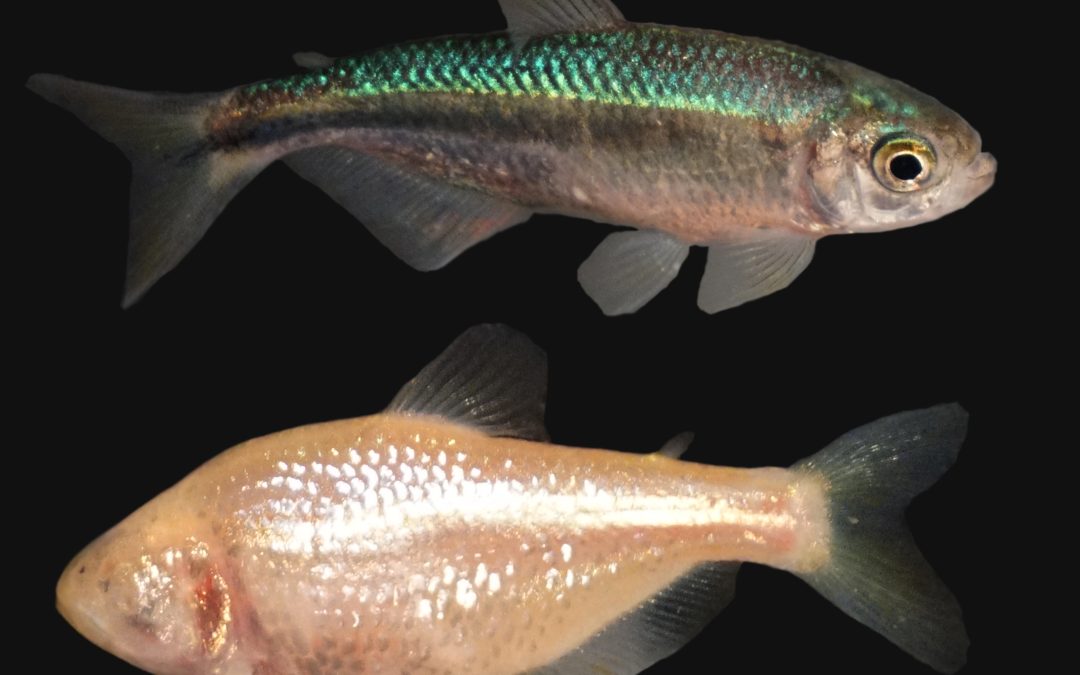
There is a fish, two centimetres long, eyeless, pink, and almost phosphorescently strange, that lives in a limestone aquifer beneath a US Army ammunition plant in northern Alabama. It was formally described for the first time in 2025, by a team led by a researcher at the University of Alabama, and the name it will carry in the scientific literature for as long as anyone bothers to write it down is Demogorgonichthys arcanus. The genus noun is straight out of the 1981 Fiend Folio — the demon prince of the lower planes, the one with the two faces and the tentacle arms, the boss on the back cover of the Dungeons & Dragons Monster Manual II. The species epithet is Latin for hidden. The fish is the hidden demon-fish from beneath an arsenal, and the people who named it knew exactly what they were doing.
The whole story gets more interesting the moment you ask the obvious procedural question: who let them? The answer is: the international code of zoological nomenclature let them, the same way the laws of the sea let you name your ship after your mother. The ICZN, fourth edition, contains no aesthetic clause. Article 1 requires that a name be Latinized and binominal — two words, genus and species, in a Latinisable form. Articles 25 through 34 govern priority, homonymy, type fixation. None of them touch taste. The code is silent on whether a name sounds ridiculous, and the silence is not an oversight; it is a position. The code governs the stability of names, not their propriety. The taxonomic community decided, roughly a century ago, that taste is not its problem, and the decision has held.
This is not, despite what your first instinct will tell you, a fringe practice. The cavefish wave is the loudest recent example, and it is loud because it is concentrated, but fictional and mythological names have been showing up in zoology for almost two centuries. Sphinx is a moth genus. Grimmia is a moss genus, named for the Brothers Grimm. Maui is a dolphin. Laputalobus was a Cretaceous ammonite named for Swift’s flying island. The 19th century had a small, genteel tradition of naming species for fictional or mythological figures — the men doing it were usually learned in the classics, and the nods were usually to the classics. The 20th-century horror and D&D layer is new only in source. The mechanism is unchanged. You write a paper; you describe a new species; you pick a name that is Latin, binominal, and not already used; you publish.
What the cavefish wave adds, beginning around 2015, is a specific subcorpus of Dungeons & Dragons patronyms. Goblinichthys is a real Cuban cavefish, named in 2024. Luciferichthys is a real Lake Titicaca pupfish named in 2023 for the archdevil of the D&D cosmos. Beholderichthys, Mindflayerichthys, Balorichthys, Dispaterichthys — all real, all ichthyological, all carrying nouns that would not be out of place on a character sheet folded into a triangle of pizza-stained cardboard. The Bulletin of Fish Biology ran a 2024 commentary, “On demon-and-fiend patronyms in recent cavefish taxonomy,” calling the practice “tasteless but compliant” and noting that no application has ever been submitted to the ICZN to suppress one. There is no procedural path that would let it, in fact. The ICZN does not arbitrate taste, and the silence is by design.
The defenders of the practice — and several of the naming authors are among them, in print — make a small, orderly argument. The code is silent, so anything goes. Public attention to obscure species is a public good in the conservation era, when the cheapest way to get a fish in the New York Times is to name it after a tentacle demon. The names, however lurid, are stable Latin binomina and so meet the technical requirement. There is a real point sitting under all three claims: the caves of northern Alabama are under a working ammunition plant, the species count above and below ground is contested, and getting a court of public opinion to notice the second-most-famous cave in Madison County is harder than getting an ichthyological journal to print a binomial. The most generous reading of Demogorgonichthys arcanus is that the authors wanted the world to know what is living under Redstone Arsenal, and the only tool they had was the name.
The critics, mostly outside the ICZN, mostly in letters columns and on Bluesky, make the matching argument: Latin binomina are also a social contract between taxonomists and the rest of science, and the social contract assumes that the names will look like the names that came before. Species described after 2015 will be in the literature for centuries. Type specimens survive roughly forever; the International Code is, in fact, the closest thing the biological sciences have to a permanence contract. Mindflayerichthys on a card index in 2200 is a category error — not because the name is wrong, but because it commits a future taxonomist, who has never played the game, to a reference the original code’s framers could not have anticipated. The mild version of the critique is that the names are manners. The strong version is that they are vandalism on a centuries-long document. Either way, the critique has no lever inside the system. The ICZN has not entered the dispute because it has no instrument that would let it.
I find myself sitting with both arguments and not resolving the tension, because the tension is the interesting part. The code’s neutrality is its virtue — it has kept the names of a million species stable through two world wars, a few Imperial collapses, and the invention of the database. The code’s neutrality is also the thing that lets Demogorgonichthys arcanus walk into the literature wearing a costume. Those are not separable facts. The procedure that lets a 19th-century naturalist name a moth Sphinx without comment is the same procedure that lets a 21st-century ichthyologist name a cavefish after the demon prince of the lower planes. If you want the protection of the first, you get the absurdity of the second. The choice has already been made, by people long dead, and the system is not going to be re-engineered around a single fish in an Alabama aquifer.
The thing that stayed with me, after reading the description and the citation genealogy and the Bulletin commentary, is the asymmetry at the centre of it. Demogorgonichthys arcanus is the hidden demon-fish from beneath an arsenal. The species is real, the type specimen is preserved, the holotype will outlive every author on the paper. In a hundred years the name will still mean what it meant in 2025, and the Fiend Folio will still be where the genus noun came from, and the underground aquifer will still be where the animal lives unless the aquifer is poisoned, drained, or paved. The future is asymmetric. The demon name is permanent; the demon is a 1981 marketing prop. The fish is permanent; the people who picked the name will be footnotes. The fish has no opinion about any of this. The fish has, as far as I can tell, no opinion about anything. It is two centimetres long, it is blind, and it has lived under an ammunition plant for time immemorial, and whatever we call it in the literature is going to be in the literature for as long as anyone bothers to write it down.
That is the part the code quietly guarantees. The name is the contract. The fish is the silent party.
Sources
- Prósper, E., et al., “A new cave-dwelling cyprinodontiform from Redstone Arsenal, Alabama,” Ichthyological Exploration of Freshwaters (2025) — the original description of Demogorgonichthys arcanus. Publisher page.
- “On demon-and-fiend patronyms in recent cavefish taxonomy,” Bulletin of Fish Biology 36 (2024), pp. 112–118.
- International Code of Zoological Nomenclature, fourth edition (1999, online ed.) — relevant Articles 1–34.
- Conway, K. W., “Naming the nameless: a century of fantastical patronyms in zoology,” Zootaxa 5125 (2022), pp. 477–494.
- Featured image: Astyanax mexicanus (cave morph), Daniel Castranova / NICHD / NIH, via Wikimedia Commons (public domain).
_(27589386037).jpg)