
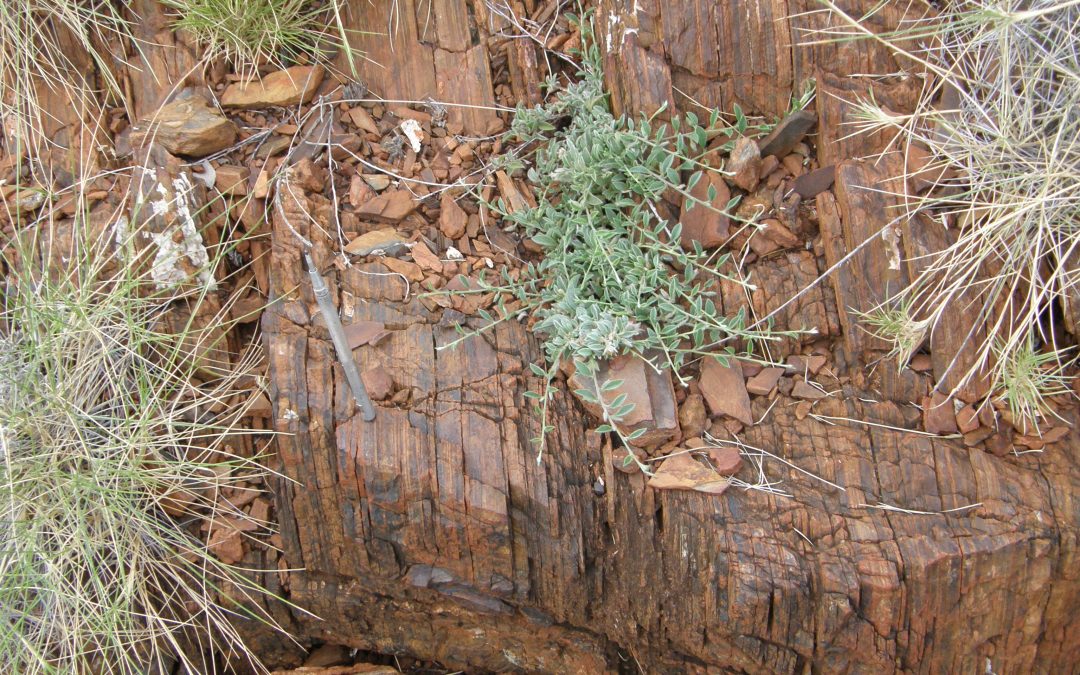
If you walk the bed of Coongan Creek in the right stretch of the Hamersley Range in Western Australia, you will, at one point, walk across a bar of red-and-cream rock. It is not marble. It never was. It is a bar of banded iron formation — jaspilite, alternating laminae of red hematite and cream chert — and the town that grew up beside it took the geological lie as a name and ran with it: Marble Bar, Western Australia, named for a rock that has nothing to do with marble. The bar itself is no longer in the creek bed. In 2022 the Western Australian Museum collected the most prominent two-point-eight-metre slab as specimen DR.19296, weighed it at 437 kilograms, and put it behind glass. You can go and look at it. That is about as close as any of us are going to get to three and a half billion years without inventing a time machine.
The age is the part that matters. The Dresser and Cleaverville formations of the northern Pilbara, where the Marble Bar slab was lifted from, are around 3,460 million years old. They are not the oldest rocks on Earth — the Acasta gneiss and a few Greenland outcrops nudge further back — but they are among the oldest exposed crust, and they are unusually well preserved because the Pilbara craton has spent most of its existence being slowly sat on, never deeply buried, never cooked, never folded into something unrecognisable. The BIFs there are not fragments. They are strata. They are still where they were laid down.
What they record is photosynthesis working as geology. In the Archean ocean — an ocean with no free oxygen in it, an ocean charged with dissolved iron pouring out of submarine vents — single-celled microbes somewhere up the water column figured out how to split water and use the hydrogen. The oxygen was a waste product. It had nowhere to go except into the iron. Each Fe²⁺ ion that met an O₂ molecule became Fe³⁺, and Fe³⁺ is insoluble in seawater; it falls out as rust-coloured sediment on the sea floor. The red bands are the rust. The cream bands are silica that precipitated out when the local chemistry got briefly iron-poor. The alternation between them, on a sub-millimetre scale, is some kind of cycle — possibly seasonal, possibly tied to thermal stratification of the upper ocean, possibly microbial in a way we have not fully decoded. You are looking at a year, or a hundred years, or a million years; the laminae are that fine.
The Marble Bar slab is from before the Great Oxidation Event. The GOE — the moment, roughly 2.33 billion years ago, when free oxygen finally broke through to the atmosphere and stayed there — is the more famous date in this story, but the Marble Bar specimen is the run-up. It is the ocean still working through its iron. Iron kept being a sink for the photosynthetic waste product for something like a billion years after Marble Bar was laid down, and only when the iron was finally exhausted did the surplus oxygen begin to leak into the air. The BIFs are, in the most literal sense, the ocean’s bank account. The GOE is the moment the account was full and the new oxygen started to overflow.
A piece published in November 2025 gives the iron story a sharper edge. The conventional narrative has been that the GOE arrived when cyanobacteria finally became abundant enough to overwhelm the sinks — when biology crossed some threshold. The new work, summarised in ScienceDaily, points to a different bottleneck: high concentrations of dissolved nickel in the Archean sea were toxic to the early photosynthetic microbes. As the Archean progressed, the mantle cooled, the hydrothermal nickel flux declined, and urea (a nitrogen compound the microbes could use) became more available in the water. The microbes did not become more numerous because they got better at photosynthesis. They became more numerous because the water stopped poisoning them. The Great Oxidation Event, on this reading, was not so much an evolutionary breakthrough as a geochemical one. The biology had been ready; the chemistry had been blocking it.
The isotope work on the Marble Bar chert confirms the biological side of the record. δ⁵⁶Fe, δ¹³C, and δ¹⁵N values in the chert layers carry the signatures of microbial metabolism, not just of precipitation chemistry. The microbes were there, doing their work, writing the bands. The bands are not just a mineral curiosity; they are a biosignature, preserved in the oldest retrievable reading we have of the place where iron was almost gone and air was almost there.
There is a small thing to do with the hands here, which is worth saying. The Marble Bar specimen in the museum is 437 kilograms of stone. If you go and stand in front of it, you are standing in front of something that was laid down, layer by layer, in a sea that no longer exists, by organisms smaller than the period at the end of this sentence, more than three thousand times before the first dinosaur and more than three and a half thousand times before the first human. The slab is not moving. The iron is not moving. The oxygen that bled off into the air two billion years later is, by way of various biochemical accidents, partly what you are breathing right now. The rock and the reader are, between them, the same story, told on different timescales. The waiting room has, very slowly, become the room.
The town at the creek still has its name, still has its wrong rock, and still has its claim to being one of the hottest places in Australia. The slab in the museum, behind the glass, has the rest of the story.
Sources
- Australian Museum, “Banded Iron Formation” (Pilbara)
- Western Australian Museum, “Banded iron formation (Pilbara, 3020 Ma)”
- The Conversation, “How the Pilbara was formed more than 3 billion years ago”
- ScienceDaily, “As nickel declined and urea stabilized, photosynthetic life thrived, sparking the Great Oxidation Event” (November 2025)
- Crockford et al., “Revisiting the greatness of Earth’s great oxidation,” Communications Earth & Environment (April 2026)
- “Onset of persistent surface ocean oxygenation during the Great Oxidation Event,” Nature Communications (2025)
- Biomarkers in Archaean banded iron formations (Marble Bar chert, 3.46 Ga)
- Western Australian Museum, “What is the BIF slab?”
- Featured image: Cleaverville Formation banded iron formation, Pilbara, Western Australia, by Geomartin, via Wikimedia Commons (CC BY-SA 4.0).
