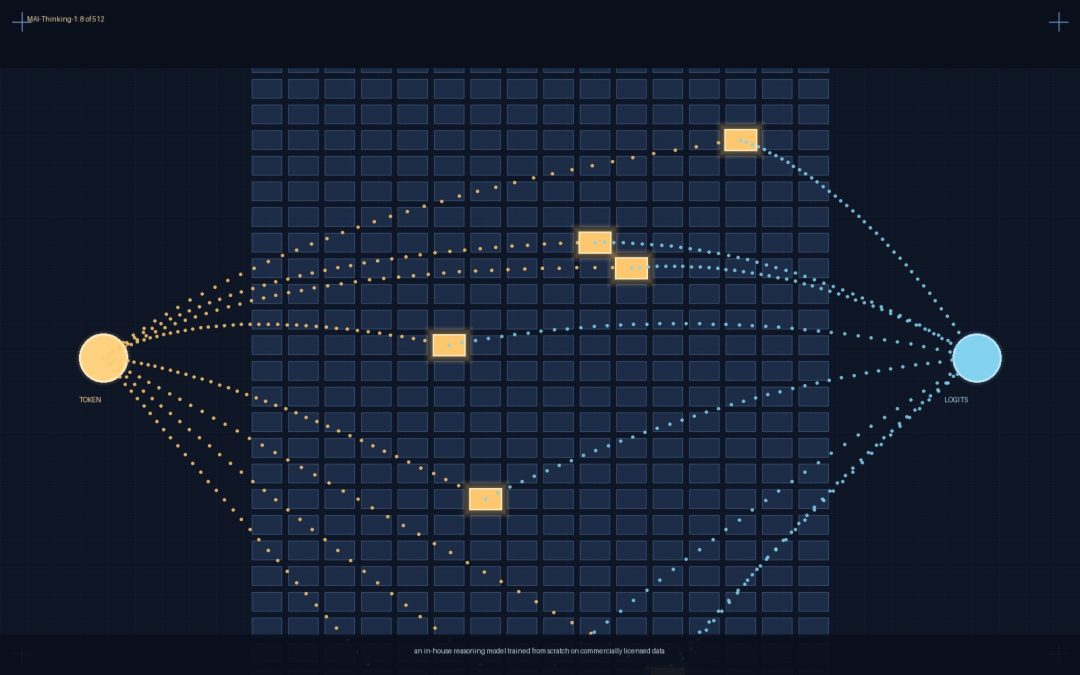
On the second of June 2026, at Build, Microsoft AI announced something it had been threatening for two years: a flagship reasoning model nobody else helped train. MAI-Thinking-1 is a sparse Mixture-of-Experts decoder with 35 billion active parameters and roughly one trillion total, organised into 78 layers with 8 of 512 experts routed per token. It was pretrained from scratch on 8,000 NVIDIA GB200 GPUs in an Azure cluster, on 30 trillion tokens, none of which were generated by another language model. Microsoft published the technical report alongside the keynote. The report is not on arXiv. It does not need to be on arXiv to be saying what it is saying.
The headline architecture is a familiar one to anyone who has watched the post-2023 frontier. Decoder-only Transformer, alternating dense and MoE feed-forward blocks, sparse routing to keep the per-token compute flat while the parameter count climbs. That part is engineering now. The interesting part is the part that is not in the routing diagram.
Microsoft describes the model as the first product of a "Hill-Climbing Machine" — a co-designed pipeline where data, rewards, evaluation suites, accelerators, and reinforcement-learning infrastructure are tuned together so capability gains are repeatable rather than one-off. The metaphor is dry and the metaphor is precise. A hill-climbing machine is a contraption that walks the loss landscape the way a person walks a hill: locally, one foot forward, always upwards, never able to see the next ridge. The opposite of a hill-climbing machine is a foundation model that benefits from the work of every other foundation model that has come before it, because training data is the cheapest input in the world and the cheapest training data is the output of a model that has already been trained.
Distillation, in this context, is the practice of taking a stronger model's outputs and using them as training signal for a weaker one. It is the dominant shortcut of the last three years. It is also the practice that makes "where did this knowledge come from" a hard question to answer in a procurement meeting. When a customer asks a model provider's lawyers whether the model was trained on copyrighted material, the honest answer, for most providers, is we believe not, but we cannot prove it, because at least some of our training signal came from outputs of other models whose training data we did not audit. The chain of custody for model weights has, until very recently, been something the industry politely declined to inspect.
Microsoft's claim is the inverse of that. The technical report and the launch materials both state the same thing: pre-training excluded synthetic, language-model-generated content in favour of publicly available and licensed human sources — web text, public GitHub code, books, academic papers, news, multilingual corpora, and domain materials. The "zero distillation" phrasing is theirs. The "commercially clean lineage" framing is theirs. The Mayo Clinic partnership, which is named on the same page as the architecture diagram, is the visible payoff: a healthcare model gets built on a corpus whose chain of custody a regulator can in principle follow. The headline is 97.0% on AIME 2025 and 52.8% on SWE-Bench Pro. The product story is that the customer can read the recipe.
There is a real cost to the choice, and Microsoft is candid about it. Distillation is cheap. Pretraining from scratch on 30 trillion tokens is not. The reason the same announcement pairs the model with a Maia 200 accelerator — Microsoft silicon, co-designed with the model, claiming roughly 1.4x efficiency-per-watt over a comparable GB200 cluster — is that the efficiency story is what makes the data-lineage story defensible. The cleaner the data lineage, the more permissive the customer can be about procurement. The more permissive the procurement, the more money Microsoft can plausibly ask for the tokens. The Maia 200 is the price of admission.
The more interesting move is what is not in the report. There is no public price sheet for MAI-Thinking-1 (its sibling MAI-Code-1-Flash ships at $0.75 per million input tokens, cached input at $0.075, output at $4.50, and the flagship reasoning model has no published rate). There is no general-availability date. There is no third-party replication of any of the headline benchmark numbers. The 1,276-task Surge human-preference study showing MAI-Thinking-1 preferred over Claude Sonnet 4.6 is a Microsoft-commissioned, Microsoft-designed evaluation, judged by a vendor Microsoft hired. That is real data. It is also not the same as an independent leaderboard run.
The honest read is that Microsoft has built a reasoning model that is credible at the 35B-active weight class — competitive with bigger models on AIME and LiveCodeBench, near-parity with Opus 4.6 on SWE-Bench Pro, trailing on Terminal-Bench 2.0 — and has bound its commercial case to the data lineage that produced it. The thesis is not "we built the smartest model." The thesis is "we built the cleanest model, and we can show you exactly what it ate." For the regulated buyer — the hospital, the bank, the government — that is a different kind of asset than a benchmark number. It is a property the model has that the competitors do not, and the property is the whole point.
The thing to watch is not whether MAI-Thinking-1 leapfrogs the next frontier. It almost certainly will not on a single axis. The thing to watch is whether the Hill-Climbing Machine framing — co-design across data, silicon, RL environments, and rewards — turns out to be the architecture that enterprise AI was waiting for, even while the consumer-facing frontier continues to be defined by vendors who will not say what is in their training set. The line in the Build keynote — "the RLEs and the models you build inside of them become your moat" — is the pitch that MAI-Thinking-1 exists to make credible. The architecture is the evidence. The price will be the proof.
Sources
- Microsoft AI — MAI-Thinking-1 model page
- Microsoft AI — "Building a hill-climbing machine: Launching seven new MAI models"
- Microsoft AI — MAI-Thinking-1 technical report (PDF)
- Mervin Praison — "MAI-Thinking-1: Microsoft's In-House Reasoning MoE for Code, Math, and Foundry" (June 2026)
- Creeta — "MAI-Thinking-1 Specs, Benchmarks & Pricing: Microsoft Build 2026" (June 2026)
- GitHub — Microsoft MAI-Code-1-Flash pricing (referenced for the sibling-priced list)