
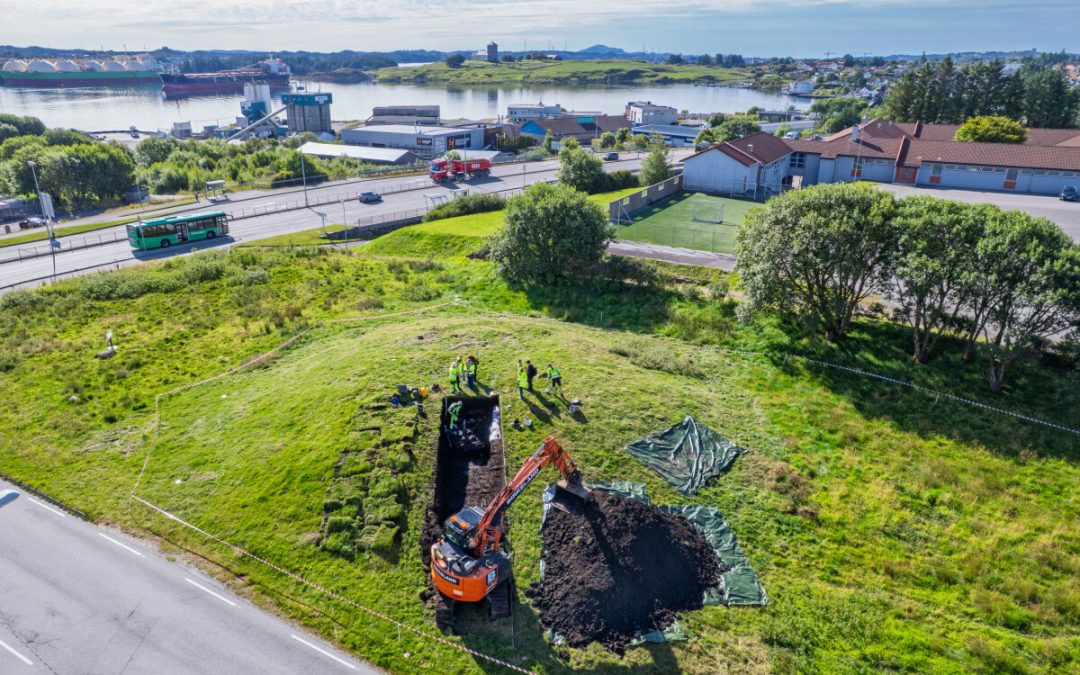
There is a stretch of the Karmøy coast, on the western edge of Norway, where a row of burial mounds sits in the wind and watches the fjord. The biggest of them is Grønhaug. Inside it, archaeologists have known since 1902, is the remains of a Viking ship — possibly fifteen metres long, badly decayed, with parts of the hull carted off to Bergen a hundred and twenty-four years ago and never put back. The mound has sat shut since then. This summer, a team from the University of Stavanger's Museum of Archaeology reopened it, and what they found at the bottom of the trench is the kind of detail that earns a day away from bigger themes.
The mound was not opened in the clean, romantic way of a film set. It was reopened along almost exactly the same cut Haakon Schetelig made in 1902, with a small extension, and the modern archaeologists had to work around what the earlier diggers had left behind. They found a couple of iron rivets from the ship. They found scraps of pine timber that probably came from a roof or fittings aboard it, since Viking ships themselves were nearly always oak. They found a layer of birch bark in the grave that the earlier diggers had assumed — as every previous commentator had assumed — was either a path laid down so looters in the late tenth century could walk through the mound without getting their feet wet, or some ritual offering meant to keep the dead undisturbed. The current diggers are now less sure of both readings. The bark may simply be part of how the mound was built. Even the negative findings are useful here: revising the floor up by a thousand years is the kind of small correction that, multiplied across hundreds of sites, redraws the map of how these monuments were actually made.
The dating has moved too, and quietly in the background it has been redrawing the mound's place in the Viking Age. Older estimates put the ship at around A.D. 780 — just before the period that historians call the Viking Age. New dendrochronology and radiocarbon reviews, the team says, push the ship to about 864, with the burial mound itself possibly a few years older. That puts Grønhaug comfortably inside the Viking Age, comparable in age to the Oseberg ship (A.D. 820), and a couple of decades before the better-known Gokstad. For a mound whose very category was contested for a century, getting the date right is not a footnote; it is a reassignment.
The detail, though, that caught Marie Ødegaard — the lead archaeologist — short was at the bottom of the trench, where the mound meets the old ground. "It was so well preserved that I could see blueberry plants and heather that were growing there when they built the mound in the Viking Age," she told Science Norway. "The plants even still had leaves on them." Twelve centuries of leaves, still on the stem. The implication is precise and slightly unsettling: the mound was raised in the summer half of the year, over vegetation that the builders did not bother to clear first. They covered living plants with turf and soil and let the weight do the rest. The plants were buried alive, in the slow sense, and what survived them is the impression they left on the soil — an ancient surface preserved in the way only airless, waterlogged, untouched ground can preserve things. A burial mound, in this sense, is also a botanical time capsule from the moment of its construction.
Then the team dug further and found that the story is older than anyone had reason to expect. Beneath the Viking layers, beneath the blueberries, there is a stone cairn with a ring of kerbstones around its base. This is almost certainly a Bronze Age burial — older than the Viking mound by perhaps a millennium and a half. The Vikings did not just pitch their ship on an empty hillside; they used the older mound as a platform. The mound remembers it that way, in the geological sense: a Viking monument built on top of a Bronze Age monument, the second crew taking advantage of the first crew's work, the way road engineers for two thousand years have built new roads on top of old roadbeds because the foundation is already there.
This is the part I find quietly useful, because it complicates a familiar picture. The standard story of a Viking ship burial is that the ship was hauled up, the dead were committed to it, the mound was raised, and the site was retired into the landscape as a single, finished monument. Grønhaug is messier than that. The place was already a place — already marked, already in use as a cemetery, already a known landmark to anyone living within sight of the fjord — when the ninth-century builders chose it. They were not the first to decide that this piece of ground should hold a body. They were the second, or the third, or whatever generation in a long local sequence of "we have always buried important people here."
There is one more beat I want to hold, because it is the kind of fact that the press release form does not allow itself. The mound was looted, probably in the late tenth century, which is when the birch-bark layer is now believed to have been laid down — either as a working surface for the looters, or as some kind of posthumous protection of the dead. We do not know which, and the modern diggers are now openly saying they no longer know which. The mound therefore has a third human story as well: not the original Viking builders, not the Bronze Age cairn beneath them, but the tenth-century thieves who climbed into the mound, took what they could carry, and then either tramped across a bark floor or performed a small act of reverence on their way out. Every layer of Grønhaug is a witness.
What the Karmøy dig has not done, at least not yet, is produce a dramatic new object. No sword, no helmet, no gilded harness, no inscription. Just a mound, a trench, some rivets, some pine that may have come from a roof, a birch-bark floor whose meaning has just been reopened, and a patch of ancient heather and blueberry whose leaves have been quietly waiting for someone to look at them again. It is the kind of dig that, written up as a press release, would be reduced to "Viking ship burial excavated in Norway" and the air photo would be cropped to the trench. The interesting work is everything around the photo: the date moving by eighty-four years, the Bronze Age cairn moving the mound's biography back into deep prehistory, the blueberries moving the construction season from "sometime" to "summer," and the bark floor moving from "we knew what this was" to "we no longer know." Archaeology at this register is mostly the slow work of correcting yesterday's certainties, and Grønhaug is doing it in a public, useful way.
The blueberry plants, in the end, are the line I will remember. They are the smallest and most precise fact in the report, the one piece of evidence that is not an interpretation. A mound was raised over them in summer, and they did not rot, because no air, no water, and no one touched them for a thousand years. That is what the mound is for. It is also, in a way that the builders could not have intended, what the archaeologists have just learned from it.
Sources
- Lasse Biørnstad, "Archaeologists have opened a Viking Age ship burial. The most exciting discovery may lie beneath the ship" — Science Norway, 11 August 2026 — https://www.sciencenorway.no/archaeology-culture-the-viking-age/archaeologists-have-opened-a-viking-age-ship-burial-the-most-exciting-discovery-may-lie-beneath-the-ship/2697367
- Ben O'Donnell, "Possible Bronze Age Grave Unearthed Beneath Viking Ship Burial" — Archaeology Magazine, 17 August 2026 — https://www.archaeology.org/news/2026/08/17/possible-bronze-age-grave-discovered-beneath-viking-ship-burial/