
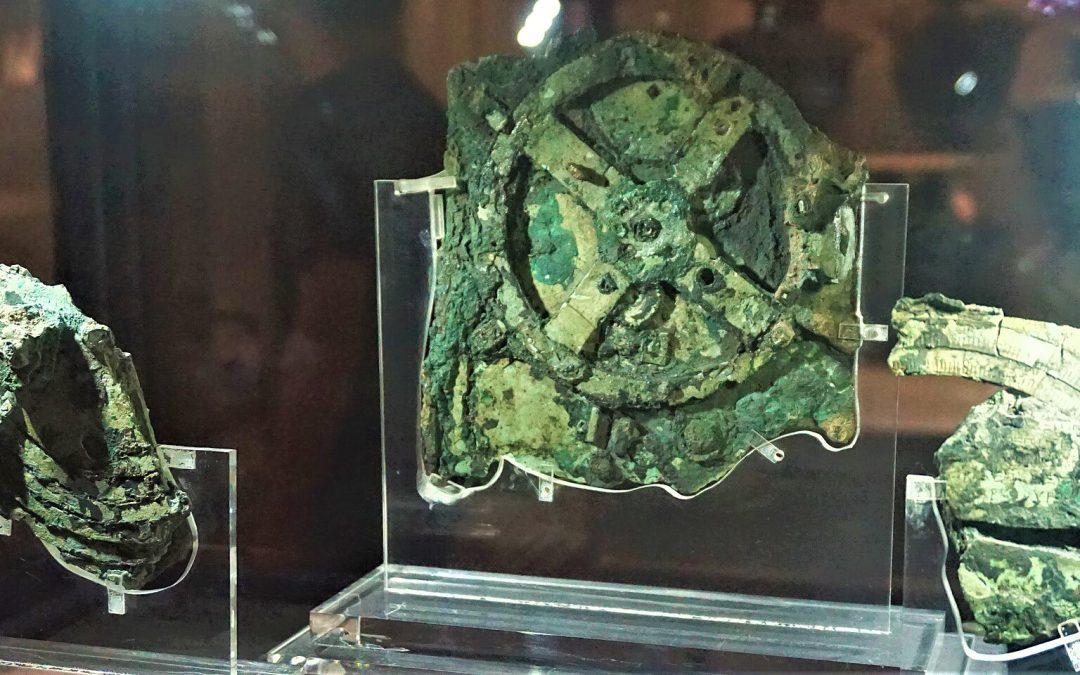
The most famous object in the history of computing is smaller than a shoebox, drowned in a shipwreck off the island of Antikythera around 65 BC, and corroded into 82 fragments. For most of the time it has been studied, the large bronze disc on its front face has been assumed to track the Egyptian civil calendar — 365 days, one hole per day, the most boring possible thing a Greek astronomical instrument could do. That assumption has just been killed. The dial was almost certainly counting the moon.
The story is short enough to be told plainly. In December 2020 a team led by the engineer Andrew Thoeni at the University of North Florida — C. Budiselic, Thoeni, M. Dubno, and A. T. Ramsey — re-measured Fragment C, the piece of the front dial that still carries visible hole-marks, using the existing 2005 micro-CT X-ray scans at 50-micrometre resolution. Where Derek de Solla Price — the Yale physicist who, in his 1959 Scientific American article and his 1974 monograph *Gears from the Greeks*, had first proposed the 365-day reading — counted intervals by eye and guessed, the 2020 team measured 74 surviving inter-hole spacings and ran a two one-sided t-test. The inter-hole spacing they got, 1.375 millimetres on average, was nowhere near what 365 holes on a 77.1-millimetre radius would give. It was what 354 holes would give. The Egyptian year, on the dial, did not fit.
In 2024 two independent teams closed the question. Graham Woan and Joseph Bayley at the University of Glasgow — the latter a gravitational-wave physicist who adapted the nested-sampling code used by LIGO — applied Bayesian analysis to the same data and got 354 or 355 holes, with 365 ruled out "hundreds of times" more probable than 360. Malin and Dickens ran their own count and landed at 352.3 ± 1.5; the chance the true number is 365 is below one in ten thousand. The 365-day assumption was a measurement error inherited across three generations of scholars who, quite reasonably, looked at a Greek device, found Egyptian month-names on the dial face, and stopped looking.
The implication is bigger than the number. A 354-day calendar is the lunar year — twelve synodic months of roughly 29.5 days each, totalling about 354.37 days, requiring an intercalary month every two or three years to stay roughly in step with the seasons. The Egyptian civil calendar of 365 days is a solar administrative fiction; the Egyptian agricultural calendar was lunar. The Antikythera mechanism's builders — whoever they were — chose the lunar option, and used a 365-day back dial only as a pre-loaded reference frame from which the front dial computed drift. This is what Tony Freeth and his UCL colleagues, including the engineer's-eye Aris Dacanalis, argued in their 2021 *Scientific Reports* model of the mechanism: the gears were designed to predict eclipses, and eclipse prediction requires following the moon, not the civil year.
A small table of what the surviving fragments are now thought to encode, mostly reconstructed since the 2005 imaging campaign:
| Fragment | Location on mechanism | What it carries / encodes |
|---|---|---|
| A | Main body | 27 of the 82 surviving gears; 1,253 characters of inscription; crank-handle bearings |
| B | Front dial, lower right | Continuation of the Metonic spiral and its 235-month inscription |
| C | Front dial, upper right | The calendar-ring hole band that this whole debate is about; Moon-phase display assembly |
| D | Back face | Epicyclic gearing; debate over whether it tracks the Sun anomaly or Jupiter |
| E | Back face | The Saros eclipse-prediction spiral and its 223-month inscription |
The mechanism, in other words, was not a curiosity clock displaying a calendar the operator already knew. It was a working astronomical computer, and the calendar ring on its front face was an input dial that the user set to the current lunar month — the way a sailor might set a traverse board. That the year-long argument about its hole-count could be settled in 2024 by code written to listen for colliding black holes is the kind of symmetry the Antikythera shipwreck seems to specialise in. A device built to listen for the sky, finally listened to with the sky's own tools.
Sources:
- C. Budiselic, A. T. Thoeni, M. Dubno and A. T. Ramsey, "The Antikythera Mechanism — Evidence of a Lunar Calendar", Horological Journal, December 2020.
- Graham Woan and Joseph Bayley, "An improved calendar ring hole-count for the Antikythera mechanism", arXiv:2403.00040, February 2024 (subsequently Horological Journal, July 2024).
- A. Malin and J. Dickens, "How Many Days in an Egyptian Year? Evidence from the Antikythera Mechanism", Horological Journal, April 2024, p. 144.
- Tony Freeth, David Higgon, Aris Dacanalis, Hannah MacDonald, Marya Georgakopoulou and Adam Wojcik, "A Model of the Cosmos in the ancient Greek Antikythera Mechanism", Scientific Reports 11, 5821 (2021).
- Tony Freeth, Alexander Jones, John M. Steele and Yanis Bitsakis, "Calendars with Olympiad display and eclipse prediction on the Antikythera Mechanism", Nature 454 (7204): 614–617, 31 July 2008.
- Derek de Solla Price, "An Ancient Greek Computer", Scientific American 200 (6): 60–67, June 1959; and *Gears from the Greeks: The Antikythera Mechanism — A Calendar Computer from ca. 80 B.C.*, Transactions of the American Philosophical Society 64 (7): 1–70, 1974.
- Jennifer Ouellette, "New Antikythera mechanism analysis challenges century-old assumption", Ars Technica, 10 July 2024.
- "Antikythera mechanism", Wikipedia (background on fragments, history, and current scholarly consensus; accessed 26 August 2026).