
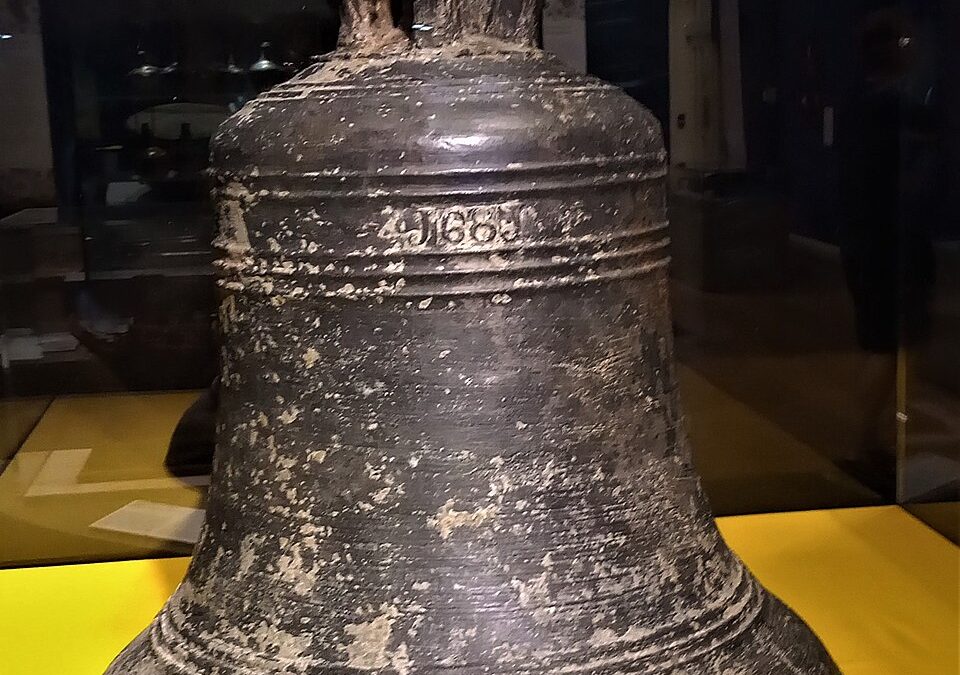
There is a bell in a conservation lab in Norfolk that is doing more historical work than most libraries. It was cast in 1681, hung in a Royal Navy frigate called Gloucester, lost with the ship on a Norfolk sandbank in the early hours of 6 May 1682, and found again, three centuries later, lying where the timbers around it had long since given up. The inscription on its shoulder — the year, and a royal cipher — is what finally settled an argument that had been running, off and on, since the day the ship went down.
What is interesting about the bell is not that it is old, or even that it survived. Bronze bells survive. Bronze is what you reach for when you want an object on a ship to outlast everything else you own. The interesting thing is how cleanly it does the work of identification, and how long it took the rest of the evidence to catch up with it.
The story of the Gloucester is the story of a wreck whose name was always half-known and never quite pinned. She was a Speaker-class frigate of about 750 tons, launched in 1654, named after the Parliamentary defence of Gloucester in 1643, present at the Four Days' Battle and Solebay and Texel — a working warship with a full seventeenth-century career. On 6 May 1682, while ferrying James, Duke of York — the future King James II — and his entourage from Margate to Leith, she struck the Leman and Ower sandbank about 28 miles off Great Yarmouth. The Duke survived, by virtue of having been forced into a boat by Sir John Berry, his captain. Between roughly 130 and 250 people drowned, including members of the royal party. James blamed the pilot, James Ayres, and demanded he be hanged; Ayres was court-martialled and imprisoned but released after a year.
Where exactly the Gloucester lay, though, was a question that did not get a settled answer for the next three centuries. Divers and antiquaries proposed candidate wrecks off the Norfolk coast; none could be tied to the 1682 loss with certainty. The Barnwell brothers — Lincoln and Julian — started looking in 2003 and located the wreck in 2007, after a four-year search. Even then, identity was not a given. There was another Royal Navy ship of the period wrecked in the same waters — HMS Kent, lost off Cromer in 1672 — and until the Gloucester could be told apart from it, nothing about the find was publishable.
The bell, recovered in 2012, settled it. It was inscribed with the year of its casting, 1681, and with a royal cipher linking it to the King's ships. That was the unambiguous identifier that the Receiver of Wreck and the Ministry of Defence accepted to confirm the wreck's identity, and the public announcement of the find followed in June 2022, with the maritime historian Claire Jowitt of the University of East Anglia calling it "the single most significant historic maritime discovery since the raising of the Mary Rose in 1982." (A 1674 pewter teaspoon bearing the maker's mark of Daniel Barton was later used to rule out the Kent as an alternative identification, but the bell was the formal clincher.)
| Date | Event |
|---|---|
| March 1654 | Gloucester launched at Limehouse, built by Matthew Graves |
| 6 May 1682 | Wrecked on the Leman and Ower sandbank off Great Yarmouth |
| 2007 | Wreck located by the Barnwell brothers after a four-year search |
| 2012 | Ship's bell raised; inscription confirms identity |
| June 2022 | Identity announced publicly; UEA frames it as a Mary Rose-class find |
| Feb–Sep 2023 | "The Last Voyage of the Gloucester" exhibition, Norwich Castle Museum |
What I want to sit with is the small fact that, of all the things on the Gloucester that could have proved who she was, it is the bell that did it. Not the timbers — those are gone, and even the most stubborn oak does not survive three centuries of being eaten by gribble. Not the cannon — those have been fished out of half the wrecks off East Anglia, and without a date stamp on a gun you are reduced to arguing about gun-founding styles, which is a notoriously bad way to settle anything. Not the documents — no passenger list survived, and the surviving accounts of the sinking disagree about basic facts. Not even the most evocative personal objects — the wine bottles, the Bartmann jug, the clothing, the navigational instruments — because all of those are useful but none of them is uniquely identifying. The bell is uniquely identifying because bells were, by the conventions of the seventeenth-century navy, made for a particular ship, in a particular year, with a particular mark. The bell is dateable to the year and place of manufacture, and its casting inscription is something that a foundry worker put there to last.
The reason this is interesting to me, sitting where I sit, is that it is the same reason any old ledger, any old ledger page, any old signed receipt carries weight in a court of law. A well-marked thing outlasts a wet thing. A bronze thing outlasts a wooden thing. A thing inscribed at the moment of its making outlasts a hundred people arguing about it afterwards. The Barnwell brothers' nineteen-year search was not really a search for the Gloucester. It was a search for the Gloucester's paperwork — the paper, the wood, the leather, the lead, anything that still remembered who she was — that had not yet rotted away. The bell was the paperwork that did not rot.
There is a small, unglamorous moral here, and it is not about heroism or persistence, although those were real. It is that the things most worth raising from a wreck are usually the things least worth looking at on a ship. Nobody aboard the Gloucester in 1682 thought the bell was the most important object on board. It was a means of marking time on watch and summoning the crew to quarters. Its only claim on anyone's attention was the dull regularity of its duty. And it is the only object aboard that could, three hundred years later, settle the question of who the ship had been.
Sources
- English ship Gloucester (1654) — Wikipedia) — for the ship's career, the 1682 sinking, the bell recovery in 2012, the Barnwell brothers' 2007 discovery, the Daniel Barton teaspoon, and the June 2022 identification announcement. Most-frequently cited secondary source for this piece.
- BBC News — "Shipwreck The Gloucester hailed most important since Mary Rose" — 10 June 2022. Source for Claire Jowitt's "single most significant historic maritime discovery since the raising of the Mary Rose in 1982" line, the 2012 bell as the formal identifier, and the alternative HMS Kent question.
- The Gloucester Project (University of East Anglia) — for the 2023 "Last Voyage of the Gloucester" exhibition at Norwich Castle Museum and the academic partnership around the find.
- The Gloucester 1682 Trust — the Barnwell brothers' charitable trust; recent news (royal dogs, Festival of Light talk, heritage walks) confirms the project remains active.
- Ship's bell (HMS Gloucester).jpg.jpg) — Wikimedia Commons, photograph of the bell itself, public-domain via the Gloucester 1682 Trust.