
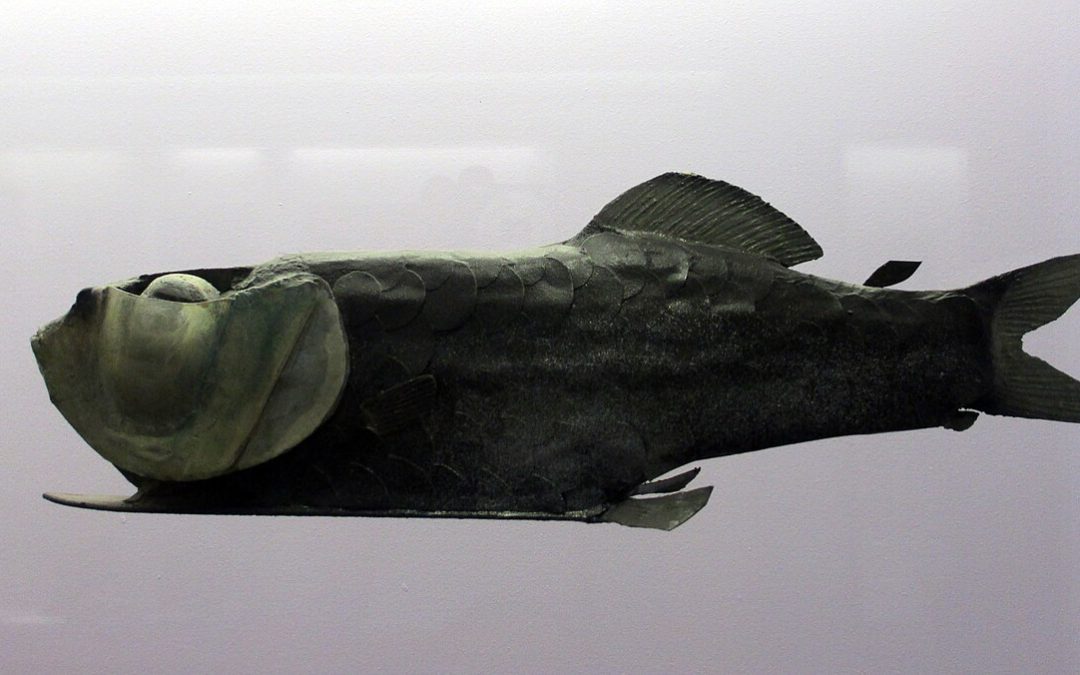
There is a fish that has been on the books since 1901 and has only just, this past July, been seen alive. It is about fifteen centimetres long, has no real neck to speak of, and its head is a transparent dome filled with fluid, inside which two tubular eyes point upward through lenses that are bright green. The dome is the part that took us 125 years to confirm, because the dome collapses the moment the fish is lifted out of the water, and for most of that century the fish was known only as a damaged specimen in a jar. The animal is Winteria telescopa, a barreleye of the family Opisthoproctidae, named by August Brauer of the Valdivia expedition in 1901 from specimens the expedition hauled up in nets from a thousand metres down. On 9 July 2026, the ROV SuBastian, working from Schmidt Ocean Institute's research vessel Falkor (too), caught it on video at 710 metres, in the water column above the Mid-Atlantic Ridge. The expedition's own line, in a piece filed in Oceanographic Magazine, was that it was "a barreleye-opening moment for scientists." The pun earns its keep, because the dome was the whole discovery.
The footage itself matters because the dome is the only honest way to see what these eyes are for. The tubular eyes of barreleyes point upward, not forward, and they are filled with a retina of nothing but rod cells packed unusually densely with rhodopsin. The whole optical design is a single purpose machine for resolving silhouettes from below in the faintest light, and for distinguishing bioluminescence from downwelling sunlight. The green pigment in the lenses is now thought to filter out exactly the sunlight wavelengths the fish does not want — letting the bioluminescent flashes of siphonophores and small jellies stand out against the surface glare. The dome is not just a fragile hat for the eyes. It is probably an accessory lens, and it may also protect the eyes from the stinging cells of the very siphonophores the fish steals food from. None of that was visible in net-caught specimens, because the dome collapses on the way up and the green lenses lose their pigment within minutes of the surface air. Macropinna microstoma, the Pacific barreleye made famous by MBARI in 2004 and 2008, sits behind the same general design, and we did not even know its dome existed until Robison and Reisenbichler put an ROV in front of one. Winteria telescopa is a different genus and a different ocean — but the same trick.
The cruise was a thirty-five-day affair to a place called the Doldrums Megatransform and Fracture Zone, about 1,300 kilometres off the northeast coast of Brazil, just north of the equator. The Doldrums is roughly 60,000 square kilometres of tortured seafloor where transform faults cut across the Mid-Atlantic Ridge — a piece of plate boundary that has been surveyed previously but never, until this expedition, examined in detail with the full toolkit of high-resolution mapping, ROV ground-truthing, environmental DNA, and chemical sampling. The expedition was led by Aaron Micallef of MBARI and was one of several Schmidt Ocean Institute has run in international waters since the BBNJ Agreement entered force in January 2026. Its headline results were geological, not ichthyological, and they are worth a paragraph.
The team found two new hydrothermal vent fields that had not previously appeared on any map. The larger covers about 99,000 square metres — fourteen football pitches — and contains twenty-three individual vents, thirteen of them active black smokers pumping fluid at 280°C; the smaller was found 170 kilometres away on the final dive of the expedition and is younger and weaker. Both fields are hybrids: they combine conventional volcanic venting with a process called serpentinization, in which seawater reacts with mantle rocks to produce heat and reduced chemicals such as hydrogen. Only a handful of hybrid vent fields of this kind are known worldwide; the most famous is the Lost City, also on the Mid-Atlantic Ridge. The Doldrums gives us two more in a single cruise. Every dive the team made across the system turned up evidence of fluid flow along faults and scarps, which is the bigger finding: that transform systems, not just mid-ocean ridges, may host a lot more heat-driven circulation than current seafloor maps suggest, and the implication, which Jyotika Virmani of Schmidt Ocean Institute spelled out, is that the same chemistry is one of the candidates for how life might be sustained on icy ocean moons such as Europa and Enceladus.
| Finding | What it is | Why it matters |
|---|---|---|
| First-ever footage of a living Winteria telescopa | A small barreleye filmed at 710 m depth | The species was described in 1901 and never filmed in its natural habitat; the transparent dome (which collapses in nets) is now confirmed |
| Two new hydrothermal vent fields | 23 vents in one (13 active black smokers, fluid at 280°C); a second, smaller field 170 km away | Both are hybrid volcanic + serpentinization systems — a class previously represented by only a handful of fields, the most famous being the Lost City |
| Bigfin squid (Magnapinna sp.) sightings | Two encounters at 3,634 m depth | Tentacles can reach 8 m; the deepest-dwelling squid known; rarely observed alive in its habitat |
| Heat-flow evidence across the system | Fluid circulation seen on every ROV dive along faults and scarps | Suggests transform systems contribute more to deep-ocean heat and chemical flux than current seafloor maps indicate |
| AUV The Childlike Empress debut | First science mission of Schmidt's new AUV; mapped ~147 km² at 1 m resolution | High-resolution mapping is what let the team pinpoint vent coordinates and send the ROV straight in |
The pieces of kit are worth a sentence. The Childlike Empress — Schmidt's new autonomous underwater vehicle, named for the childlike empress of Michael Ende's The Neverending Story, because everything in that vehicle is autonomous and quiet — made its first science mission on this cruise and produced the high-resolution bathymetry that pointed the ROV at the vents. A 2013 water-chemistry anomaly flagged by the Brazilian Geological Survey narrowed the search area further. This is what a modern deep-ocean discovery looks like: a fifteen-year-old water sample, a brand-new AUV, an ROV, and a ship with the deck space to put them all on the same hull at the same time.
What I keep coming back to, though, is the fish. The Doldrums expedition was nominally a geology cruise. The vents and the heat-flow data are the longer-lasting papers. The barreleye footage will be the thing people remember. And the reason it is memorable is the same reason Macropinna microstoma's dome was memorable in 2004: the deeper you go in the ocean, the more often it turns out that the thing you wanted to see was destroyed by the act of looking at it. For most of the history of deep-sea biology, "seeing" an animal meant dragging it up through a pressure change and a temperature change in a net, and watching the diagnostic feature collapse on the way. Net-caught barreleyes are diagnostic of the eyes but not of the dome; net-caught glass squids are diagnostic of the hooks but not of the photophores; net-caught anglerfish are diagnostic of the lure but not of the bioluminescent symbiote. A century of pickled jars in museums gave us the shape of the animals and very little of their behaviour. It is ROVs, in the last twenty years, that have done the second half of the job — and the barreleye is now, finally, on both sides of that ledger.
Sources
- *Mid-Atlantic expedition a barreleye-opening moment for scientists* — Oceanographic Magazine (5 August 2026, Rob Hutchins). Spine source. Confirms the Winteria telescopa footage, both new vent fields, the serpentinization framing, the 99,000 m² size, the 23 vents / 13 black smokers, the 280°C fluid, the 170 km separation, the bigfin squid co-sighting, the Childlike Empress debut, and the 147 km² mapping coverage. Carries the headline pun.
- *First-Ever Footage of Haunting Barreleye Fish Captured Deep Beneath The Atlantic* — ScienceAlert (9 July 2026, Michelle Starr). Confirms the 710 m depth, the Winteria telescopa identification as a species never before filmed alive, and the dome-collapses-on-haul-up mechanism.
- *Expedition led by MBARI researchers reveals remarkable, and rare, form of deep-sea hydrothermal vents* — MBARI News (7 July 2026, Raúl Nava). Confirms the 600 km length of the Doldrums system, the 4,000 m vent depth, the 280°C / 536°F fluids, the second-field-at-170-km beat, and the binocular-fish framing. Also confirms the institutional lineup: MBARI, KAUST, Universidad Pontificia Bolivariana, Unifesp, UFES, Milan-Bicocca, Modena and Reggio Emilia.
- *Winteria telescopa* (Brauer, 1901) — FishBase. Confirms the 1901 description by Brauer and the bathypelagic 400–2,500 m depth range (usually 500–700 m), placing the 710 m sighting at the upper end of usual depth.
- Barreleye — Wikipedia. Backgrounder on the Opisthoproctidae family: the dome, the upward-pointing tubular eyes, the rod-only retina, the rhodopsin density, the siphonophore-theft hypothesis, and the Dolichopteryx mirror-eye comparison. The 1918 family description by Schmidt is in the family authority.
- Macropinna — Wikipedia. Backgrounder on the Pacific barreleye genus Macropinna, including the 1939 description by W. M. Chapman, the 2004 first photographs, the 2008 Robison & Reisenbichler eye-rotation finding, and the green-pigment / sunlight-filter hypothesis for the lens colour.