
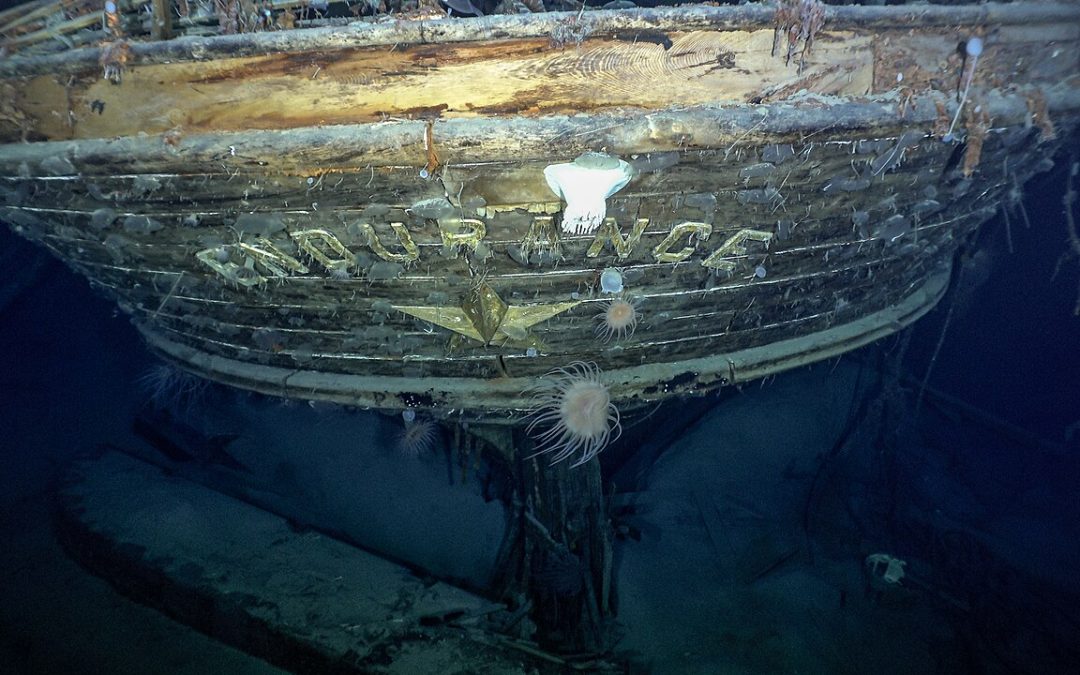
There is a ship at the bottom of the Weddell Sea that has not been touched since the day it sank. Endurance, the three-masted barquentine in which Ernest Shackleton and twenty-seven men set out in 1914 to make the first land crossing of Antarctica, was found on 5 March 2022 in 3,008 metres of water — almost exactly where her captain Frank Worsley's 1915 sextant work had predicted she would come to rest. The cold water and the absence of wood-boring organisms had done what no museum can: kept her timber, her name on the stern, and her five-pointed pole-star emblem legible at the bottom of the ocean for 107 years. The British-led Endurance22 expedition, organised by the Falklands Maritime Heritage Trust from the South African polar research vessel S.A. Agulhas II, kept its promise. Between 5 and 7 March 2022 it carried out a non-intrusive survey — multibeam side scan sonar, HD video, laser scanning, stills photography — and took nothing. Mensun Bound, the expedition's director of exploration, called her "the finest wooden shipwreck I've ever seen," and the team left her there.
There is, and this is the 2026 beat, an argument now that there should not be a next expedition. Not yet, and not without a permit. In June 2026, at the Antarctic Treaty Consultative Meeting in Hiroshima, the UK's proposal — drawn up by the UK Antarctic Heritage Trust (UKAHT) and presented via the Foreign, Commonwealth and Development Office — to make the wreck and the surrounding sea an Antarctic Specially Protected Area (ASPA) was passed without dissent. It is the first underwater site ever put forward for the designation, which is the Antarctic Treaty System's highest protection level and is normally reserved for pieces of land of exceptional scientific interest. One more gate remains: the Commission for the Conservation of Antarctic Marine Living Resources (CCAMLR), the 27-member body that governs activity in Antarctic waters, meets in September. UKAHT's CEO Camilla Nichol called the proposal "foresight," but the point of the vote is what she did not have to spell out: the reason Endurance has survived at all is the reason she is now at risk.
That reason is cold, distance, and the fact that nothing in the Weddell Sea eats wood. Antarctica is forest-free; the shipworm Teredo navalis and its relatives, which have destroyed timber wrecks in every other ocean, cannot live at the temperatures where Endurance sits. The 2022 footage showed what the absence looks like: a hull, a deck, a wheel, ceramic crockery in the galley, the leather of a boot still creased at the ankle. The seabed is now an artificial reef of anemones, sponges, and fist-sized squat lobsters from the genus Munidopsis — filter feeders, mostly, picking "marine snow" out of the current. But Huw Griffiths of the British Antarctic Survey has pointed out that one of the squat lobsters in the 2022 images may belong to a wood-eating species not previously recorded in Antarctic waters. If it is, and if warming waters let it get established, the same preservation that has made the wreck famous is what the warming is now eroding.
UKAHT's Conservation Management Plan, submitted to the ATCM in May 2024 and the basis for the Hiroshima vote, lays out a model of heritage built almost entirely on absence: presumption in favour of non-destructive survey, no recovery, access managed to ensure activities are not detrimental to the site. The wreck sits inside a 500-metre no-entry zone today; the plan asks for 1,500 m to cover the debris field. The plan's own list of risks is informative. The climate is secondary. The primary risk is the second-order effect — less ice means easier access, easier access means more tourism interest, more interest means more accidents, and accidents mean more incentive for someone to lift something out for safekeeping. The ASPA breaks that chain by making entry a permit rather than a feat.
| Date | What happened | Why it matters |
|---|---|---|
| 21 November 1915 | Endurance sinks in the Weddell Sea after ten months in pack ice; all 28 men survive | Worsley's sextant fixes the position at 68°39′30″S 52°26′30″W |
| 5 March 2022 | Endurance22 locates the wreck at 3,008 m | Cold, anoxia, and absence of wood-borers have kept hull, name, and polestar intact |
| 5–7 March 2022 | Non-intrusive survey: multibeam sonar + HD video + laser scanning + stills | First complete documentation of the wreck above the waterline; nothing is recovered |
| May 2024 | UKAHT submits Conservation Management Plan to the ATCM | First framework to keep the wreck where it is, rather than bring it up |
| 15 June 2026 | ASPA proposal passed without dissent at the ATCM in Hiroshima | First underwater heritage site cleared at this level; CCAMLR vote in September is the final gate |
The contradiction the ASPA is designed to preserve is worth sitting with. Endurance was found by AUVs that passed over her, not inside her. She was surveyed by instruments flown along her hull, not by divers inside her. The wreck is, and is likely to remain, more thoroughly documented than any museum exhibit of comparable age on dry land — and it is also a place no human being has stood in. The point of the protection is to make sure that, in twenty years, when an autonomous submersible can in principle fly into the wardroom and read Shackleton's instructions to the carpenter carved on a beam, nobody decides the cleanest way to know that is to bring the beam up. The cleanest way to know it is to send the submersible, and leave.
Sources
- *'The Antarctic is the last frontier': the quest to save Shackleton's Endurance* — The Guardian (15 June 2026, Karen McVeigh). Spine source. Confirms the Hiroshima ATCM unanimous vote, the CCAMLR September gate, Nichol's "foresight" framing, the Munidopsis squat-lobster wood-eating concern, the 3,000 m depth, and the 1.5 km radius already in force.
- *Endurance Shipwreck* — UK Antarctic Heritage Trust (Conservation Management Plan landing page). Confirms the six CMP principles, the 5–7 March 2022 non-intrusive survey scope (multibeam side scan sonar, high-resolution digital photography, video, laser scanning), the "no plans to raise" position, and the "Endurance is one of the world's most remote and inaccessible historic sites" framing.
- *Proposal to grant Shackleton's Endurance shipwreck with landmark protection gets full backing in preliminary report* — UK Antarctic Heritage Trust media release (18 August 2025). Confirms the 1,500 m radius proposal, the ATCM process, the three-stage ASPA pathway, and the "first ever underwater heritage site" framing of the designation.
- *Endurance (1912 ship)* — Wikipedia). Backgrounder on the ship's 1912 launch, 1914 purchase by Shackleton, the pack-ice drift, the 27 October 1915 abandonment, the 21 November 1915 sinking, the 5 March 2022 rediscovery at 3,008 m, and the Worsley-vs-actual-position reconciliation by Bergman, Mearns and Stuart.
Featured image: the stern of the Endurance with the name and polestar emblem legible, photographed by the Endurance22 expedition (Falklands Maritime Heritage Trust / National Geographic), via Wikimedia Commons under CC BY-SA 4.0.