The date on it is older than the library it was buried with. On 25 June 2026, in a lecture room at the Biblioteca Nazionale di Napoli Vittorio Emanuele III with Mount Vesuvius still rising in the distance, the Vesuvius Challenge presented the first Herculaneum papyrus to have been read end to end without ever being physically opened. The scroll's inventory number is PHerc. 1667. The papyrologists who worked the surface, led by Federica Nicolardi of the Università degli Studi di Napoli Federico II, now place the handwriting in the second century BC, possibly as early as the late third — making it one of the oldest scrolls in the entire Herculaneum collection. The recovered text is almost 1.5 metres of continuous Greek across roughly 20 columns. Its title and author are officially unknown, but the content is a philosophical treatise on impulse (ὁρμή) and practical wisdom (φρόνησις), reads cleanly Stoic, and contains a passing reference to Aristocreon, the nephew and pupil of Chrysippus of Soli. If the attribution holds, this would be a near-primary voice of the early Stoa surfacing for the first time in two thousand years. Almost nothing of Chrysippus's own writing survives.
The whole point of the project is that nothing was peeled apart. The 18th-century method for reading the Herculaneum scrolls, the one invented by the Greek abbot Antonio Piaggio in 1756 at the request of the King of Naples, was a vertical mechanical unroller that slowly drew a scroll off itself onto a drum, lifting the layers with silk thread as it went. It worked, in the narrow sense that it produced text — but it also destroyed the beginning of every papyrus it touched, and could only read scrolls whose outer layers were already flaking into the open. A 20th-century successor, the CISPE "Oslo" peeling technique developed from 1969 by the papyrologist Marcello Gigante, separated papyrus layers chemically; it reached smaller, more recalcitrant rolls but exploded at least one scroll into 300 pieces and read few of them whole. PHerc. 1667 itself, which the older teams assigned a readability score of zero when a partial attempt was made on it in the 1980s, was passed over precisely because its layers were too tightly compressed to read by any technique that needed to get between them. The scroll sat in the Officina dei Papiri in Naples, untouched and unopened, until the Vesuvius Challenge came for it with a scanner instead.
The Seales lab's pipeline runs the other direction. You scan the scroll still rolled, using high-resolution micro-CT — synchrotron imaging at the Diamond Light Source I12 beamline in the UK and, more recently, the BM18 flagship beamline at ESRF's Extremely Brilliant Source in Grenoble, a fourth-generation high-energy synchrotron brought back online in 2020 after a €150-million, 21-country upgrade — then let a machine-learning segmentation model peel the layers apart in software, flatten them virtually, and feed the surface to an ink-detection network trained on synthetic ink signatures developed during the Challenge. Individual scans produce as much as 300 terabytes of data per scroll; the Vesuvius Challenge scans are now the largest dataset ever produced by ESRF. The conservative thing and the productive thing are the same scan. The reading is the preservation. The scroll never has to leave the shelf.
The breakthroughs that landed in Naples on 25 June came in a stack, not one at a time:
- PHerc. 1667, Naples. Virtually unwrapped end to end — nearly 1.5 metres, ~20 columns. A Stoic-leaning ethical treatise, second or late third century BC. Title and author unknown; Chrysippus a strong candidate on internal grounds.
- PHerc. 172, Oxford's Bodleian Library. More than 70 columns of text recovered from a separate scroll, scanned at Diamond Light Source in the first scan ever of a Herculaneum scroll held outside Italy.
- New Philodemus book titles. Inside PHerc. 139, the team read Φιλοδ]ήμου | περὶ θεῶν Η̅ — Philodemus, On the Gods, Book 8. Only Book 1 of On the Gods (PHerc. 26) was previously known. The find establishes that the treatise ran to at least eight books. In a second scroll, the team has also recovered enough text to support a new critical edition of **Philodemus, On Vices, Book 1**, with related works on theology, providence, and divine nature now sitting alongside it.
That last point is the one that lands hardest in the long term. Philodemus of Gadara was the first-century BCE Epicurean philosopher whose library, more or less intact, makes up the Villa of the Papyri's roughly 1,800 carbonised rolls. His On the Gods is a known text — Book 1 survives in the unrolled papyri — but until last week, nothing in the extant record had a copy of any other book. The identification collapses the treatise down from a single fragment to a work of at least eight books, of which Book 8 is the first non-Book-1 piece recovered, and it confirms once more that the sealed library is not a collection of unknown scraps; it is a coherent, datable philosophical library, the working reading matter of a known intellectual household in the years before the eruption. The library of Piso, recovered from the carbonised shelves of a single villa, now has a chapter on Epicurean theology that has been out of human reach since AD 79 — and a Stoic ethical treatise from two centuries earlier sitting on the shelf behind it.
The Vesuvius Challenge's own timeline, as it stands today:
| Date | What happened | Why it matters |
|---|---|---|
| AD 79 | Vesuvius erupts; carbonises the Villa of the Papyri library | The sealed scrolls survive only because they were buried intact |
| 1752 | Villa of the Papyri rediscovered; excavations begin | ~1,800 carbonised rolls eventually catalogued |
| 1756 | Piaggio's mechanical unroller developed in Naples | First technique for reading the scrolls; destroys their outer layers |
| 1969 | CISPE ("Oslo") peeling method developed by Gigante | Reaches smaller scrolls; still destructive; at least one scroll exploded into 300 fragments |
| 1980s | Partial attempt on PHerc. 1667; readability score assigned zero | The scroll is judged unreadable by every technique that needs to get between the layers |
| March 2023 | Vesuvius Challenge launched by Brent Seales, Nat Friedman, Daniel Gross | Multi-track prize structure turns a lab problem into an open competition |
| 12 October 2023 | Luke Farritor wins the $60,000 First Letters Prize for ΠΟΡΦΥΡΑϹ ("porphyras") | First word recovered from inside a sealed scroll by machine vision |
| 5 February 2024 | Inaugural Grand Prize announced ($700,000 plus two $50,000 runners-up) | First proof that the virtual-unwrapping pipeline works on real rolled papyrus |
| 25 June 2026 | PHerc. 1667 read end to end; PHerc. 172 yields 70+ columns; new Philodemus titles in PHerc. 139 and elsewhere | The breakthrough becomes a workflow; more than 600 Herculaneum scrolls remain unopened |
The interesting thing about this is that the conservation principle and the discovery method have collapsed into the same act. With Endurance it took a separate design — sonar, HD video, laser, stills; then a second step, the Antarctic Treaty designation, to keep the wreck where it was. With the scrolls there is no second step. The conservative thing and the productive thing are the same CT scan. This is the line the older techniques could not walk. Piaggio's machine could read but not preserve; the Oslo method could read small, recalcitrant rolls but only by losing others; the 1980s partial attempt on Scroll 4 could read nothing at all. The machine-learning approach is the first one in which the constraint that keeps the object intact — don't unroll it, don't peel it, don't break it apart — is the constraint that produces the text. The cleanest way to read a sealed thing is now to scan it more carefully and let the unrolling happen in software, in a file, where it can be audited, redone, versioned and shared without ever putting a hand near the scroll.
Six hundred and fifty-odd Herculaneum scrolls are still sitting in the Officina dei Papiri waiting. Some of them are in Naples. Some of them are in Oxford. Some of them are at the Institut de France. None of them have to be opened to be read.
Sources
- "The day the Herculaneum scrolls began speaking again" — University of Kentucky UKNow (25 June 2026, by Lindsey Piercy). Spine source: the Naples announcement, the PHerc. 1667 second-century-BC dating and Chrysippus attribution, the Aristocreon reference, the nearly 1.5-metre / ~20-column figure, the 1980s partial-attempt readability-zero score, the PHerc. 139 Philodemus On the Gods Book 8 identification, the >70 columns recovered from PHerc. 172 at the Bodleian, the >600 still-unopened scrolls figure, the Diamond Light Source I12 and ESRF BM18 beamline details, and the 300-TB-per-scroll dataset figure.
- Vesuvius Challenge — Reading the Herculaneum Scrolls with AI (official site). Prize structure, the $60,000 First Letters Prize awarded to Luke Farritor on 12 October 2023, the inaugural Grand Prize ($700,000 plus two $50,000 runners-up) announced 5 February 2024, and the broader competition timeline from the March 2023 launch.
- "Herculaneum papyri" — Wikipedia. Background on the Villa of the Papyri, the 1,800-scroll figure, the Piaggio machine, and the CISPE / Oslo peeling method.
- Brent Seales et al., "From detection to reading: end-to-end virtual unwrapping of PHerc. 1667" — arXiv:2606.29085 (June 2026). The end-to-end virtual-unwrapping preprint for PHerc. 1667.
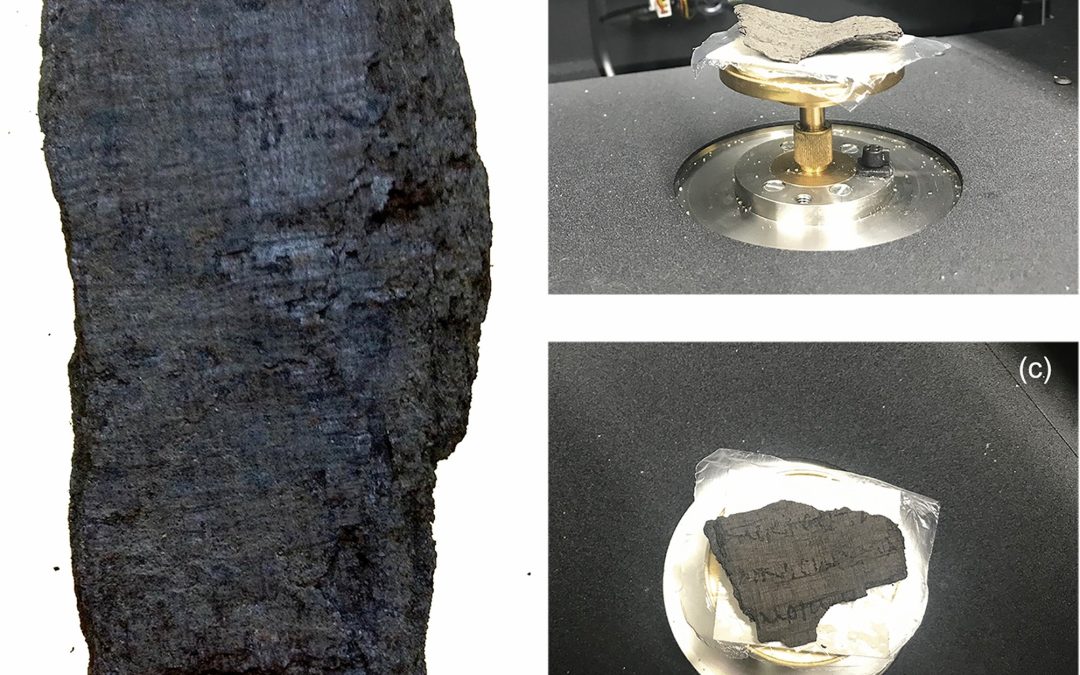
Featured image: carbonised Herculaneum papyrus fragments (PHerc. 1103 and PHerc. 110) imaged by contrast-enhanced photography, by Stabile, Palermo, Bukreeva, Mele, Formoso, Bartolino & Cedola, via Wikimedia Commons under CC BY 4.0.
