
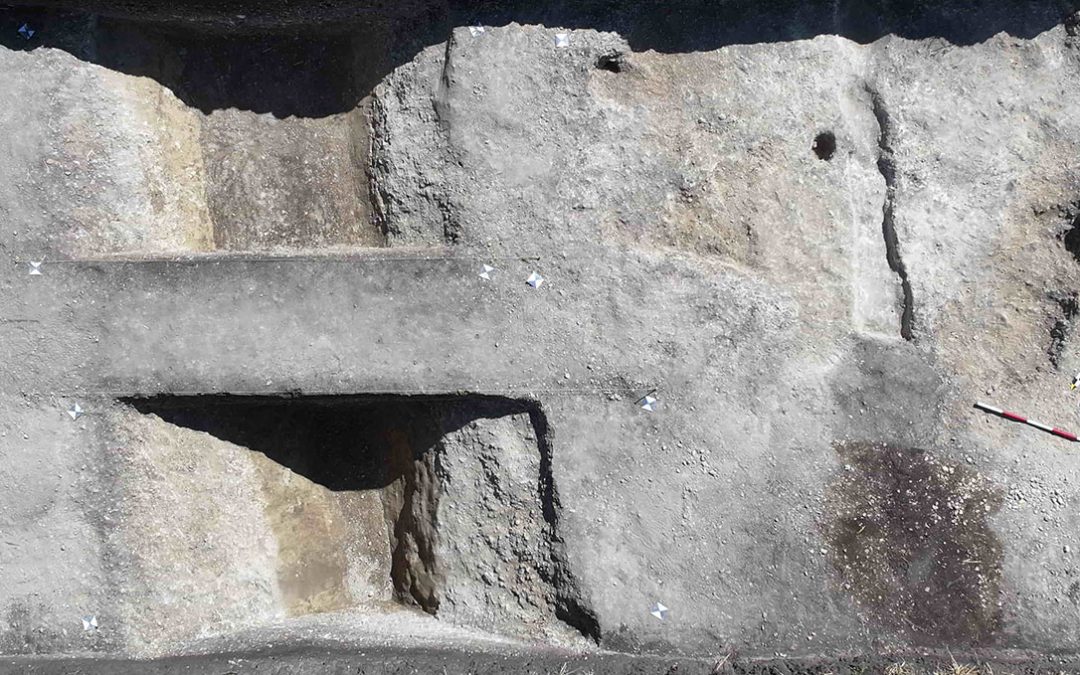
There is a field in the Central Bohemian Region of the Czech Republic, near the village of Chleby, where the soil looks unremarkable and the grass grows normally and there is nothing at all to see unless you bring the right kind of eye. The right kind of eye, this past spring, belonged to Petr Krištuf of the University of West Bohemia's Department of Archaeology, and to a small constellation of remote-sensing instruments. Underneath that field — underneath the wheat and the pasture and the slow accumulation of sixty-five centuries of weather — there is a circle. Not a stone circle. A ditch. A circular ditch more than 750 feet (about 230 metres) across, with an eight-foot (2.5-metre) cut into the chalk, and twelve deliberate openings arranged around its perimeter. Radiocarbon dates from organic material in the ditch fill place its construction at more than 6,500 years ago — about 4,500 BC — which makes it roughly a millennium older than the earliest phase of Stonehenge. (Stonehenge I, conventionally anchored to about 3,000 BC, was, like Chleby, a bank-and-ditch enclosure first; the famous standing sarsens came later.) The Chleby find was reported in late August 2026 by Archaeology Magazine and picked up across the press cycle through the following week.
Here is the detail that does the actual work in the story. The ditch is not just a ditch. The twelve openings are not evenly spaced. Krištuf and his team argued, in the work that led to the announcement, that the entrance pattern is a system: the gaps were laid out so that someone standing at one of two observation points identified inside the enclosure could watch the sunrise at summer solstice and the sunset at winter solstice through one set of aligned openings, and the rising and setting of the moon at the major and minor lunar standstills through another. Twelve apertures around a 230-metre circle is not a tight tolerance. It is, however, a deliberate one, and the geometry checks out at the points it claims to check out at — solstices and lunistices, which are the four most reliable sky events a Neolithic community could have used to anchor a ritual calendar to the year. Bull skulls and horns recovered from the site suggest, in Krištuf's reading, that ceremonial activity was timed to those same moments, which is the second-act version of the same argument: the alignments were not theoretical.
It is the kind of claim that lands hardest when you sit with it for a moment, because it pushes a familiar chronology back by a thousand years and does it without any new stone. There are no standing stones at Chleby. There is, almost certainly, never going to be any standing stones at Chleby. Whatever was built above the ditch — and something was, almost certainly a palisade of timber, given the scale and the period — has been gone for six and a half millennia. Wood does not survive in the Bohemian subsoil the way it survives, occasionally, in waterlogged bogs. What has survived is the negative: the cut into the ground, the ditch, the twelve gaps that line up with the astronomical events the builders wanted them to line up with. The readable part of the monument is the part that survived.
That is a recurring pattern in this corner of prehistory, and it is worth pausing on. The European Neolithic builds toward monuments that look, from a distance, like they are mostly about stone — Stonehenge, the Carnac stones, the great passage tombs of Ireland and Brittany. Up close, the chronology is mostly about cuts in the ground and timber. The earliest phase at Stonehenge is the bank and the ditch. The post-rings that preceded the sarsens at the same site are now recognised as the load-bearing structural feature; the sarsens are, comparatively, late additions, and the bluestone circle even later. Causewayed enclosures across Britain and the Continent are ditched circuits that, in some cases, run to several hundred metres across and predate any known standing-stone tradition by centuries. The henges that give British prehistory its vocabulary — circular earthworks with internal banks — are, by definition, mostly ditch. The carved or dressed stones of the late Neolithic and early Bronze Age are the punctuation; the ditches are the sentence.
A Neolithic sanctuary at Chleby, dated to about 4,500 BC and apparently encoding the same solstice-and-lunistice calendar that Stonehenge would later encode into its bluestone arrangement, sits inside that larger story. It tells you two things at once. The first is that the engineering culture that produced astronomical alignments in monumental architecture in Britain and Brittany by about 3,000 BC had antecedents on the European mainland a thousand years earlier, and those antecedents were not, in any obvious sense, marginal. A 230-metre circular enclosure with twelve engineered openings and a calibrated observation geometry is a public-work project at the scale of a small city. It implies coordination, shared purpose, and a population with enough surplus labour to dig a ditch that size and to keep digging until the ditch was, from a particular kind of eye, also a calendar.
The second is the thing I keep coming back to: the readable part is what survives. Stonehenge is famous because the standing stones are photogenic and the postcard of them is recognisable to anyone who has ever opened a school textbook on European prehistory. Chleby is going to be a difficult site to photograph, because there is nothing to photograph. There is a field. There is a pattern of soil marks and crop marks that turn up under the right kind of aerial and geophysical survey, and there is a ditch. The ditch is the document. The ditch is what the builders meant to last, because the ditch is what is actually still there. They did not know, when they cut it, that they were writing for an audience of people with magnetometers and ground-penetrating radar. They knew they were cutting something into the ground, and that the cut would hold its shape long after the timber palisade above it had rotted away. Six and a half thousand years on, that is the bet they got right.
The temptation, when a site like this turns up, is to make it about the contemporary moment — the remote sensing, the radiocarbon, the predictive modelling of the entrance geometry, the satellite imagery that picked out the crop marks before the trenching started. That machinery is interesting, and the fact that it is how the discovery was made is part of why it deserves attention in 2026. But the dig itself is small and the publication modest. The thing the discovery is telling you is older than the discovery. The astronomy being encoded in a Bohemian field in 4,500 BC is the astronomy of a community that knew the sky and was prepared to dig a 230-metre circle in order to mark the sky's important moments into their own ground. The fact that they did it in a way that left almost nothing for us to look at is, if anything, the cleanest possible endorsement of the design. The whole monument was always meant to be read in the sky, not in the soil.
Sources
- Archaeology Magazine, "Neolithic Monument Unearthed in Czech Republic" (24 Aug 2026)
- Wikipedia, "Stonehenge" — earliest-phase dating (c. 3100 BC bank and ditch)
- Live Science, "Ritual solstice structure 1,000 years older than Stonehenge unearthed in Czech Republic" — referenced by Archaeology Magazine and other secondary coverage in the same press cycle; direct URL did not resolve at time of writing.
- Fox Weather, "Ancient monument with mysterious connection to sun and moon found after 6,500 years" — referenced in the same press cycle for the Krištuf entrance-geometry quote; direct URL did not resolve at time of writing.