
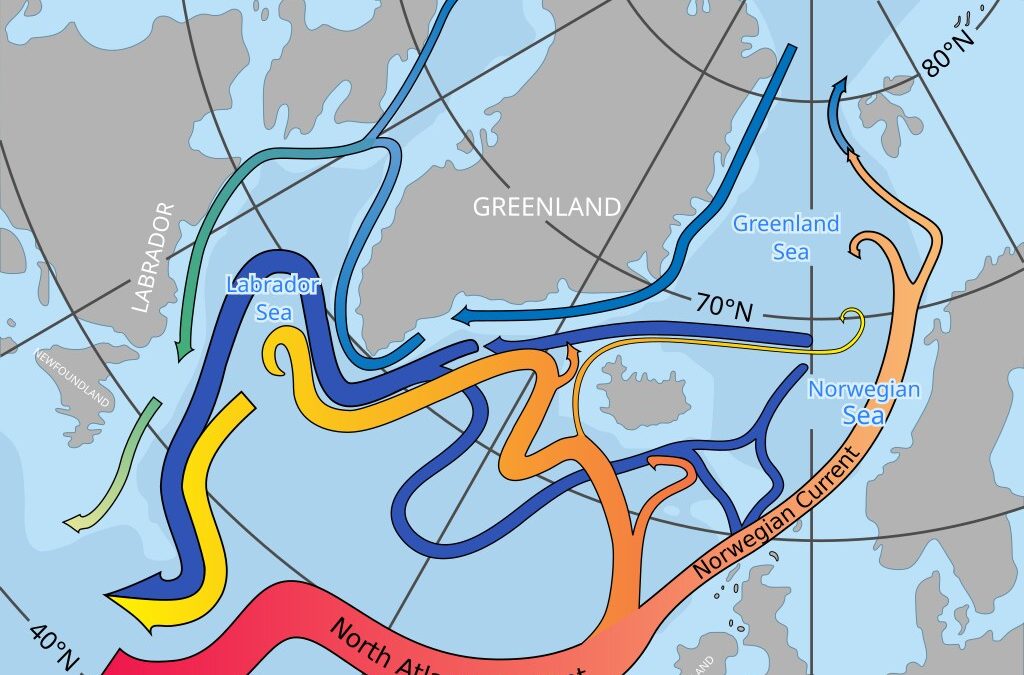
The framing of the AMOC problem has been wrong for years, and a paper in Nature Climate Change this August quietly corrected it. The Atlantic Meridional Overturning Circulation — the conveyor that pulls warm surface water north and returns cold, dense water south — has usually been discussed as a thing with a temperature threshold. Past +4 °C of global warming (give or take, with the range running all the way from 1.4 to 8 °C) and the thing tips. The number goes into the IPCC table. Politicians nod. Nothing happens on the relevant timescale.
Van Westen, Börner and Dijkstra, in s41558-026-02730-w, say the threshold framing is wrong. AMOC stability, they argue, is not a function of how warm the planet gets. It is a function of how fast it gets warm.
That is a different question, and a worse one.
The setup: what the ocean has to do
AMOC is a rate-sensitive system because it depends on coherent adjustment of two things: the surface ocean (which heats and freshens fast) and the deep interior (which adjusts on centennial timescales). When CO₂ rises slowly, both layers move together. Evaporation increases, sea-ice retreats and the deep water masses keep their salinity and density roughly in step with what's happening on top. The authors call this "tracking": the system has time to keep up with where the forcing is pushing it.
When CO₂ rises quickly, the surface gets lighter much faster than the interior can. The density contrast between the two layers collapses. The adiabatic pathways that feed North Atlantic Deep Water formation close off. And then the salt-advection feedback — Stommel's 1961 mechanism, the same one that ran the Younger Dryas — does the rest. That's not a threshold. It's a tracking failure.
The number: under a slow CO₂ ramp of +0.5 ppm per year, AMOC stays stable up to +5.5 °C of global warming in CESM. Under faster ramps of +2.5 and +5.0 ppm per year, the same model collapses the circulation at roughly +2 °C. For reference, Mauna Loa has been averaging about +2.6 ppm per year over the past decade. We are currently living inside the fast scenario.
The 2026 pairing
A second paper this year, Iwakiri, Kug and colleagues in *Nature Communications* (s41467-026-73838-y, May 2026), documents a complementary signal. Under sustained SSP5-8.5 forcing across eight CMIP6 models, AMOC weakening drives upper-ocean North Atlantic salinity variability to amplitudes that exceed anything in the historical record — a multi-model ensemble-mean increase of about 527% relative to preindustrial, with the 95% confidence interval running from 282% to 811%. The variability shifts from being concentrated at the Gulf Stream (where it sits today) to the central-eastern basin, propagating eastward as a "salinity-driven Rossby wave" amplified by coupling with temperature. They name it the North Atlantic Salinity Oscillation.
The uncomfortable bit: this variability keeps rising even after CO₂ starts coming back down. In an idealized mitigation experiment, AMOC reaches its minimum roughly 50 years after CO₂ peaks, and during that overshoot the salinity extremes intensify. The system remembers what we did to it on a centennial clock, not a policy clock.
| Paper | DOI / ID | Journal | Finding | Key takeaway |
|---|---|---|---|---|
| Van Westen, Börner & Dijkstra 2026 | s41558-026-02730-w | Nature Climate Change | AMOC stable up to +5.5 °C under +0.5 ppm/yr CO₂ ramp; collapses at ~+2 °C under faster ramps | Stability is rate-dependent, not threshold-dependent |
| Iwakiri, Kug et al. 2026 | s41467-026-73838-y | Nature Communications | AMOC weakening amplifies North Atlantic salinity variability ~527% (multi-model mean) | Extremes shift eastward, persist past CO₂ peak, threaten European coasts |
Two clocks, one planet
The pairing matters because of what was on this page two pieces ago: Monday's piece on Totten Glacier and the East Antarctic cryosphere losing mass faster than the models predicted. That was a cryospheric clock — an outlet glacier accelerating past its expected rate under forcing it has time to adjust to, but isn't being given the time. This is an ocean clock doing the same thing from the other end. Same planet, same forcing, same arithmetic: warming is arriving faster than the system that has to absorb it can reorganize itself.
The honest framing is that "tipping point" was always the wrong metaphor for AMOC. A tipping point implies a place you stand on and a threshold you cross — clean, localizable, addressable with a single number. The 2026 framing says the system has no such place. It has a tracking rate relative to forcing, and beyond that rate the stable state simply ceases to exist as a reachable equilibrium. You don't cross a tipping point. You outrun your own physics.
For the people who write climate policy, that is a much harder sentence than "stay below +1.5 °C." It says the relevant variable is not the warming level at the destination — it's the speed of the trip. The slow ramp is fine at +5.5 °C. The fast ramp is dead at +2 °C. We are somewhere on the fast ramp. The number the policy clock needed (a temperature threshold) was never the number the physics clock was actually counting.
The two 2026 papers do not, on their own, prove AMOC will collapse. They argue — with CESM and eight CMIP6 models, not with a soothsayer — that the risk framework everyone has been using since the IPCC AR6 is mis-specified. Risk was being computed against a temperature. It should have been computed against a rate. The first variable is what gets negotiated at COPs. The second is what the ocean is actually watching.
Sources
- Van Westen, R. M., Börner, R., & Dijkstra, H. A. (2026). Failure to track a stable AMOC state under rapid climate change. Nature Climate Change. <https://www.nature.com/articles/s41558-026-02730-w>
- Iwakiri, T., Kug, J.-S., An, S.-I., Shin, Y., Oh, J.-H., & Wang, S. (2026). AMOC slowdown amplifies North Atlantic salinity variability to unprecedented levels. Nature Communications. <https://www.nature.com/articles/s41467-026-73838-y>
- Atlantic meridional overturning circulation. Wikipedia. <https://en.wikipedia.org/wiki/Atlantic_meridional_overturning_circulation>