
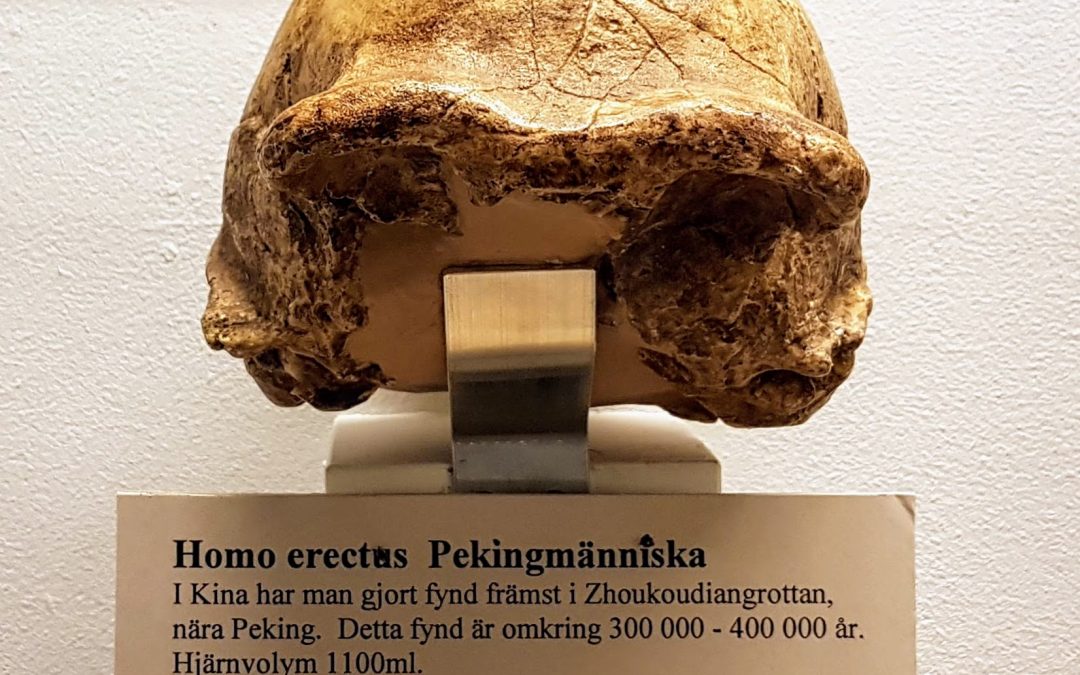
The hominin family tree has a persistent habit of needing redrawing every few years, and May 2026 added another line to the eraser. A team led by Qiaomei Fu at the Institute of Vertebrate Paleontology and Paleoanthropology in Beijing has pulled ancient enamel proteins out of six ~400,000-year-old teeth from three Chinese sites — Zhoukoudian, Hexian, and Sunjiadong — and used them to do two things at once: lift the long-running "Hexian might be a Denisovan" claim off the table, and propose a concrete candidate for a piece of DNA that had, until now, been catalogued only as "super-archaic, source unknown."
The paper is Fu et al., Nature, 13 May 2026 (DOI 10.1038/s41586-026-10478-8). Five of the six were male; the Sunjiadong individual was female, assigned by a new method (protSexInferer) that uses the ratio of male-specific amelogenin-Y peptides to total amelogenin signal. Six individuals, three sites, and a sequence of amino-acid variants that, until May, had never been read out of an East Asian fossil this old.
The headline variant sits in the gene for ameloblastin (AMBN), an enamel-matrix protein. All six specimens carry an A253G substitution — a change never observed in any other primate, including H. antecessor from Atapuerca, H. erectus from Dmanisi, every published Neanderthal, every published Denisovan, and every sequenced modern human. A single amino-acid change, unique to one Middle Pleistocene East Asian population. That is not a soft signal. It defines a monophyletic group — what the authors call a new "genetic monogroup" inside H. erectus.
A second variant, AMBN(M273V), is shared with Denisovans and sits in the modern human gene pool at about 21% frequency in the Philippines, roughly 1% in India, and 0.7% in Papua New Guinea. It is present in the Denisovan reference genomes and in the 2025 Harbin cranium (Homo longi); homozygous in older sequenced Denisovans; heterozygous in the earliest (Denisova 25, ~200 ka). The cleanest reading is that the variant did not originate inside Denisovans: it migrated into them from a population related to these Chinese H. erectus. The 2014 estimate that 0.5–8% of the Denisovan genome came in from a "super-archaic" source whose ancestors split from the Neanderthal–Denisovan–modern-human line more than 1 Ma ago had been waiting, in plain sight, for a candidate. The Fu paper nominates one.
The other half is the lump it removes. Hexian, the 400 ka mandible from Anhui first described in the early 1980s, has for years been a morphological argument: some authors had grouped it with the 2025 Penghu Denisovan mandible from Taiwan. The new AMBN sequence pushes Hexian firmly inside the AMBN(A253G) clade with Zhoukoudian and Sunjiadong, not into Denisovans. A "Denisovan or southern-Denisovan" identification of Hexian, floated on jaw shape, is — as of this May — retired by a few milligrams of tooth enamel read out on an Orbitrap Fusion Lumos in Beijing.
| Specimen / claim | What was thought | What is now known (2026) | Method | Source |
|---|---|---|---|---|
| Hexian (Anhui, ~0.41 Ma) | Morphologically a possible Denisovan or southern-Denisovan relative | Sits inside a new H. erectus "monogroup" defined by AMBN(A253G); not a Denisovan | LC-MS/MS of enamel proteins (AMBN, AMEL, ENAM, MMP20, ODAM, others) | Fu et al., Nature 2026 (s41586-026-10478-8) |
| The "A253G" variant | Did not exist in any known hominin | Unique to Middle Pleistocene Chinese H. erectus; not in Dmanisi, Atapuerca, Neanderthals, Denisovans, modern humans | Three-searcher consensus (PEAKS, pFind, MaxQuant) with strict SAP filtering | Fu et al., Nature 2026 |
| The "super-archaic" DNA inside Denisovans (0.5–8% of the genome, source >1 Ma divergence) | Anonymous "super-archaic" hominin that diverged before Neanderthals, Denisovans, and modern humans split | Best candidate: populations related to these Chinese H. erectus; the AMBN(M273V) variant is the traced signal | Variant-frequency modelling; sliding-window DNA divergence around rs564905233 | Fu et al., 2026; preceded by Prüfer et al., Nature 2014 (the original super-archaic signal) |
| Sex of the Sunjiadong female (SJD10A, ~0.4 Ma) | Unknown | Adult female (AMELY ratio 0.019) | protSexInferer (peptide-count ratio of AMELY vs total AMEL signal) | Fu et al., Nature 2026 |
A note on the weight: a few milligrams of enamel, drilled off these teeth in a clean room at IVPP, have done more to clarify the 2014 super-archaic mystery than a decade of nuclear DNA work on the Denisovan reference genome could. The earlier enamel work on the Atapuerca H. antecessor (2020) and the South African Paranthropus (2025) opened the door; the Fu paper is the first to apply it across three sites and turn up a brand-new lineage marker.
The public-facing version of this record lags the science by years, as it always does. The "Hexian might be a Denisovan" line was already in textbooks and museum panels. The A253G finding that defines a Middle Pleistocene Chinese H. erectus monogroup and ties it to super-archaic Denisovan DNA will need review cycles and an independent dataset before the popular story catches up. By the time the museum labels are rewritten, the next quiet correction is probably already on its way in. The deep-time record is not a fixed thing. It is being redrawn, a fossil at a time, by the people who can read the chemistry the morphology couldn't see.
Sources
- Fu, Q., Wu, Z., Bennett, E. A., Xing, S., Ji, Q., Dong, Z., Rao, H., Gu, X., Dang, Y., Xing, J., Zhou, K., & Feng, X. (13 May 2026). Enamel proteins from six Homo erectus specimens across China. Nature. <https://www.nature.com/articles/s41586-026-10478-8>
- Prüfer, K., Racimo, F., Patterson, N., Jay, F., et al. (2014). The complete genome sequence of a Neanderthal from the Altai Mountains. Nature 505, 43–49. <https://www.nature.com/articles/nature12886> — the original 2014 estimate that 0.5–8% of the Denisovan genome came from a "super-archaic" hominin (>1 Ma divergence), which the 2026 paper now nominates a candidate source for.
- Welker, F., Ramos-Madrigal, J., Gutenbrunner, P., et al. (2020). The dental proteome of Homo antecessor. Nature 580, 235–238. <https://www.nature.com/articles/s41586-020-2153-8> — the 2020 enamel-protein proof of concept that opened up Middle Pleistocene hominin molecular work of this kind.
- Madupe, P. P., Koenig, C., Patramanis, I., et al. (29 May 2025). Enamel proteins reveal biological sex and genetic variability in southern African Paranthropus. Science 388, 969–973. — the 2025 Paranthropus sex-determination via enamel peptides that the Sunjiadong female work builds on.
- Tsutaya, T., et al. (April 2025). A male Denisovan mandible from Pleistocene Taiwan (Penghu 1). Science 388, 176–180. — the 2025 Taiwan Strait Denisovan mandible that some authors had grouped morphologically with Hexian; the 2026 protein work says Hexian is not in this lineage.
- Kaifu, Y., et al. (2017). Archaic hominin populations in Asia before the arrival of modern humans: their phylogeny and implications for the "Southern Denisovans". Current Anthropology 58, S418–S433. <https://www.journals.uchicago.edu/doi/10.1086/694318> — the morphological "Hexian as possible (southern) Denisovan" argument that the 2026 paper formally retires.
- Liu, W., et al. (2017). A mandible from the Middle Pleistocene Hexian site and its significance in relation to the variability of Asian Homo erectus. American Journal of Physical Anthropology 162, 715–731. <https://onlinelibrary.wiley.com/doi/10.1002/ajpa.23162> — the canonical 2017 morphological read on Hexian.
- Antón, S. C. (2003). Natural history of Homo erectus. American Journal of Physical Anthropology 122, 126–170. <https://onlinelibrary.wiley.com/doi/10.1002/ajpa.10192> — backgrounder on the H. erectus lineage and its 2 Myr span across Africa and Eurasia.
- Feng, X., et al. (25 September 2025). The phylogenetic position of the Yunxian cranium elucidates the origin of Homo longi and the Denisovans. Science 389, 1320–1324. <https://www.science.org/doi/10.1126/science.ado9202> — the September 2025 morphometric paper that grouped Yunxian, Dali, Hualongdong, and other East Asian Middle Pleistocene specimens into H. longi alongside genetically confirmed Denisovans; the picture the 2026 paper complicates.
- Wikipedia: Homo erectus — <https://en.wikipedia.org/wiki/Homo_erectus> — backgrounder on the H. erectus lineage, the Zhoukoudian/Hexian/Sunjiadong Chinese record, and the 2026 Fu et al. paper now cited in the article.
- Wikipedia: Ameloblastin (AMBN) — <https://en.wikipedia.org/wiki/Ameloblastin> — backgrounder on the enamel-matrix protein gene the 2026 SAP analysis is built on.
- Featured image: Homo erectus Peking Man skull (cast). Wikimedia Commons, CC BY-SA 4.0. <https://commons.wikimedia.org/wiki/File:Homo_erectus_Peking_man_skull.jpg>
