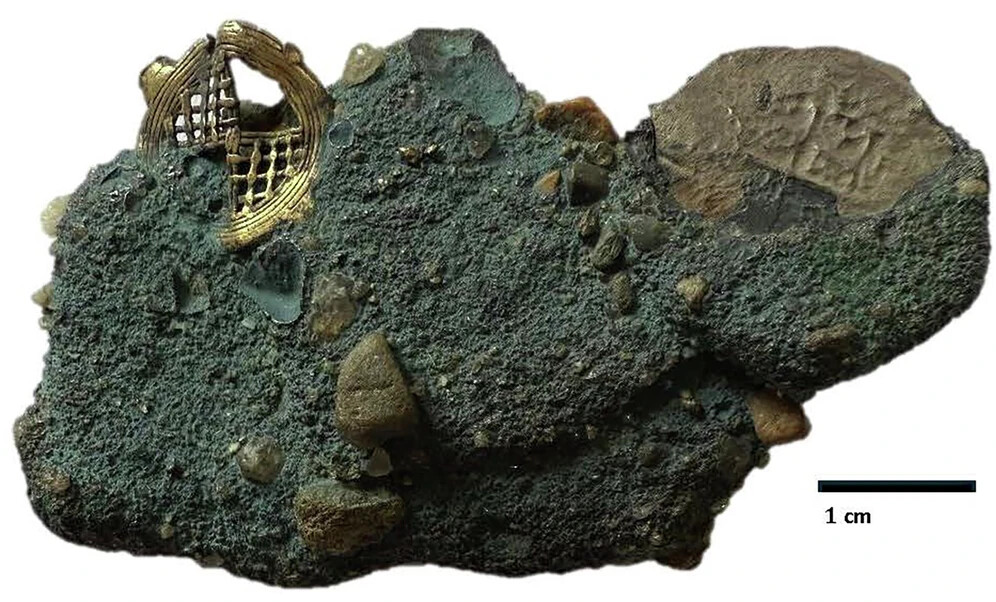
The Whydah Gally was a slave ship that became a pirate ship that became a 1717 shipwreck off Cape Cod that became, in March 2026, the closest thing we will ever get to a witness in a 300-year-old argument about West African metalwork. Twenty-seven Akan gold pieces from the wreck — pulled out of the concretions that had been holding them since the nor'easter of 26 April 1717 — were assayed by portable X-ray fluorescence and scanning electron microscopy with energy-dispersive spectroscopy, and the resulting compositions, published in npj Heritage Science this spring, walk straight into a debate that European traders had been losing badly for centuries without admitting it.
The headline numbers, from the Skowronek, Clifford and DeCorse paper, are these: gold content by pXRF ran from 73.5 to 96.7 weight percent, with a mean of 87.5 percent; by SEM-EDS, 70.3 to 100 percent. Silver was the dominant impurity, copper a distant second, and the silver-to-gold ratios track the published compositions of geological deposits in Ghana's Ashanti Gold Belt — particularly the high-silver Prestea occurrence — not anything European or South American. The paper's careful bottom line is that the elemental patterns "do not support claims of systematic heavy adulteration of Akan gold" and instead sit "within the natural variability of West African gold." The reason that careful phrasing matters is that the historical claim being tested is also careful in its own way, and the data do not so much flatten it as trim it back.
The claim in question shows up in European sources stretching from Pieter de Marees (1602) through William Bosman (1704) into the nineteenth century: that Akan traders "passed off adulterated materials of lesser value as high-karat gold," that the kracawn — the brass-and-gold amalgam used as currency around Elmina — was "little more than brass," and that nugget interiors should be cut open to check for iron filings or powdered glass. Dutch West India Company records repeat the complaint. None of these sources offer an assay. They offer suspicion, repeated often enough that suspicion became the historical default.
The new assays do not prove that every Akan trader, on every occasion, handed over clean gold. The paper explicitly notes that cast pieces show copper contents slightly above what the Ashanti Belt's geological deposits can account for, and floats two plausible explanations: an intentional addition of a percent or two of copper as a hardener for fine lost-wax castings — wafer-thin goldwork that genuinely does benefit from a little alloy — or workshop contamination from crucibles that had also been used for brass. Either way, the copper amounts are around one weight percent or below, well below anything that would change the colour, and well below anything the European complainants were alleging. The merchants were not describing what the goldsmiths were actually doing. They were describing what they were afraid of, with the confidence that comes from never having tested the premise.
The Whydah itself is the more interesting artifact. She sailed from England in 1716, traded along the West African coast from the Senegambia to the Bight of Benin — including the Gold Coast — delivered enslaved Africans to Jamaica, was captured off Long Key in February 1717 by Samuel "Black Sam" Bellamy, and capsized in a storm off Wellfleet two months later with the Akan gold still in her hold. Barry Clifford's team has been excavating the site under U.S. Army Corps of Engineers permit since 1984, and the Whydah Pirate Museum in West Yarmouth holds more than 300 gold objects from the wreck — most of them millimeter-scale beads, nuggets and fragments, only about two dozen intact, the rest sold by weight rather than as art. That sample, narrow as it is, is also the largest and most tightly dated assemblage of Akan goldwork in the world, and the only one with a sealed eighteenth-century West African context.
The small observation worth sitting with is methodological. A pirate shipwreck, a Thermo Scientific Niton pXRF running at 50 keV for two minutes per sample, and a Zeiss SEM-EDS backscattered-electron image have together done something that three centuries of European paperwork could not: they have measured the gold that the documents were talking about. Portable instruments on well-dated assemblages can rewrite the documentary record. In this case the record they are rewriting was itself written by the side of the trade that was losing the quality argument, and the correction is overdue.
Sources:
– Skowronek, Clifford & DeCorse — *Pirate gold provides new insights into West African trade using pXRF and SEM-EDS analysis*, *npj Heritage Science* 14:169 (March 2026)
– Whydah Pirate Museum — official site of the Whydah Project, West Yarmouth, MA
– Wikipedia — *Whydah Gally* (ship, Bellamy, the 1717 sinking, and the Clifford excavation history)
– *npj Heritage Science* — journal page (Springer Nature, open access)