
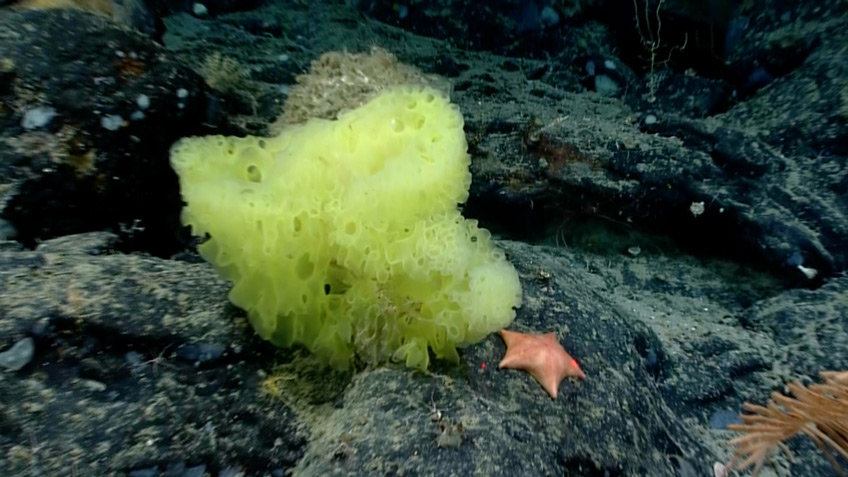
On 12 September 2026, Complex posted a thirty-second NOAA clip that did what clips from the deep usually fail to do: it registered instantly. A bright yellow sponge sat next to a pink sea star on the abyssal mud, two kilometres down on Retriever Seamount — a submarine peak roughly 200 miles east of New York City — and the internet, with the alacrity of a generation raised on the cartoon, recognised the pair on sight. The clip is the same one NOAA Ocean Exploration first published in August 2021, from Dive 19 of the 2021 North Atlantic Stepping Stones expedition, at 1,885 metres. It has cycled around before. What changes each time is just the date.
The yellow animal is a glass sponge of the genus Hertwigia, a hexactinellid — a sponge whose skeleton is built from biologically secreted silica spicules rather than the soft spongin of bath sponges, which is why the class gets the nickname. Glass sponges are mostly found between 450 and 900 metres, cup-shaped, generally pale, and not known for vivid colour; the bright yellow here is itself the surprise, not just the position. The pink neighbour is a poraniid sea star of the genus Chondraster. The two are unrelated — sea stars and sponges diverged somewhere in the neighbourhood of 600 million years ago, and a glass sponge's body plan has no more in common with a sea star's than a cathedral has with a battleship. The colour match is coincidence.
The biological observation underneath the meme is grimmer than the cartoon. Christopher Mah, the Smithsonian-affiliated echinoderm specialist who has become the public face of the comparison since the 2021 sighting, has noted on the NOAA feature page that Chondraster has been observed feeding on sponges. Sea stars do this by climbing onto prey and extruding their stomachs out through their mouths, digesting tissue in place. The "real-life SpongeBob and Patrick" sitting peacefully side-by-side is, with reasonable probability, a predator caught approaching a meal — or returning to one. The friendship is a projection.
| The pair, briefly | |
|---|---|
| Where | Retriever Seamount, NE Canyons and Seamounts Marine National Monument, ~200 mi E of New York |
| Depth | 1,885 m (about 6,200 ft) |
| Yellow animal | Hertwigia sp. (glass sponge; silica-skeleton, not spongin) |
| Pink animal | Chondraster sp. (poraniid sea star; predatory on sponges) |
| Platform | NOAA Ship Okeanos Explorer ROV, Dive 19, 27 July 2021 |
| Virality | Surfaced again via @Complex on X, 12 September 2026 |
Mah is the connective tissue. The 2021 NOAA feature was written by him; the 2026 viral recirculation cited him; the 2020 NOAA dive where he first made the SpongeBob comparison famous on Twitter was also his. The pattern has recurred enough that he now says, wryly, that he normally avoids the reference. He has not avoided this one. The line "I normally avoid these refs… but WOW. REAL LIFE SpongeBob and Patrick!" is a public scientist, in his published role, doing the small useful thing of acknowledging what the instrument caught while making sure the audience knows what was actually caught.
The Sunday version of the story is this: an ROV went looking for nothing in particular on an underwater mountain two miles down, the camera caught a yellow sponge and a pink sea star in the same frame, and the human-coded resemblance was strong enough to register through the entire compression chain of internet virality. The honest move is to enjoy the resemblance — it is, in fact, funny — and then to name what is actually there. What is actually there is two unrelated animals, separated by most of the history of animal life, one of which was likely about to eat the other. The cartoon got the colours. The cartoon did not get the relationship.
Sources
- Christopher Mah, "Video Feature: 'Real-Life' Sighting of SpongeBob SquarePants and Patrick Star" — NOAA Ocean Exploration, 3 August 2021 (primary source; identifies Hertwigia and Chondraster; 1,885 m on Retriever Seamount, Dive 19, 27 July 2021)
- @Complex on X — viral recirculation, 12 September 2026 (the original NOAA ROV clip)
- Slamani Aghilas, "Spongebob and Patrick Appear in the Ocean's Abyss as Scientists Uncover a Bizarre Deep-Sea Scene" — Indian Defence Review, 15 September 2026
- Hassan Raza, "Scientists Discover Real Life SpongeBob and Patrick Living in the Deep Atlantic Ocean" — Bioscience, 15 September 2026
- Glass sponge (Hexactinellida) — Wikipedia (silica spicule skeleton, 450–900 m typical depth, abyssal distribution)
- SpongeBob SquarePants — Wikipedia (Stephen Hillenburg's marine-science background; series debut 1 May 1999; yellow sponge / pink starfish pairing)
- NOAA Ocean Exploration 2026 Expeditions — NOAA Ocean Exploration (institutional context; the 2026 field season has no Atlantic dive matching this clip, consistent with the footage being the 2021 Retriever Seamount recording)